
What CEOs from LinkedIn Top Startups 2026 post on LinkedIn: an analysis of 702 posts
Published: · Updated: · 13 min read
Quick answer
What I checked, and why these five?
On October 14, 2026, LinkedIn published LinkedIn Top Startups 2026: the 15 fastest-rising Israeli companies. The list ranks companies by employee growth, job interest, talent attraction and engagement, between July 2025 and June 2026. It doesn't rank content. Lior Noy, LinkedIn's Country Manager for Israel, shared the Israeli list, and the companies on it celebrated with designs of their own.

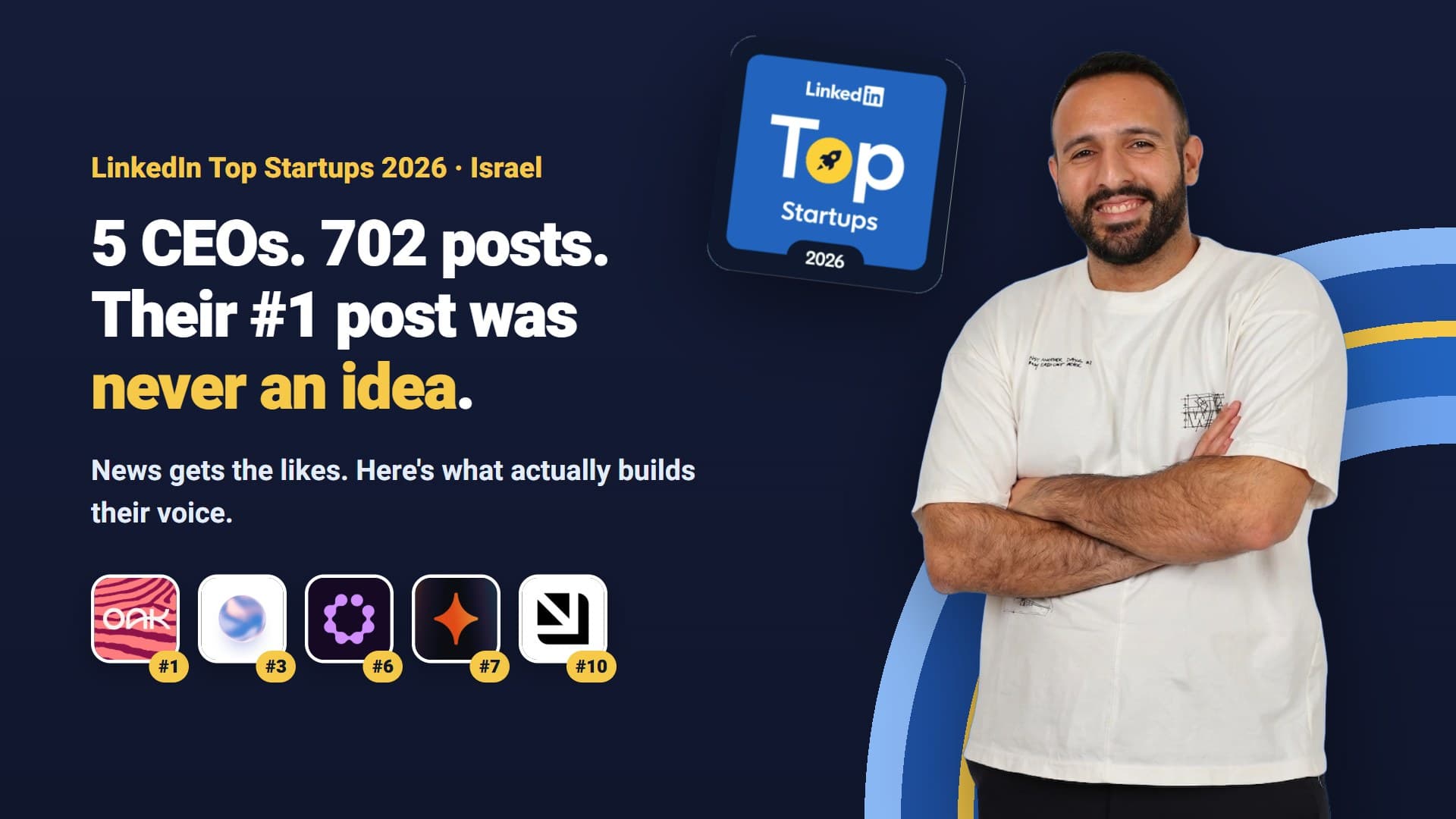
I picked five companies from the list and looked at what their CEOs publish on their personal profiles: Oak (#1), Wonderful (#3), Cyera (#6), Notch (#7) and Port (#10). I exported their LinkedIn activity, 702 records, and read all of it. 514 are their own posts, and 188 are reposts of other people's posts with no words of their own.
I also read articles they wrote, podcast pages and interviews, and checked the latest updates on their company pages. To compare the five over the same period, the metrics use the 156 posts they published between March 16 and October 7, 2026.
| CEO | Company | Rank on the list | Records | Own posts | Reposts without comment | In the comparison window |
|---|---|---|---|---|---|---|
| Shai Morag | Oak | 1 | 166 | 156 | 10 | 16 |
| Bar Winkler | Wonderful | 3 | 22 | 21 | 1 | 14 |
| Yotam Segev | Cyera | 6 | 188 | 178 | 10 | 20 |
| Rafael Broshi | Notch | 7 | 126 | 90 | 36 | 38 |
| Zohar Einy | Port | 10 | 200 | 69 | 131 | 68 |
Two things up front. None of them is a Velut client, and I have no information about who writes their posts. And this study doesn't prove that content put these companies on the list. It shows how five CEOs of fast-growing companies build a presence, and what you can learn from it.
Finding one: news gets the reactions, but news is rare
I sorted the 156 posts in the window into four types, by each post's main purpose: company news (funding, acquisitions, customers, awards, results), ideas and expertise (a position, analysis, a how-to, a lesson from the field), events and interviews, and people and team.
For all five, the post with the most reactions was company news. Bar Winkler on Wonderful's $550M Series C (2,732 reactions). Yotam Segev on Cyera's funding round (2,645). Shai Morag on Oak coming out of stealth (1,070). Zohar Einy on Port's best quarter ever (563). Rafael Broshi on Notch's $30M Series A (508).
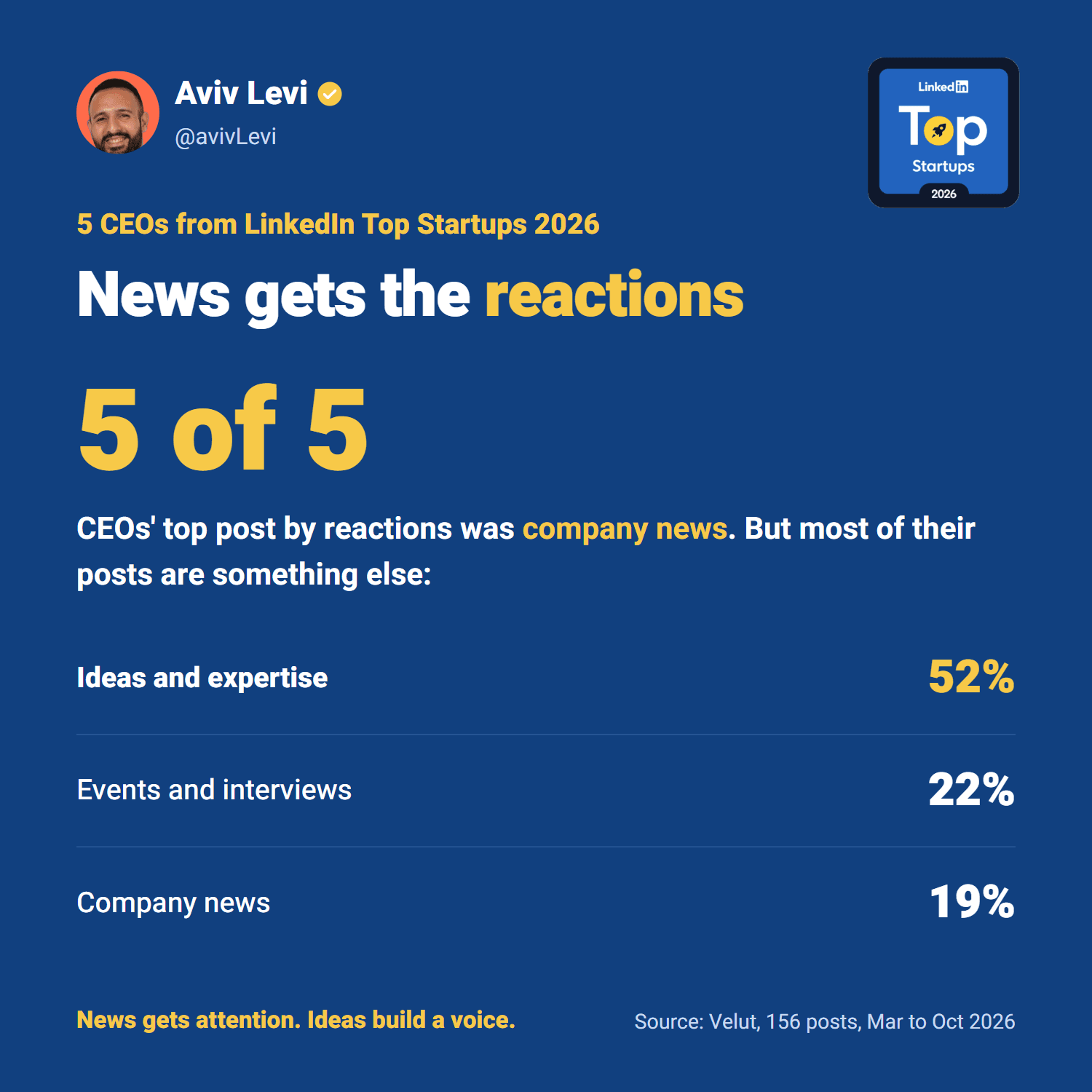
At the median, a news post got between 1.6 and 6.7 times more reactions than an idea post, depending on the CEO. But look at the volume: 29 news posts in seven months, across five companies in exceptional growth. Less than one news item per company per month. 81 of the posts, more than half, are ideas.
| CEO | Posts | Company news | Ideas | Events | People | Median: news | Median: ideas |
|---|---|---|---|---|---|---|---|
| Bar Winkler | 14 | 5 | 8 | 1 | 0 | 946 | 576.5 |
| Rafael Broshi | 38 | 2 | 21 | 14 | 1 | 275 | 41 |
| Zohar Einy | 68 | 6 | 45 | 10 | 7 | 293 | 62 |
| Yotam Segev | 20 | 12 | 0 | 5 | 3 | 887.5 | – |
| Shai Morag | 16 | 4 | 7 | 4 | 1 | 265 | 152 |
| Total | 156 | 29 (19%) | 81 (52%) | 34 (22%) | 12 (8%) |
My takeaway: news gets attention, ideas build a voice. A $550M round will get reactions even if it's written in one line. The interesting question is what the CEO publishes in all the other weeks, when there's no round and no acquisition. That's where the five are very different.
Yotam Segev is the exception: 12 of his 20 posts in the window are company news, and none is a pure idea post. Cyera simply produces a lot of news. But even with him, as you'll see, the story isn't the number. It's the people.
Finding two: each CEO builds a voice from a different source
Read their idea posts side by side and you see that each one draws from a different part of their work:
- Bar Winkler: a decision that has a cost. He explains a business choice the company already made, and why.
- Rafael Broshi: the problem buyers only discover after they buy. He starts from operational friction and gives the reader a test.
- Zohar Einy: a series, not a post. He takes one professional question and breaks it into an experiment, a result and a how-to.
- Yotam Segev: achievements belong to specific people. He turns a milestone into a story about who made it happen.
- Shai Morag: experience that explains the decision. He uses the three companies he built to explain why he's building again.
The next sections cover each of them in detail, with the posts I picked and why.
Bar Winkler, Wonderful: a position with a cost
Wonderful is #3 on the list. Bar Winkler previously founded Approve.com, acquired by Tipalti in 2021. His export holds only 21 posts, most from 2026, so it's hard to say anything about his frequency over the years. But within the sample, the posts are short and the business argument is very clear.
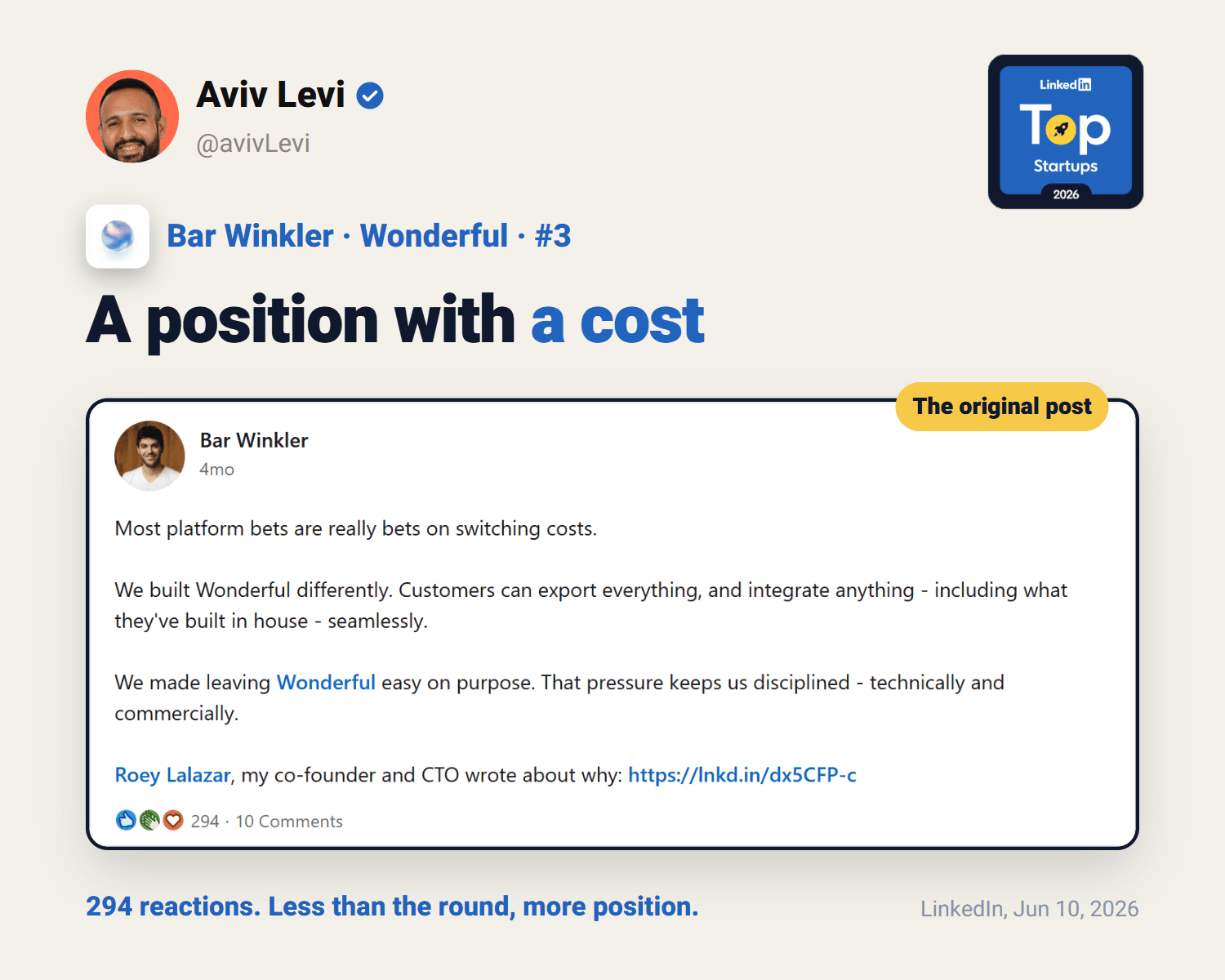
The structure repeats: a common market assumption, what it misses, what Wonderful does differently, and proof. My favorite is one of his smallest posts. Most platform bets, he writes, are really bets on switching costs. Wonderful did the opposite: customers can export everything and leave easily. On purpose, because that pressure keeps the company disciplined.
That's a position with a cost. A company that gives up lock-in is saying something about its confidence in the product. The post got 294 reactions, far fewer than the funding announcement, but it tells you more about Bar than any news post.
You can also see a thread across the year: the gap between what AI can do and what enterprises actually deploy early in the year, workflows that cross departments in June, a different way to measure AI ROI in July, and local presence in August and September. Some of these ideas also have a long-form article under his name on Wonderful's site, and the post leads to it.
| Post | Date | Reactions / comments | Why I picked it |
|---|---|---|---|
| Leaving us is easy, on purpose | Jun 10, 2026 | 294 / 10 | A position against lock-in, tied to a product decision |
| What AI ROI should really measure | Jul 21, 2026 | 587 / 64 | From measuring a single step to the throughput of a whole workflow |
| AI doesn't care about your org chart | Jun 30, 2026 | 448 / 21 | A short post that leads to a long article on the same idea |
| Local by design | Aug 27, 2026 | 1,047 / 32 | The local-presence thesis, shown through what the company does on the ground |
| Series C | Sep 2, 2026 | 2,732 / 322 | His peak. The performance belongs first to the size of the news |
The lesson: start from a decision the company already made, and explain the logic behind it. A position is interesting when it has a cost: something you gave up, or a choice a competitor wouldn't make.
Rafael Broshi, Notch: the problem buyers discover after they buy
Notch is #7. On The Product Market Fit Show, Rafael Broshi says Notch started as an insurance company selling its own policies, and the tool they built to service policyholders became the product. His archive shows the shift: digital asset insurance in 2022 and 2023, then customer service, and in 2026 AI for regulated industries, control and accountability.
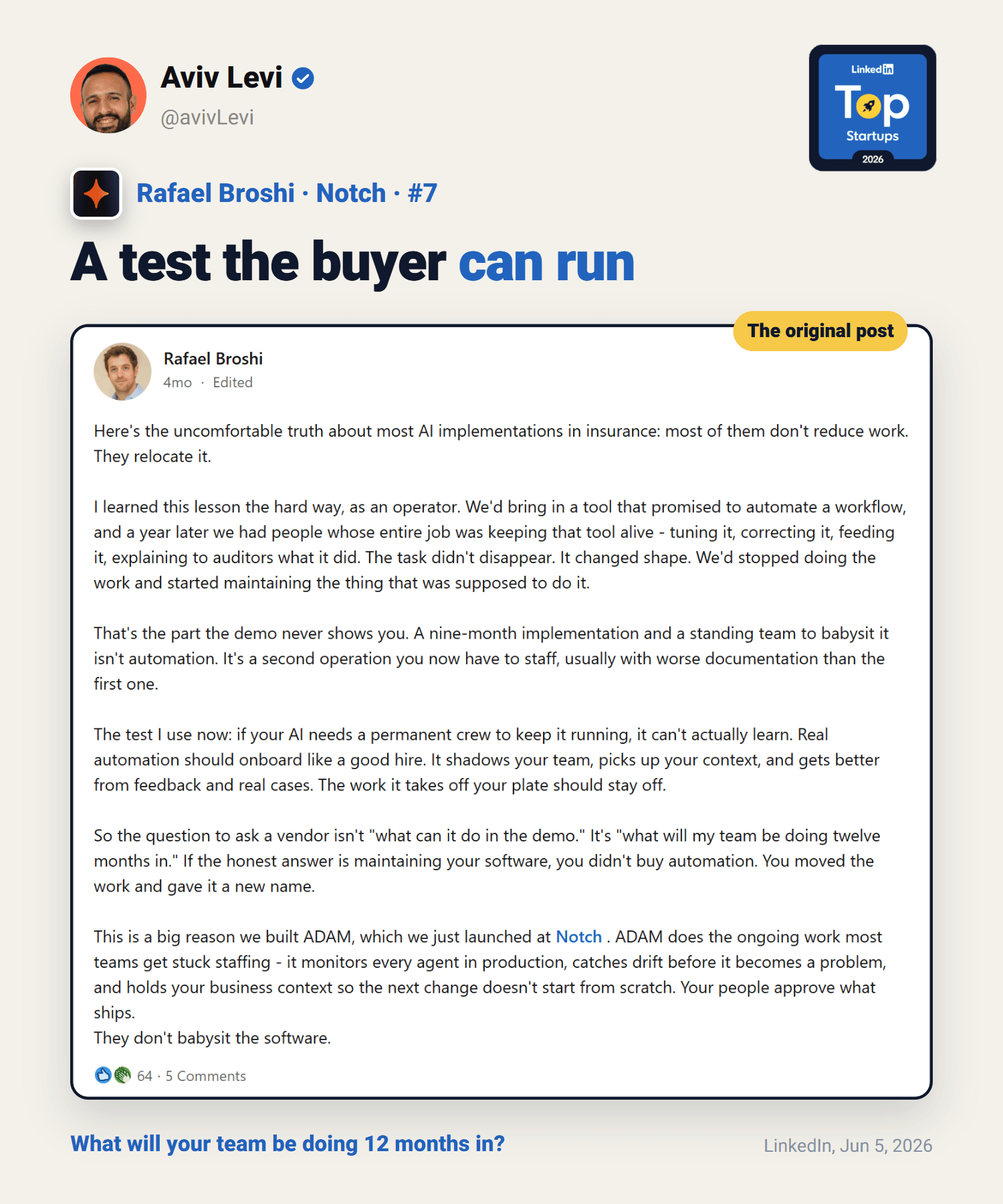
His strongest posts start from a specific friction. In June he wrote that most AI implementations in insurance don't reduce work, they relocate it: a year later, there are people whose whole job is keeping the tool alive. Then he gives the reader a test. Don't ask the vendor what it does in the demo. Ask what your team will be doing twelve months in.
That question is useful even to someone who will never buy from him, which is exactly why it works. The structure repeats: a familiar problem, an operational breakdown, a test the reader can run, and only at the end, Notch.
You can also see how content comes out of the work. In September he was asked about guardrails in a webinar and gave a short answer. Later he wrote the full answer as an article on Notch's blog, and the post points to it. One customer question became three pieces of content.
His numbers are relatively low: a median of 35 reactions in the window, and 14 of his 38 posts are conferences and booths. But his 21 idea posts focus on exactly the questions his buyer asks before buying. That's focused professional authority, even without thousands of likes.
| Post | Date | Reactions / comments | Why I picked it |
|---|---|---|---|
| Automation that relocates work | Jun 5, 2026 | 64 / 5 | Operational experience turned into a test the buyer can run |
| ADAM and implementation teams | Jun 3, 2026 | 63 / 2 | Why an outside implementation team should be a stage, not a permanent state |
| Why Notch and not Salesforce or Zendesk | Aug 12, 2026 | 47 / 2 | A direct answer to a buyer's question |
| Five layers of guardrails | Sep 25, 2026 | 36 / 3 | A webinar question that became an article and a post |
| Eight questions for a demo | Sep 10, 2025 | 53 / 5 | A useful checklist for buyers (an earlier version exists too) |
| AI, transparency and CSAT | Feb 10, 2025 | 1,214 / 281 | His peak across the archive. See the caveat in the limitations section |
| Series A and the road to it | Mar 25, 2026 | 508 / 111 | His peak in the window: company news with a founder story |
The lesson: ask which question the customer doesn't know to ask before buying, and what they learn the hard way afterwards. That produces content that helps the buyer and explains your differentiation without writing "we're the best".
Bar and Rafael: two answers to the same question
Bar and Rafael write about the same topic: how to move AI from a demo to real work inside an enterprise. But they answer differently when it comes to the vendor's role. Wonderful presents local deployment teams as a core part of its offer, and Bar writes about 35 sites and a company event almost every day. Rafael writes that no company should be stuck with an outside implementation team forever, and that such a team should be a stepping stone to independence.
They aren't arguing with each other, and both approaches can be right for different markets. But that's exactly what makes both of them strong: each has a position you can disagree with. "AI will change the enterprise" isn't a position. "Leaving us is easy, on purpose" is.
Zohar Einy, Port: a series, not a post
Port is #10. Zohar Einy served five years in Unit 8200, was an engineer-in-residence at TLV Partners, worked at Rookout and co-founded Aporia. Of the 200 records in his export, 131 are reposts with no words of his own: of the company, colleagues, investors and customers. His feed is very active, but only 69 texts in it are his. It's worth separating presence from writing.
Within those 69 is the most interesting pattern in the study: a series. On June 25 he asked whether messy context is the reason AI is so expensive, described an experiment with 1,000 questions across four setups and three models, and reported 80% savings. A week later he came back: many of you asked how to build it, so here are four steps. And in that follow-up he also refined the number: 58% from structured context, 80% when you add a skill file.
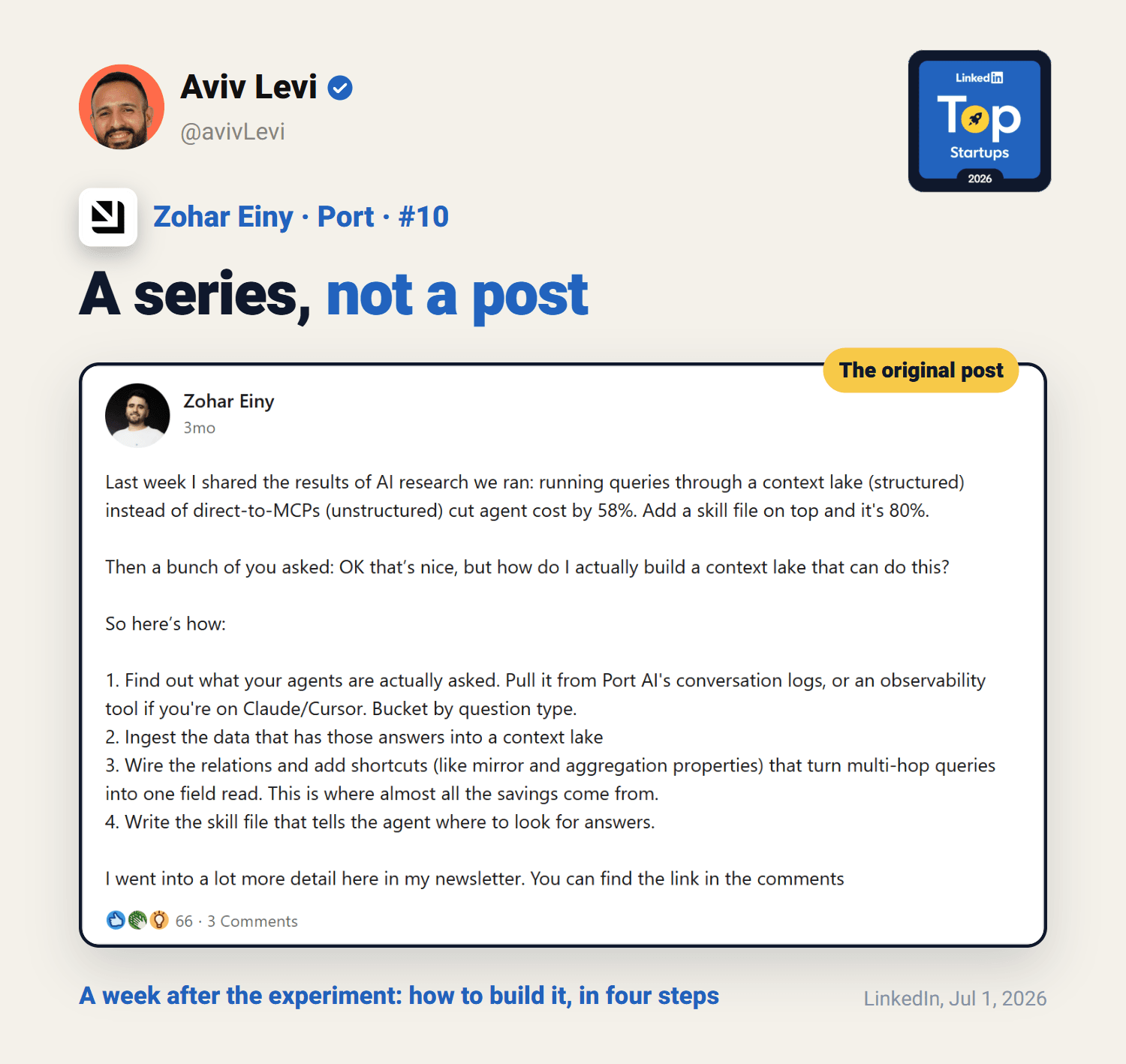
Most CEOs don't do this. They post an idea, get comments and move on to the next topic. Zohar takes one question and stays with it: hypothesis, experiment, result, how-to and expansion. That's how an idea becomes a category. Over the months you can watch his language take shape, from "agents in the SDLC" to Context Lake and AI Software Factory.
With him too, company news wins on reactions: Port's best quarter got 563, about nine times the median of his idea posts. But his how-to on autonomous ticket resolution got 17 reposts, his third-highest of all 68 posts and more than four of his six news posts. People save and pass on a useful guide.
| Post | Date | Reactions / comments | Why I picked it |
|---|---|---|---|
| Experiment: context and AI costs | Jun 25, 2026 | 130 / 6 | A question, test conditions and a reported result. Read it with the follow-up |
| How to build a context lake | Jul 1, 2026 | 66 / 3 | Turns the experiment into four steps the reader can take |
| Autonomous ticket resolution | May 28, 2026 | 116 / 4 | A detailed five-phase workflow. 17 reposts |
| Uber's context graph | Aug 24, 2026 | 150 / 5 | Another company's example that illustrates his view |
| Self-introduction | May 25, 2026 | 275 / 7 | Connects his background to why he builds Port |
| Best quarter ever | Jul 2, 2026 | 563 / 64 | His peak. Company news works differently from a how-to |
The lesson: build a series around one professional question. After you show the problem and the proof, publish how to do it. The idea keeps moving, and you don't need a new topic every week.
Yotam Segev, Cyera: achievements belong to specific people
Cyera is #6, and Yotam Segev has the highest median reactions in the window (853.5). But be careful with that number. Cyera produces news at an unusual pace: funding rounds, acquisitions, the Forbes, CNBC and TIME lists, and a visit to the White House. 12 of his 20 posts in the window are company news, and you can't separate his style from the size of the news.
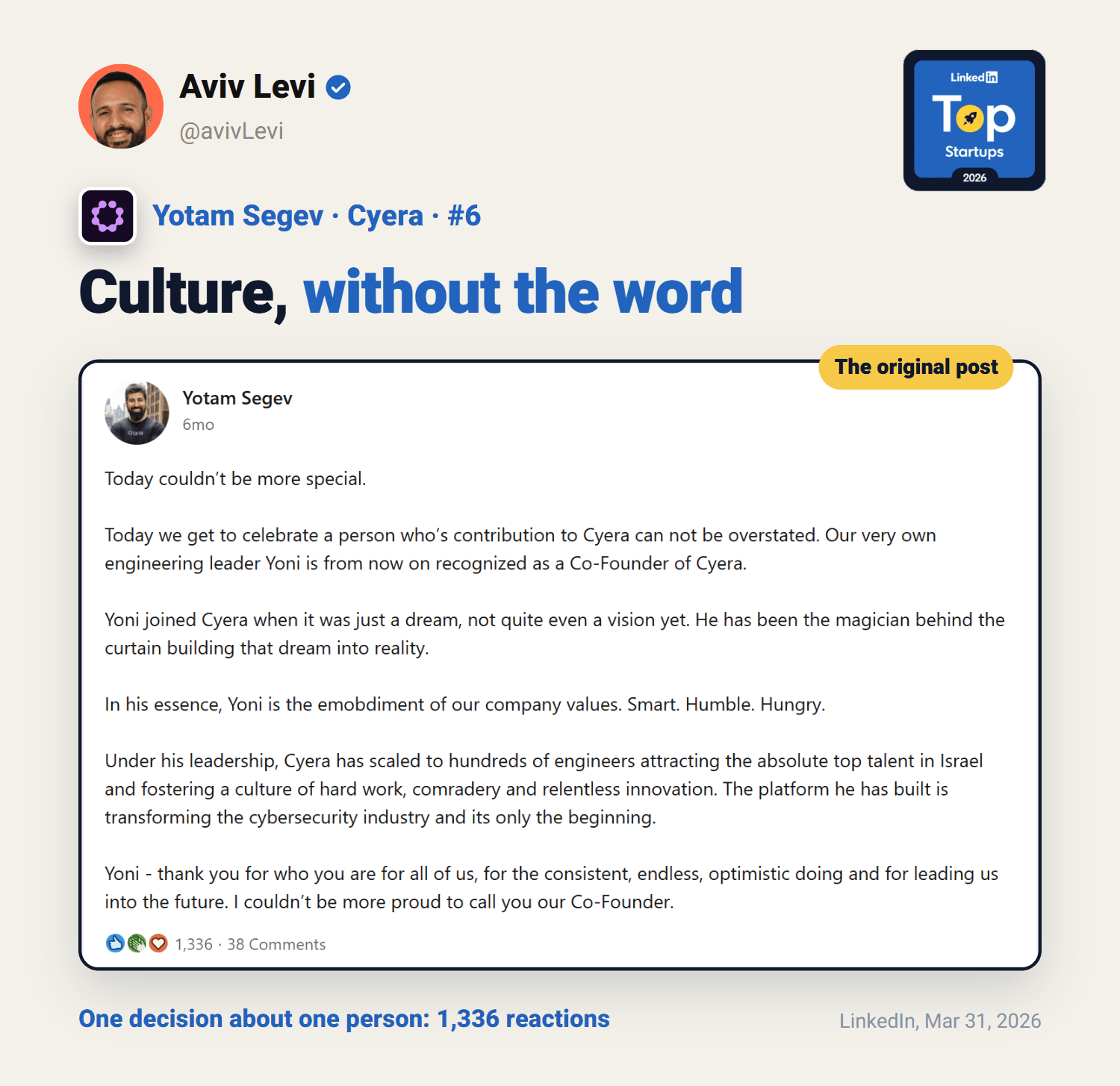
What you can see is how he writes it. A business milestone becomes a story about people: customers, employees, founders and investors. Not a generic thank-you to the team. The strongest example is from March 31: he announced that engineering leader Yoni would from now on be recognized as a co-founder of Cyera. He writes that Yoni joined when the company was only a dream, that under his leadership it grew to hundreds of engineers, and that he embodies the company's values.
It's a post about culture without the word culture. Instead of saying people matter, it shows a decision: giving an employee a founder's title. 1,336 reactions. Same with the SDR team: when Cyera made the Forbes Cloud 100, he wrote that what's better than the list is seeing the SDRs on the Nasdaq screen in Times Square, and tagged each of them.
And it isn't only people. Over the years his professional thesis widens, from cloud data security to bringing together data, identity and AI agents. In September 2025, after the breach through Salesloft Drift integrations was disclosed, he published an explanation of third-party risk and offered the community a free scan.
| Post | Date | Reactions / comments | Why I picked it |
|---|---|---|---|
| Yoni recognized as co-founder | Mar 31, 2026 | 1,336 / 38 | Company values through a decision and a specific person |
| The SDR team on the Nasdaq screen | Sep 5, 2025 | 824 / 38 | Moves the spotlight from the stage to the people who did the work |
| Acquiring Trail, and an aunt's advice | Oct 23, 2024 | 590 / 18 | An acquisition through a human image: when you marry someone, you marry their family |
| The Salesloft Drift breach | Sep 3, 2025 | 261 / 3 | A professional explanation and a practical offer to the community |
| Funding round and thanks to partners | Jun 10, 2026 | 2,645 / 172 | His peak in the window: big news with credit to customers and team |
| Acquiring Oasis | Jul 28, 2026 | 1,806 / 97 | An acquisition told as a story of a long relationship and trust |
His archive also has a personal post about a loss that got many comments. I deliberately didn't pick it. A community responding to grief isn't a measure of good content, and there's no reason to turn a personal event into a formula.
The lesson: when there's an achievement, ask who made it possible and what exactly they did. A good leadership story shows a decision, a partner or an employee. It doesn't need invented vulnerability or personal drama.
Shai Morag, Oak: experience that explains why build again
Oak is #1 on the list, three months after coming out of stealth with a $60M seed round. Shai Morag built and sold three companies: Integrity Project to Mellanox in 2014, Secdo to Palo Alto Networks in 2018 and Ermetic to Tenable in 2023, and then served as CPO at Tenable. His archive starts in 2016, and most of it isn't about Oak at all: links and news in 2016 to 2018, Ermetic and the team in 2021 to 2023, and the return to building in 2026.
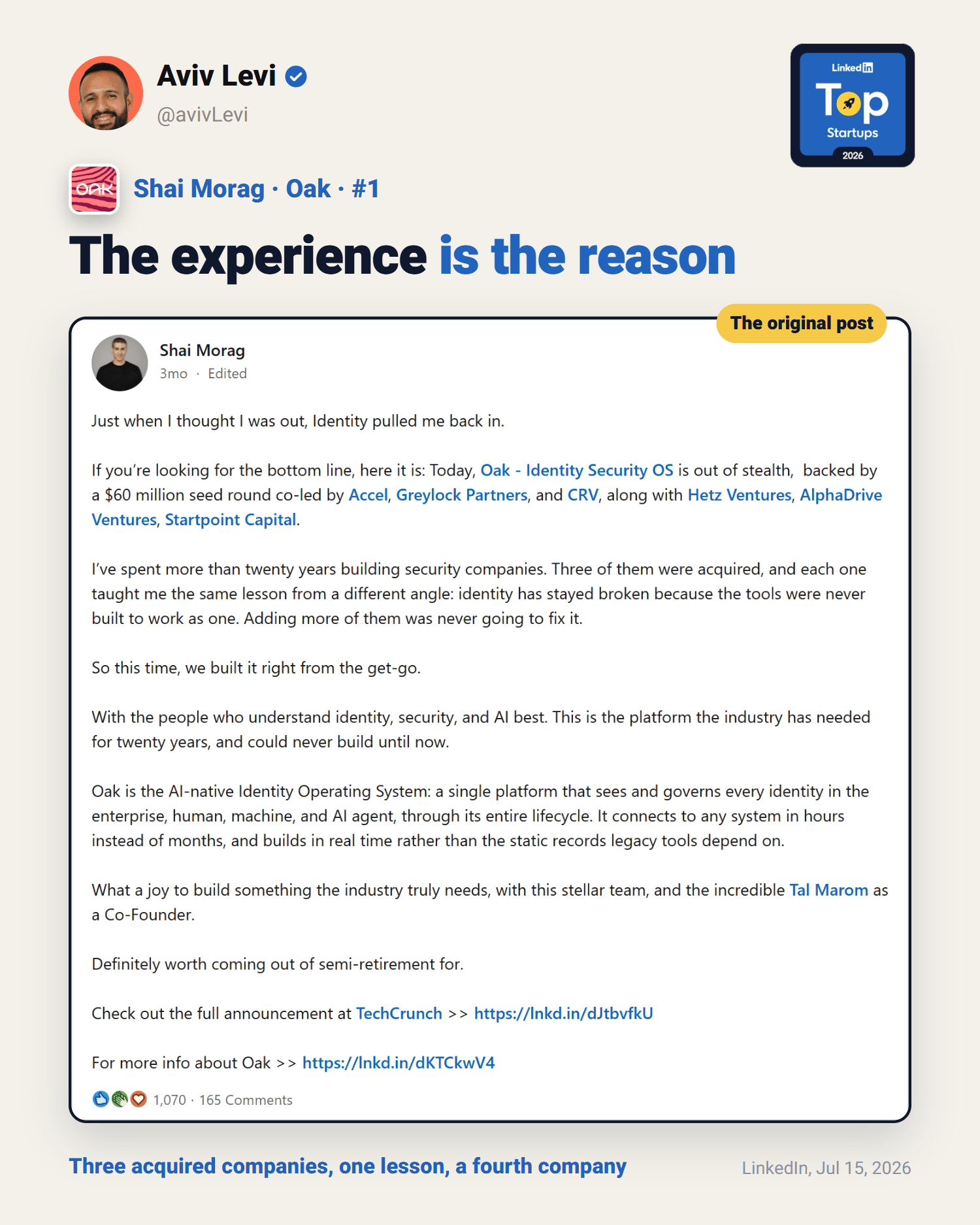
The logic of the launch post is clear: I saw the problem from the inside, the market and the technology changed, existing tools aren't enough, so I'm building again. He writes that he has built security companies for more than twenty years, that three were acquired, and that each taught him the same lesson: identity stayed broken because the tools were never built to work as one. The experience isn't a list of titles in the post. It's the reason for the company.
And there's a sequence around the launch. Five days before, a post on identity becoming the enterprise's control plane, with a hint about Black Hat. On launch day, the announcement and then a video. A week later, a specific invitation: challenge our thesis, show me your blind spots, or come see a demo. And after Black Hat, a post that opens with a jungle and pink giraffes at the booth, and ends with what customers said: they can't answer who has access to what.
I don't know whether this sequence was planned. But it works like a campaign: first the problem, then the news, then an invitation to talk.
| Post | Date | Reactions / comments | Why I picked it |
|---|---|---|---|
| Back to building, and Oak's launch | Jul 15, 2026 | 1,070 / 165 | A personal story, company news and a professional thesis in one post |
| The identity problem, before the launch | Jul 10, 2026 | 152 / 22 | Sets up the professional question before the news |
| Challenge our thesis | Jul 22, 2026 | 155 / 9 | A specific call to action tied to the reader's problem |
| Black Hat: from the jungle to customer pain | Aug 11, 2026 | 285 / 9 | From an event story to insights from the field |
| Why Oak, and why build again | Sep 17, 2026 | 114 / 3 | Points to a podcast through the meaning of the name |
| Bobby Ford joins | Oct 6, 2026 | 238 / 42 | An appointment tied to experience and trust |
The lesson: if you have unusual experience, don't list it. Find out what it lets you see that others miss, and write that.
And what do the company pages do?
I also checked the five company pages as they appear to the public on October 14, 2026. This is a snapshot of roughly the last ten updates on each page, not an archive.
The division of labor is clear. The page carries the product, the customers and the events: a new Wonderful customer in Italy, a Port customer story, Cyera security research, five Notch conferences in one week, a new Oak connector. The CEO carries the thesis, the people and the big news. And the pages amplify the CEO: Wonderful reshared Bar's post about a new customer, Oak shared Shai's post from a New York event, and Cyera points to Yotam's CNBC appearances.
What happens when the same news goes out on both channels? I found four such cases:
| The news | CEO: reactions / comments | CEO followers | Company page: reactions / comments | Page followers |
|---|---|---|---|---|
| Cyera ranks #1 on Fortune Future 120 | 976 / 49 | 23,000 | 523 / 2 | 90,684 |
| Wonderful launches Agent Access | 530 / 27 | 23,489 | 442 / 22 | 65,967 |
| Bobby Ford joins Oak | 238 / 42 | 12,143 | 144 / 29 | 4,641 |
| Shai Morag at CyberRisk in New York | 121 / 10 | 12,143 | 16 / 2 (reshare) | 4,641 |
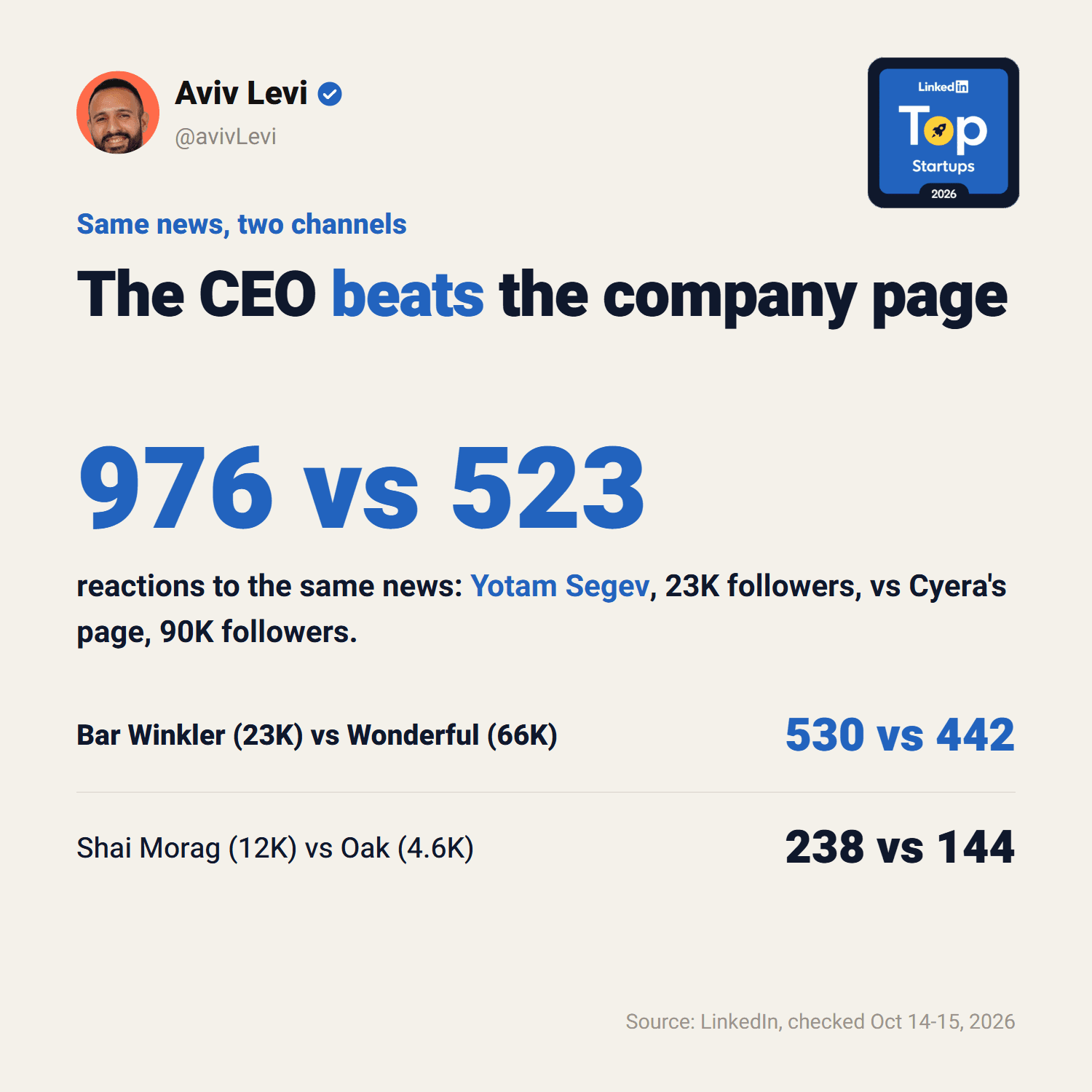
In all four cases, the CEO's post got more reactions and more comments. And relative to audience size, the gap is even bigger. Yotam Segev has 23,000 followers, about a quarter of Cyera's page, and got almost twice the reactions. Bar Winkler has 23,489 followers, about a third of Wonderful's page.
Oak is the opposite case. Its page opened this year and is smaller than Shai Morag's profile: 4,641 followers against 12,143. On the Bobby Ford news Shai got more reactions, but per follower the page did better. So the CEO's advantage isn't a law of nature. It comes mostly from the CEO having an audience of their own, and from people responding to a person more than to a logo.
It also fits what's known about LinkedIn: according to AuthoredUp, which analyzed about a million posts, organic company page content is about 2% of what's shown in the feed. And according to Meltwater and LinkedIn, 75% of LinkedIn citations in AI engines come from personal profiles.
There are more voices too. At Notch, marketing and sales people write under their own names about the team, regulation and conferences, and the page reshares them. At Port, CTO Yonatan Boguslavsky writes his own articles. The company speaks in several voices, and the CEO is the strongest one.
What the numbers don't say
- The list measures companies, not content. Its period is July 2025 to June 2026, and some of the posts I analyzed came after it.
- There's no impression, lead or sales data. Reactions aren't deals, so you can't say which of the five "converts" better.
- The export isn't necessarily complete. Zohar's has exactly 200 records from seven months, and Bar's only 22.
- Numbers inside posts are the author's report. For example Zohar's 80% savings, which the follow-up post clarified as 58% without the skill file.
- A viral post isn't a recommendation. Rafael's post about CSAT dropping after the service agent was labeled as AI got 1,214 reactions and 281 comments. It doesn't include the full experiment data, and it doesn't mean you should hide AI from customers.
- The post-type classification is mine. Each post got one type by its main purpose, and whether a product launch is news or an idea is sometimes a judgment call.
- Five CEOs aren't a representative sample. There's no control group, and no claim here about all startup CEOs.
What this means for you: five questions before your next post
Most CEOs I meet wait for news before they post: a round, a big customer, a launch. These five show why that isn't enough. Even at the fastest-rising companies in Israel, there's less than one news item a month. The rest has to come from the work itself.
So before you write, ask yourself:
- What decision did we make recently, and what did it cost us? (Bar Winkler)
- What question does my customer not know to ask before buying? (Rafael Broshi)
- What professional question could I write five posts about in a row? (Zohar Einy)
- Who made our latest achievement possible, and what exactly did they do? (Yotam Segev)
- What does my experience let me see that others in the market miss? (Shai Morag)
This is also how I work with the CEOs I write for at Velut. Before the first post we build the messages, the edge over competitors, the tone and the customer we're writing to. After that, the material comes from the work: an insight from a customer call, a decision from this week, a voice note on WhatsApp. Company news is a bonus. The voice is built in the weeks between.
The full list: all 15 LinkedIn Top Startups 2026 companies
The five I analyzed are a third of the list. Here are all 15 companies, in the official order from LinkedIn News, with a link to each company's LinkedIn page and its open jobs. The five I analyzed are in bold.
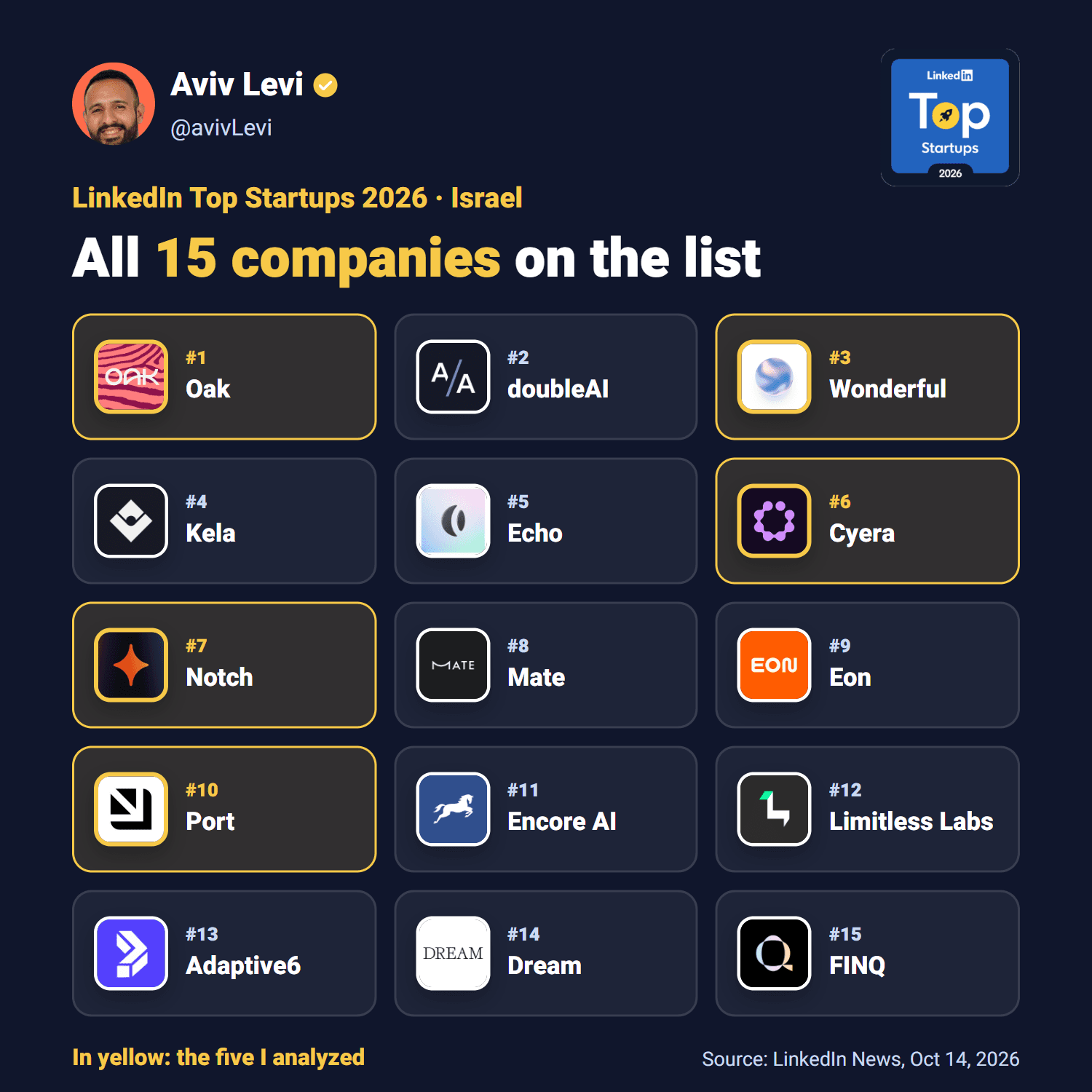
| Rank | Company | CEO | What they do | Company page | Jobs |
|---|---|---|---|---|---|
| 1 | Oak | Shai Morag | Identity and access for employees, machines and AI agents | Company page | Jobs |
| 2 | doubleAI | Amnon Shashua | Expert-level AI for complex scientific and technical problems | Company page | Jobs |
| 3 | Wonderful | Bar Winkler | An AI operating system for deploying AI agents in large enterprises | Company page | Jobs |
| 4 | Kela Technologies | Alon Dror | A platform that brings commercial tech like AI and sensors into defense systems | Company page | Jobs |
| 5 | Echo | Eilon Elhadad | Finds and fixes software vulnerabilities before they reach production | Company page | Jobs |
| 6 | Cyera | Yotam Segev | Finds, classifies and controls sensitive data across cloud, SaaS and databases | Company page | Jobs |
| 7 | Notch | Rafael Broshi | AI agents for operations in regulated industries: service, documents, claims | Company page | Jobs |
| 8 | Mate | Asaf Wiener | Automated investigation of and response to security alerts | Company page | Jobs |
| 9 | Eon | Ofir Ehrlich | Cloud backup, protection and fast recovery after an incident | Company page | Jobs |
| 10 | Port | Zohar Einy | A platform for engineering teams to manage software, infrastructure and automation | Company page | Jobs |
| 11 | Encore AI | Dvir Ginzburg | Learns from customer interactions and trains AI agents for sales and service | Company page | Jobs |
| 12 | Limitless Labs | David Priev | AI for precision manufacturing, from 3D designs to machine instructions | Company page | Jobs |
| 13 | Adaptive6 | Aviv Revach | Controls cloud and AI spend by tracing waste back to the code | Company page | Jobs |
| 14 | Dream | Shalev Hulio | AI that helps governments and critical infrastructure defend against cyberattacks | Company page | Jobs |
| 15 | FINQ | Eldad Tamir | An AI-driven fund manager for investment, pension and insurance products | Company page | Jobs |
Descriptions are shortened from LinkedIn News. Job links are the ones in LinkedIn's article; for companies without one, the jobs tab on the company page.
Frequently asked questions
What is the LinkedIn Top Startups 2026 list?
An annual LinkedIn list, published on October 14, 2026, of the 15 fastest-rising Israeli companies. It's based on LinkedIn data: employee growth, job interest, talent attraction and engagement, between July 2025 and June 2026. Oak is #1. It ranks companies, not content or CEOs.
What do CEOs of fast-growing Israeli startups post on LinkedIn?
For the five CEOs I studied, 52% of posts between March and October 2026 were ideas and expertise, 22% events and interviews, 19% company news such as funding or acquisitions, and 8% posts about people and team. Each draws ideas from a different source: a decision, a problem from the field, a how-to, people or past experience.
Which type of post gets the most reactions?
Company news. For all five CEOs, the top post in the comparison window was a funding round, a launch or a record quarter, and at the median a news post got between 1.6 and 6.7 times more reactions than an idea post. But news is rare: 29 of 156 posts in seven months.
Should you post on the CEO's profile or the company page?
Both, with a division of labor. In four cases where the same news went out on both channels, the CEO's post got more reactions and comments, even when the CEO had a quarter of the page's followers. The page fits product, customers and events; the CEO fits the thesis, people and big news. According to AuthoredUp, organic company page content is about 2% of the feed.
How often do the CEOs on the list post?
It varies a lot. Between March and October 2026, Bar Winkler and Shai Morag posted about every two weeks, Yotam Segev a bit more, Rafael Broshi more than once a week, and Zohar Einy more than twice a week. What they share isn't frequency but a steady source of ideas.
Can you copy one of their styles?
Not the style. It's built on each one's experience, decisions and people. You can copy the questions: what decision did you make, what question doesn't your customer know to ask, what could you write a series about, who made the achievement possible, and what does your experience show you.