
What is GEO? Generative engine optimization vs SEO, and how to get cited by AI

Published: · Updated: · 11 min read
Quick answer
What is GEO?
GEO stands for generative engine optimization: work on your content and your presence so AI engines choose you as a source when they write an answer. Classic SEO aims to rank high in a list of ten links. GEO aims to be one of the sources the answer itself relies on, even if nobody clicks the link.
The term comes from a November 2023 research paper, "GEO: Generative Engine Optimization", by researchers from Princeton, Georgia Tech, the Allen Institute for AI and IIT Delhi. It was accepted to KDD 2024, and it tested which changes to a text raise the chance a generative engine uses it in an answer.
Most pages that rank for "GEO" today come from SEO agencies, and most of them only talk about the website. That is half the picture; the other half is below. For a short definition, see the glossary.
What is the difference between GEO, SEO and AEO?
The three terms get mixed up all the time. The difference is what counts as success:
| SEO | AEO | GEO | |
|---|---|---|---|
| The goal | Rank high in search results | Be the direct answer to a question | Be a source an AI model cites in its answer |
| Where you see it | Google's list of links | Direct answers, featured snippets, voice assistants | ChatGPT, Gemini, Perplexity, AI Overviews and AI Mode |
| What you measure | Rankings and clicks | Whether your answer is shown | How often you are cited or mentioned |
| What it relies on | Mostly the website | Mostly the website | The website, the people in the company and what others write about you |
It matters what Google itself says. In the guide it published in May 2026, it names AEO and GEO directly:
"From Google Search's perspective, optimizing for generative AI search is optimizing for the search experience, and thus still SEO."Google Search Central, Optimizing your website for generative AI features on Google Search, May 2026
The reason, per Google: AI Overviews and AI Mode are rooted in the same core ranking and quality systems as regular Search. So why talk about GEO at all? Because Google is not the only engine, and "am I cited?" is a different question from "where do I rank?". A site can rank first and not appear in the answer, and a site in fifth place can be cited. That is exactly what the research tested.
How do AI engines choose who to cite?
According to Google, its AI features in Search use two techniques. The first is retrieval-augmented generation (RAG), which Google also calls grounding: the model retrieves up-to-date pages from the Search index, reads them and writes an answer based on them, with links. The second is query fan-out: the model runs several related searches at once. In Google's example, "how to fix a lawn that's full of weeds" fans out to "best herbicides for lawns", "remove weeds without chemicals" and "how to prevent weeds in lawn".
So the answer is built from sources that answer sub-questions, not only the original question. In my study of 150 Hebrew business searches, 54% of the links AI Overviews cited were not in the top ten results, and the first organic result was cited in only 38% of overviews. The details are in the AI Overviews article, and fan-out in AI Mode is covered in the AI Mode article.
ChatGPT works on a similar principle. According to OpenAI, when the model decides it needs current information, or when you choose search, it searches the web and links to sources. To be eligible, a site has to allow the OAI-SearchBot crawler, and even then placement is not guaranteed. What else affects ChatGPT citations is in the guide: how to get ChatGPT to cite you.
What actually works? What the GEO study found
The researchers took real web pages, changed them with nine methods, and measured how much of their text made it into a generative engine's answer and in what position. The three best methods:
- Adding quotations from credible sources.
- Adding statistics instead of general description.
- Citing sources that back up the claims.
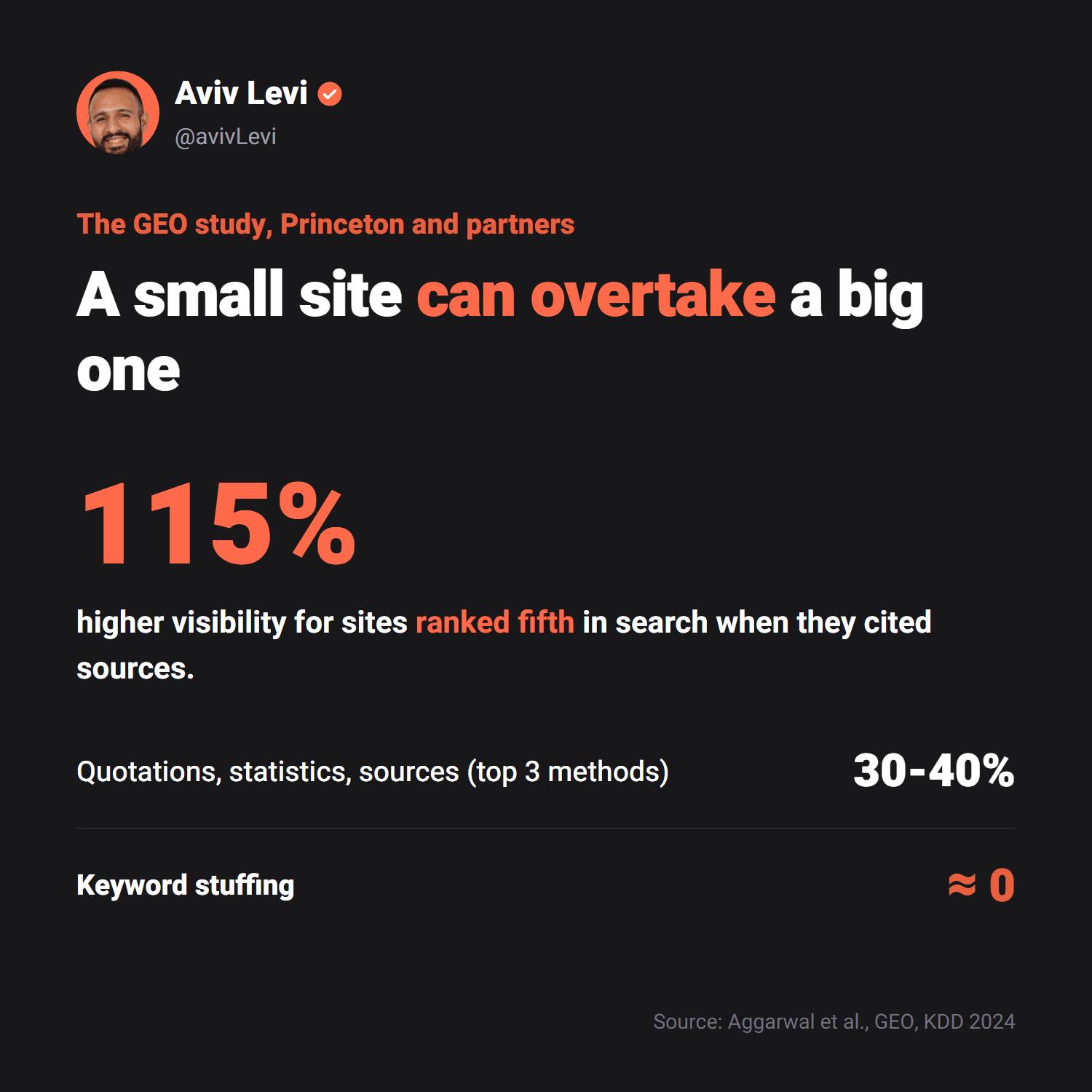
These three methods improved visibility by 30% to 40% on the study's main metric. Keyword stuffing, the best-known SEO tactic, barely improved visibility and lowered it on some metrics.
The most interesting finding for smaller companies: the methods helped lower-ranked sites much more. Citing sources raised the visibility of sites ranked fifth in search results by 115%, while with the same method the visibility of top-ranked sites dropped by 30% on average. GEO is one of the places where a small site can overtake a big one.
An important caveat: this was a 2023 experiment, in English, on engines the researchers built. Today's engines are different. But the direction matches what Google writes today: well-sourced, original content, not tricks.
What don't you need to do for GEO?
Google's guide has a whole section on AEO and GEO myths. According to Google, for its Search you can ignore these:
| The myth | What Google says |
|---|---|
| An llms.txt file | Not needed. Google Search doesn't use it. It will neither help nor harm |
| "Chunking" content into small pieces | Not required. There is no ideal page length; write for your audience |
| Rewriting content just for AI | Not needed. AI systems understand synonyms, so you don't have to chase every phrasing |
| Seeking inauthentic "mentions" | Less helpful than it seems. Ranking systems favor quality content and other systems block spam |
| Special schema for AI | There is none. Structured data still helps with rich results |
| A page for every variation of a question | May violate the scaled content abuse spam policy |
So what does help? Google recommends what it calls non-commodity content: a unique point of view, first-hand experience, something that does more than restate what is already everywhere. Its example: "7 Tips for First-Time Homebuyers" is commodity content; "Why We Waived the Inspection & Saved Money" is not. On the technical side: a page Google can crawl and index, eligible to be shown with a snippet, and not excluded from AI features in the Search Console setting.
And one warning from Google worth remembering when someone offers you a "GEO package": no third-party tool has access to its internal ranking or AI systems.
Why GEO is not only your website
This is where most GEO guides stop. They talk about the website: headings, schema, speed. But AI engines also cite people, posts, videos and discussions. Google itself writes that its AI features can show what is being said about products and services across the web, including in blogs, videos and forum discussions.
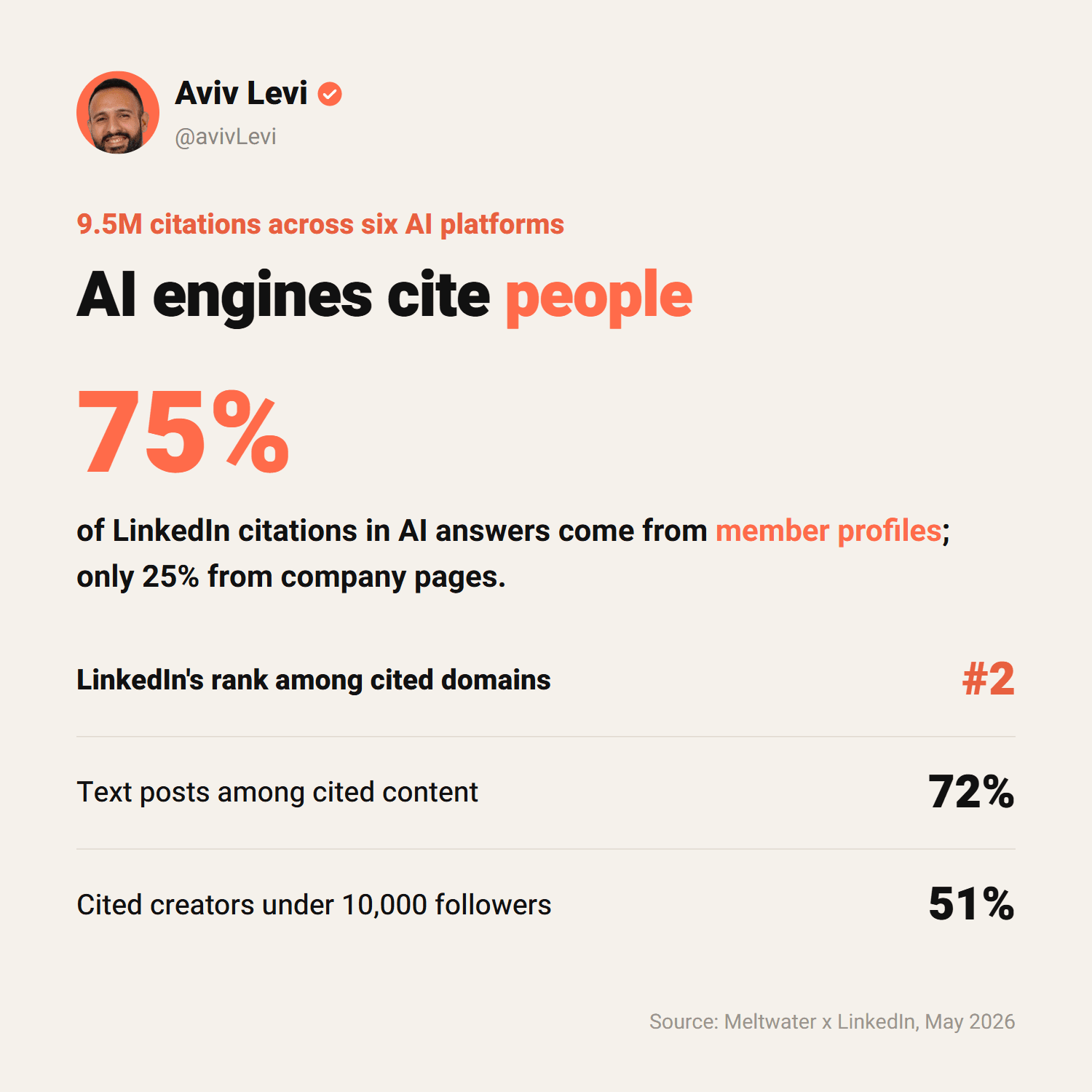
The strongest data point here comes from a May 2026 Meltwater and LinkedIn study of 9.5 million citations across six AI platforms: ChatGPT, Google AI Mode and AI Overviews, Gemini, Copilot and Claude. LinkedIn was the second most-cited domain, after YouTube. Four more findings:
- 75% of LinkedIn citations came from member profiles, only 25% from company pages.
- 72% of cited content was text posts, 12% articles and 11% video.
- 51% of cited creators had fewer than 10,000 followers.
- 48% of cited content was published in the previous three months.
Put simply: the engines are not looking for stars. They are looking for practitioners who write consistently, clearly and in their own voice about a defined field. That is exactly what a company website can't provide on its own. So I split GEO into three layers:
- The website. Pages that answer buyers' questions, with an answer at the top of each section, data and sources. This is the part everyone does.
- The people. The CEO and the experts in the company, on LinkedIn, with consistent content around 3 to 4 topics. An article published on both the site and LinkedIn is two doors to the same answer. This is what our CEO personal branding is built on.
- What others write about you. Press, podcasts, lists and reviews. Real mentions, earned on merit, not bought links.
An example from our own work: in checks I ran in October 2026, my LinkedIn article on Google AI Mode reached the top ten on Google Israel for the Hebrew "מצב ai" (18,100 searches a month) while the site version was not yet in the top 100. And for the Hebrew query "how to get ChatGPT to cite you", Google's AI Overview cited both my LinkedIn article and the website.
What GEO looks like in a smaller language market
For a Hebrew search, Google looks for a Hebrew answer. In my study, AI Overviews appeared on 94% of 150 Hebrew business searches, and 95% of the sources they cited were in Hebrew. When there aren't enough good Hebrew answers, it turns to English: for the Hebrew "how to appear in AI Overviews", it cited seven English sources and only one in Hebrew.
In many fields there still isn't enough professional content in Hebrew, or in other smaller languages, answering buyers' questions. Whoever writes it now, under their own name and with data, can become the source the engines come back to, even without the strongest site in the field.
How do you do GEO? Seven steps
- A question list. Write the 15 to 20 questions buyers ask before they buy, and add the sub-questions: price, comparisons, how to choose, common mistakes, who it is not for. That is your fan-out.
- A baseline. Run the questions in ChatGPT, Gemini and AI Mode. Note who is cited and whether you are. That is your starting point.
- One page per core question. A direct 30 to 80 word answer at the top of the page and each section, then the explanation. How to write an answer block.
- Something only you have. A number from your work, a real case, a small test you ran. That is what makes content non-commodity. And every claim with a source.
- A name and a date. A real author with a profile, and a visible updated date. Update when something changes.
- LinkedIn. Publish the same knowledge on the CEO's profile too, consistently, around the same topics. How to get ChatGPT to cite what you write on LinkedIn.
- Earned mentions. Offer data to journalists, appear on podcasts, answer questions in communities. Don't buy articles and don't buy links.
What not to do: buy a service that promises citations, produce hundreds of pages for every phrasing of a question, or pay for sponsored articles without disclosure. All of these contradict what Google writes, and nobody can promise what a model will cite.
How do you measure GEO?
On Google, the Generative AI performance report in Search Console shows impressions in AI features in Search and Discover. Outside Google there is no official metric yet, so I recommend a fixed manual check: the same question list, once a month, in ChatGPT, Gemini and AI Mode. In my own checks, answers changed even between two runs of the same question on the same day, so look at the trend over a few months, not at a single check. More on measurement.
How long does GEO take?
There is no single honest answer, and anyone who promises a citation by a certain date is promising something nobody controls. What I see on LinkedIn: it takes 3 to 6 months of consistent presence to get meaningful organic leads. On Google, a new page first has to be indexed, and even then Google writes explicitly that being shown is not guaranteed. So start before your competitors do, and measure from day one.
The bottom line
GEO is not a new field that replaces SEO, and it is not a trick. It is the same work of good content, with one more question: when your buyer asks an AI engine, are you one of the sources in the answer? The answer is built in three places: your website, your people's voices, and what others write about you.
Frequently asked questions
What is GEO?
GEO (generative engine optimization) is work that raises the chance AI engines like ChatGPT, Gemini and Google's AI Overviews cite you in their answers. The term comes from a November 2023 research paper by Princeton and partners.
What is the difference between GEO and SEO?
SEO aims to rank high in search results. GEO aims to be a source an AI model cites in its answer. Google says that for its own Search this is still SEO, because its AI features rely on the same ranking systems. In practice, GEO also counts the people in the company, their LinkedIn and what is written about you elsewhere.
Does GEO replace SEO?
No. Google writes that AI Overviews and AI Mode are rooted in its core ranking and quality systems, so SEO fundamentals stay relevant. GEO adds a question: is your content worth citing, not only worth ranking?
What is AEO?
AEO (answer engine optimization) is work that aims to make your content the direct answer to a question, for example in direct answers and voice assistants. Google mentions AEO and GEO together and says both are still SEO from its perspective.
Do I need an llms.txt file for GEO?
Not for Google. Google writes that its Search doesn't use such files, and that creating one will neither help nor harm your visibility in Search. You can create one for other services that use it.
Can anyone guarantee I appear in ChatGPT or Google?
No. Google writes that even a page meeting every requirement isn't guaranteed to be shown, and OpenAI writes that placement in ChatGPT isn't guaranteed. You can only raise the odds: clear, sourced, consistent content under a real person's name, measured over time.
What does a GEO specialist do?
Maps the questions buyers ask, checks who is cited for them today, builds content that answers them with data and sources, makes sure the same knowledge appears on the company people's LinkedIn, earns real mentions, and measures every month.
How long does it take to see results from GEO?
There is no guaranteed timeline. On LinkedIn it usually takes 3 to 6 months of consistent presence to see meaningful organic leads. On Google, a page first has to be indexed, and even then being shown is not guaranteed.