
How to get ChatGPT to cite you: the 2026 LinkedIn AI visibility guide

Published: · Updated: · 12 min read
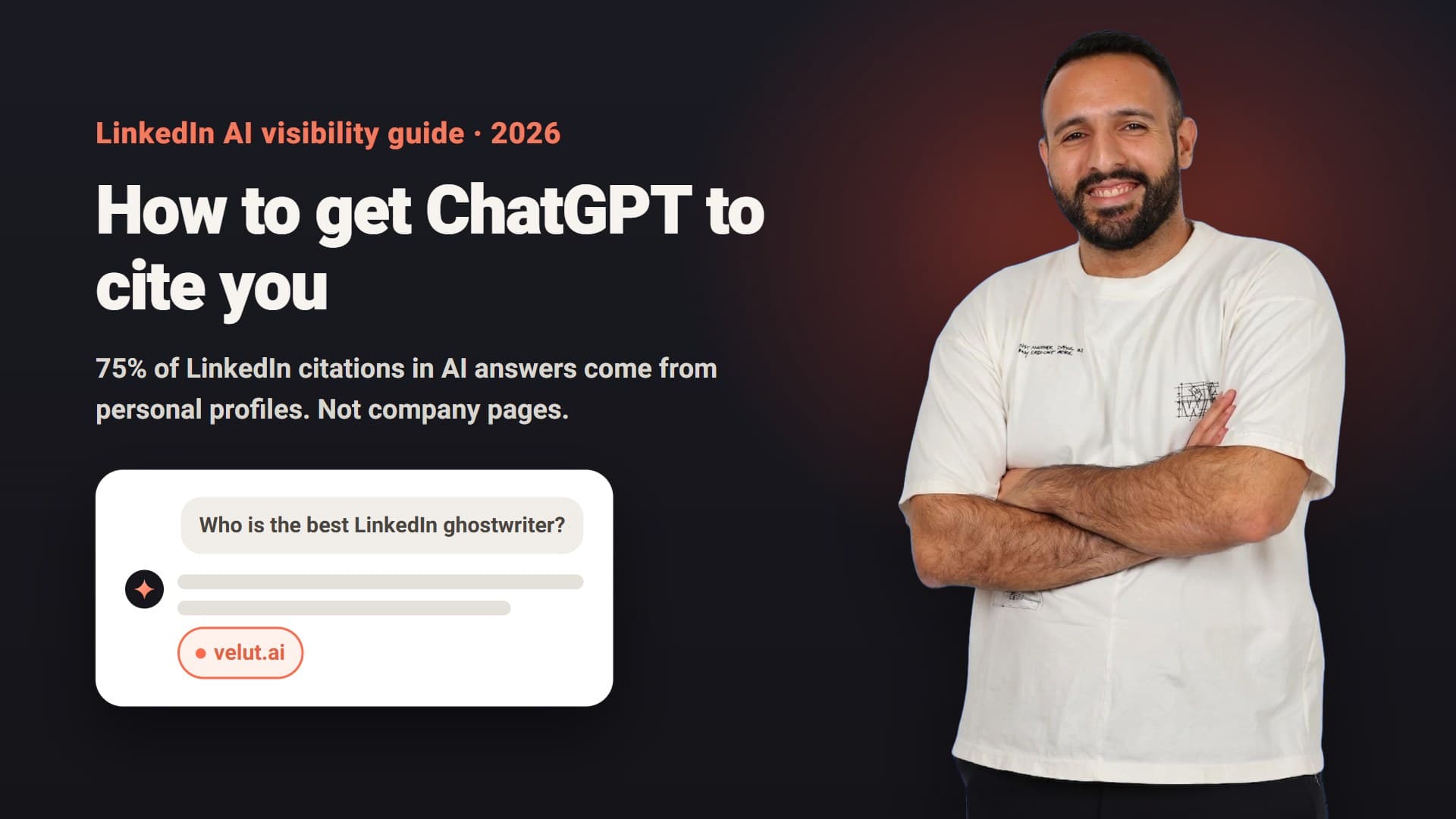
Quick answer
Your buyer no longer starts on Google
If someone asks ChatGPT today who the leading companies in your field are and your name isn't in the answer, it doesn't mean your product is worse. It means the model hasn't been given enough reasons to understand who you are, what you're an expert in, and why it should present you as a credible source.
LinkedIn published a 36-page guide on exactly this. I read all of it. Some of its conclusions contradict almost everything we were taught about the platform over the last three years.
94% of B2B buyers already use generative AI in their research. The buying cycle shrank from 11.3 months in 2024 to 10.1 months in 2025. Not because buyers are in more of a hurry, but because they learn, compare and build a vendor shortlist before they ever visit anyone's website.
Part of the shortlist decision now happens inside ChatGPT, Gemini, Copilot and Perplexity, sometimes before you even know the buyer is in market.
It's not just visibility. It's trust
The average B2B purchase involves 13 stakeholders plus 9 external influencers, and according to Forrester the group grows further when AI is part of the research.
These people aren't looking for the longest feature list. 34% of enterprise buyers in the research named the ability to justify the decision if it fails as their main emotional need. Relational qualities like "easy to work with" and "cares about our success" weigh three times more than specs and ROI claims at the moment of decision.
They are not looking for the best choice. They are looking for the safe choice. That is where expert content comes in: it doesn't just bring reach, it gives the decision-maker proof, language and sources to explain to the rest of the room why they picked you.
What actually changed?
Traditional SEO tried to get one page to the top of a list. An AI model works differently: it gathers information from many sources, connects them and builds a single answer. So one great article is no longer enough. The model looks for reinforcement:
- Does the company explain the same topic on its website?
- Does the CEO write about it?
- Does another expert in the company give a technical explanation?
- Does a customer or an external source confirm the claim?
The more credible sources reinforce the same expertise, the easier it is for the model to understand that you don't just talk about the topic. You are an authority on it.
Why LinkedIn?
According to Profound, LinkedIn is currently the most cited domain in AI search for professional topics. The reason isn't the volume of content. It's the identity behind it.
- Verified identity. A LinkedIn post is tied to a real person, role, company, experience and professional network: a billion members, 100 million of them verified. Semrush sees models moving away from anonymous sources like Reddit and Wikipedia toward named ones like LinkedIn, Forbes and Medium.
- Domain authority of about 98. LinkedIn sits alongside Wikipedia and YouTube in search-engine trust. That doesn't make your article strong automatically, but it gets crawled fast, indexed almost immediately, and starts with credit your company website needs years to build.
- Your message survives the trip. According to Semrush, LinkedIn content has a semantic similarity score of 0.57-0.60: when a model cites you from there, it tends to keep your wording and framing.
Who really gets cited: the company or the person?
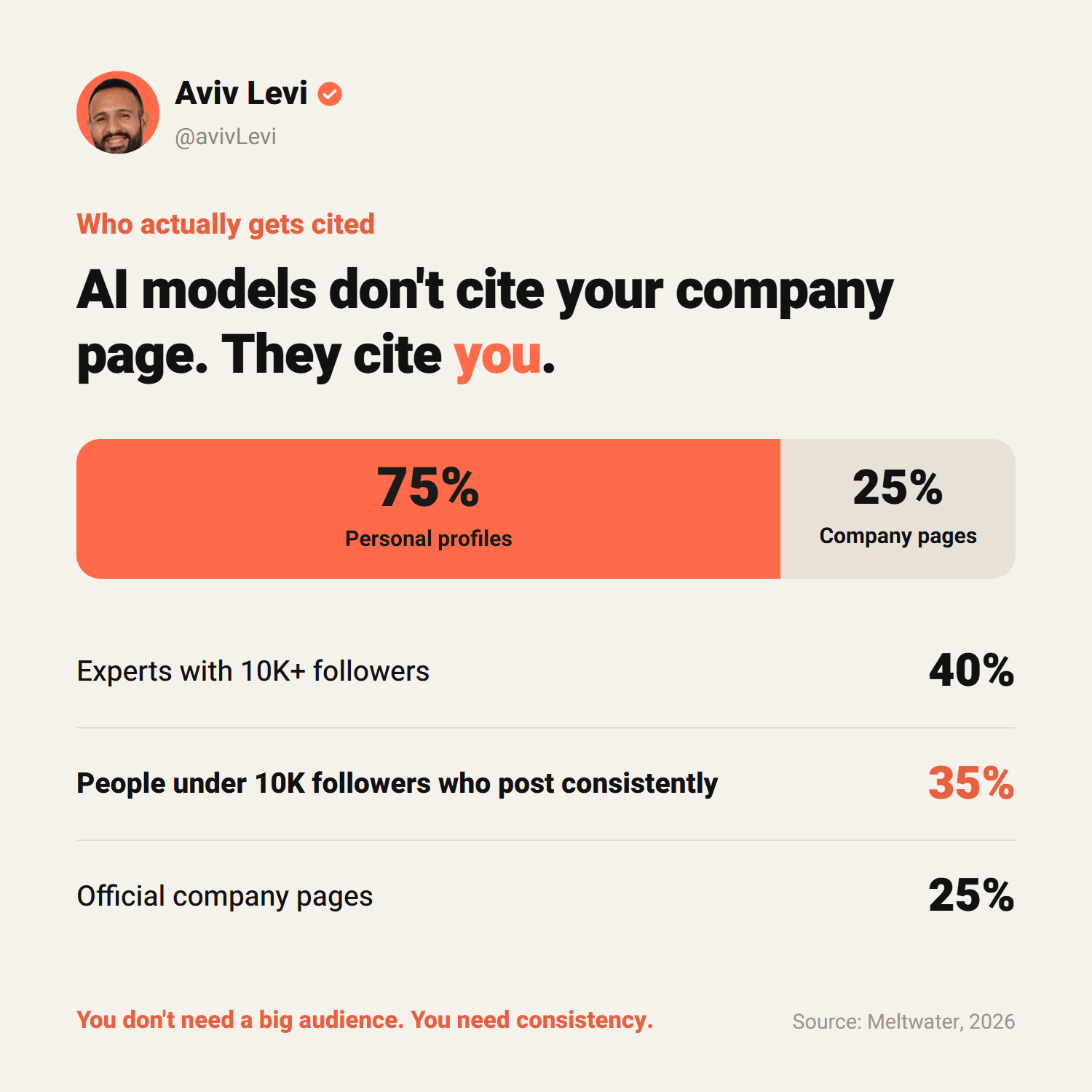
- Experts with more than 10,000 followers: 40% of citations
- People with fewer than 10,000 followers who post consistently: 35%
- Official company pages: 25%
75% of citations come from personal profiles, and only 25% from company pages. CEOs account for 8.2% of cited content and founders for 7.5%, but the role matters less than the expertise.
Pause on the middle line: a third of citations come from people without a big audience who simply post consistently in one niche. Meltwater sees writers above 2,000 followers cited a little more often, but there is no magic number. Topical focus matters more than title or audience size. And if your content only comes from the company page, you have given up 75% of the game.
How do you build a topic cluster an AI model understands?
With the CEOs and startups I work with, I define three or four core content themes for every brand. In the age of AI search their job is to teach the model what your company is an expert in. For that to work, each theme has to become a topic cluster: not a random collection of posts, but a body of knowledge that answers your customers' real questions.
- Pick one topic the company genuinely wants to be known for.
- Map 7-10 questions customers ask about it.
- Separate informational, comparison, purchase and brand questions. Each type needs a different format.
- Write one in-depth anchor article that answers the broad question.
- Break it into posts, each handling a single angle.
- Bring in more voices: the CEO, a product expert, a technologist, a customer, an outside source.
- Use the same terminology on the website, the company page and personal profiles.
Articles or posts?
According to LinkedIn's internal data, articles account for about 60% of content citations on the platform and posts for about 40%. The two formats play different roles:
- Article = the depth asset. Defines concepts, presents a framework and serves as the main citation source. 800-1,200 words, weekly.
- Post = the distribution asset. Takes one idea, starts a conversation and leads to depth. 200-300 words, 2-3 a week.
The workflow: publish an anchor article, break it into three to five posts, see which angles spark meaningful comments, and feed what you learned into the next article. There is no magic length: the guide presents 800-1,200 words as a range that works, and its summary mentions up to 2,500. For AI models, articles and newsletters are treated much the same.
How do you write content that is easy to cite?
This is where many companies fall short: they write impressive content and bury the answer under four paragraphs of introduction.
- Start from a real question. A headline like "How to choose a SaaS security platform in 2026" is clearer to readers and models than "The revolution nobody talks about".
- Put the answer before the explanation. Open every major section with a 30-80 word answer block: the direct answer first, then the explanation, example, data and caveats.
- Use subheadings that are questions. That tells the model each section answers a different sub-question.
- Give the model something worth citing. Names, numbers, prices, dates, criteria, a clear process.
- Bring information only you have. An internal data point, a customer story, a mistake that cost money, a pattern you spotted first.
- End with a practical summary. Key takeaways or a checklist, not an inspirational line.
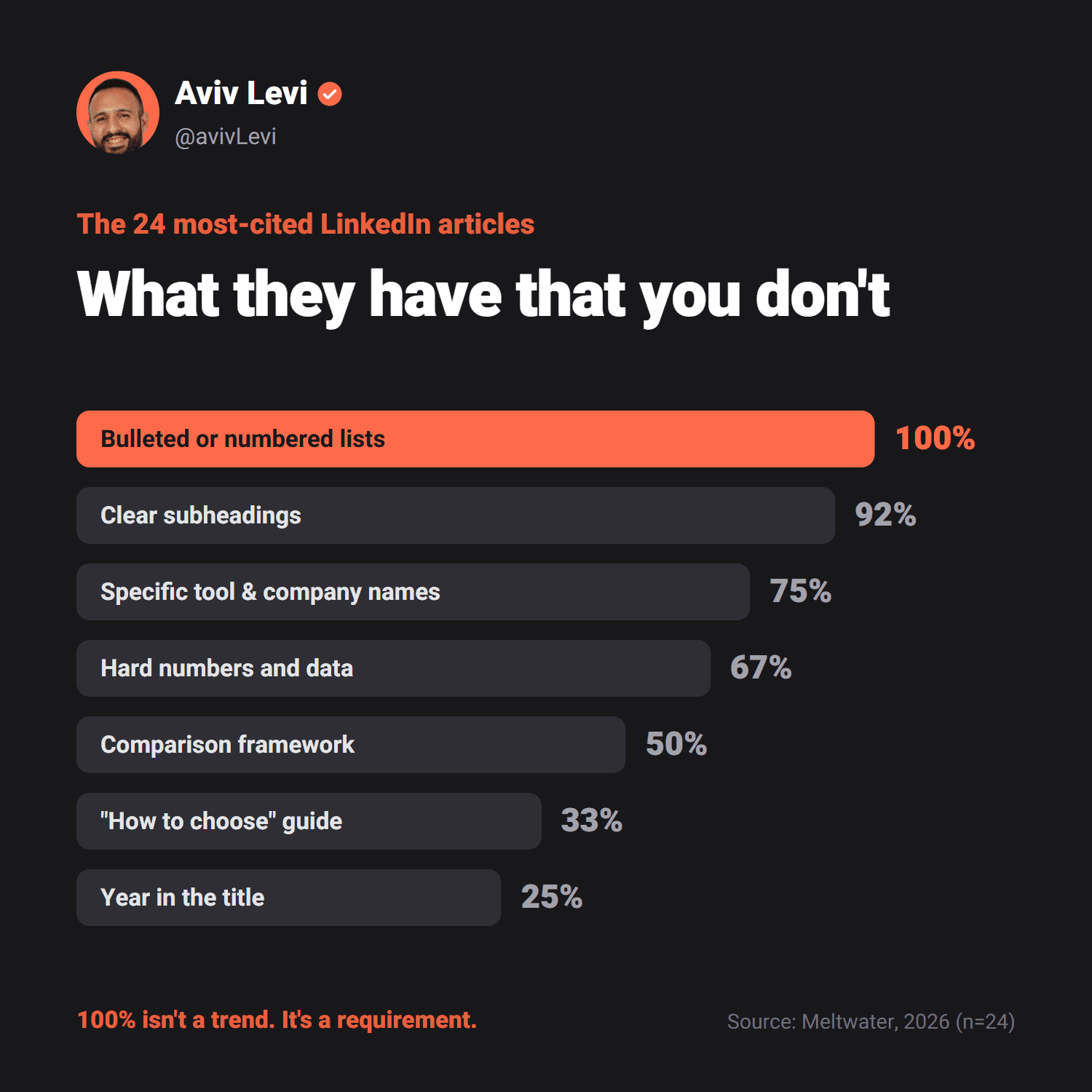
The structure of the 24 most-cited LinkedIn articles: bulleted or numbered lists 100%, clear subheadings 92%, specific tool and company names 75%, hard numbers 67%, a comparison framework 50%, a "how to choose" guide 33%, a year in the title 25%.
Four things hurting you today
- Hashtags and emojis in the first line. The first line is an SEO asset, not a place for decoration.
- Resharing instead of having your own position. 95% of LinkedIn content citations come from original posts, not reposts.
- Measuring likes as success. Engagement is a leading indicator. Citation is the outcome.
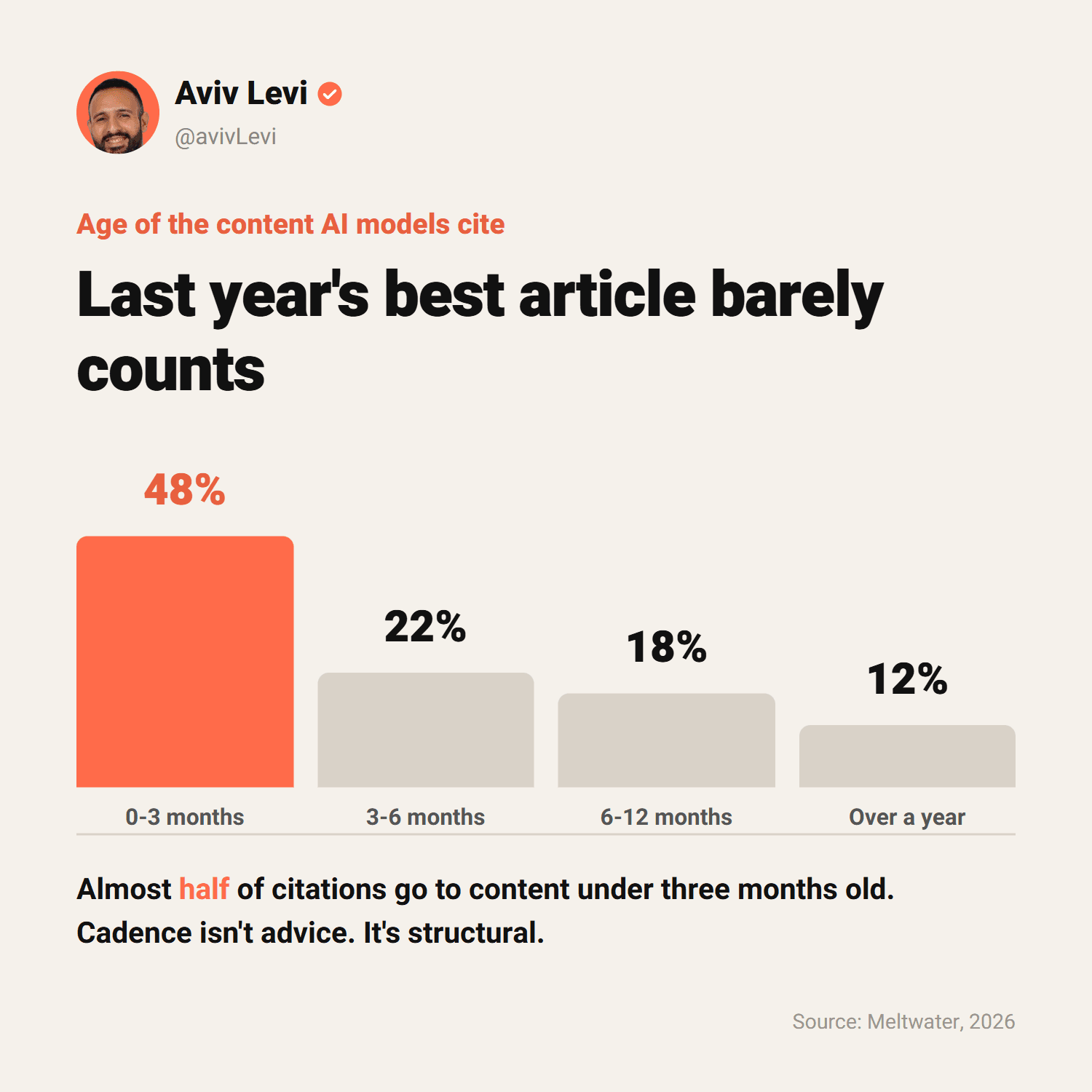
- Publish and forget. Almost half of cited content was less than three months old, and only 12% was over a year old. Update old articles and make sure your content is public and accessible.
Where does authority come from?
LinkedIn describes layers of trust that get stronger when they tell the same story:
- The company page defines the brand as a clear entity, with a two-way link to the website.
- The CEO or founder presents the worldview.
- Product and technology experts explain how things work.
- Employees show the knowledge lives across the organisation. LinkedIn measured 6x engagement when employees are activated as creators.
- Customers provide proof from the field.
- Press, podcasts and research provide validation you don't control.
When a company says it leads its field, that's a claim. When a customer, a journalist or an independent expert reinforces the same expertise, that's evidence.
How do you measure AI search visibility?
Measurement starts with a fixed list of prompts: real questions customers ask about your field, category, competitors and brand. From there, track:
- Brand mentions: how often your brand appears in answers, even without a link.
- Citations: how often the model attributes information to your content and links to it.
- Share of voice: your share of all citations in the category versus competitors.
- Citation rank: whether you are the main source or a footnote.
- Sentiment: how the model describes you.
- Business impact: whether visibility drives visits, inquiries and opportunities.
Give it time. According to Profound, the median time to a first citation is 6.81 days, and 90% of pages were cited within 37.1 days. Evaluate citations and share of voice over windows of 30 days or more.
The checklist
- Define in one sentence what the company does and in which category
- Pick three or four topics to be known for
- Map 7-10 real prompts per topic
- Write one in-depth anchor article around one meaningful question
- Open with a TL;DR and add an answer block to every section
- Break every article into three to five posts
- Activate two or three real experts inside the company
- Connect the website, company page and personal profiles
- Seek external validation: customers, interviews, research
- Measure mentions, citations, share of voice and sentiment
- Set a baseline today and review again after at least 30 days
And the most important line of all: is there an angle here only you can write? Structure gets you a seat at the table. Point of view is what gets cited.
The bottom line
If you want ChatGPT to cite you, don't write for ChatGPT. Build a body of knowledge a real person would want to save and forward to a colleague, then make sure it is clear, consistent and accessible everywhere AI models learn from.
Frequently asked questions
How do I get ChatGPT to cite me?
Build a consistent, original and verifiable body of knowledge around 3-4 topics, showing up in articles, posts, personal profiles, your website and external sources that reinforce each other. Content with a direct answer up front, question-style headings and sourced data is easier to cite.
Why does LinkedIn matter for AI visibility?
According to Profound, LinkedIn is the most cited domain in AI search for professional topics, thanks to verified identity and high domain authority. 75% of LinkedIn citations come from personal profiles (Meltwater, 2026).
Article or post: which is better for AI visibility?
Both. According to LinkedIn's internal data, articles account for about 60% of citations and posts for about 40%. The article is the depth asset; posts distribute it.
How long until content gets cited?
According to Profound, the median time to a first citation is 6.81 days, and 90% of pages were cited within 37.1 days. Measure over windows of at least 30 days.