
Google AI Overviews: what they are, who they cite and how to get cited

Published: · Updated: · 12 min read
Quick answer
What are Google AI Overviews?
AI Overviews are written answers that Gemini, Google's AI model, generates at the top of the results page. They summarise information from several sites and link to them. According to Google, they appear when its systems decide generative AI will be especially helpful, for example when you need to quickly understand information spread across several sources.
AI Overviews launched in the US in May 2024 and, by May 2025, reached more than 200 countries and territories in more than 40 languages, including Hebrew. In January 2026 Google made Gemini 3 their default model worldwide, and you can now ask a follow-up question from an overview and continue into a conversation in AI Mode. I covered AI Mode in the previous article in this series.
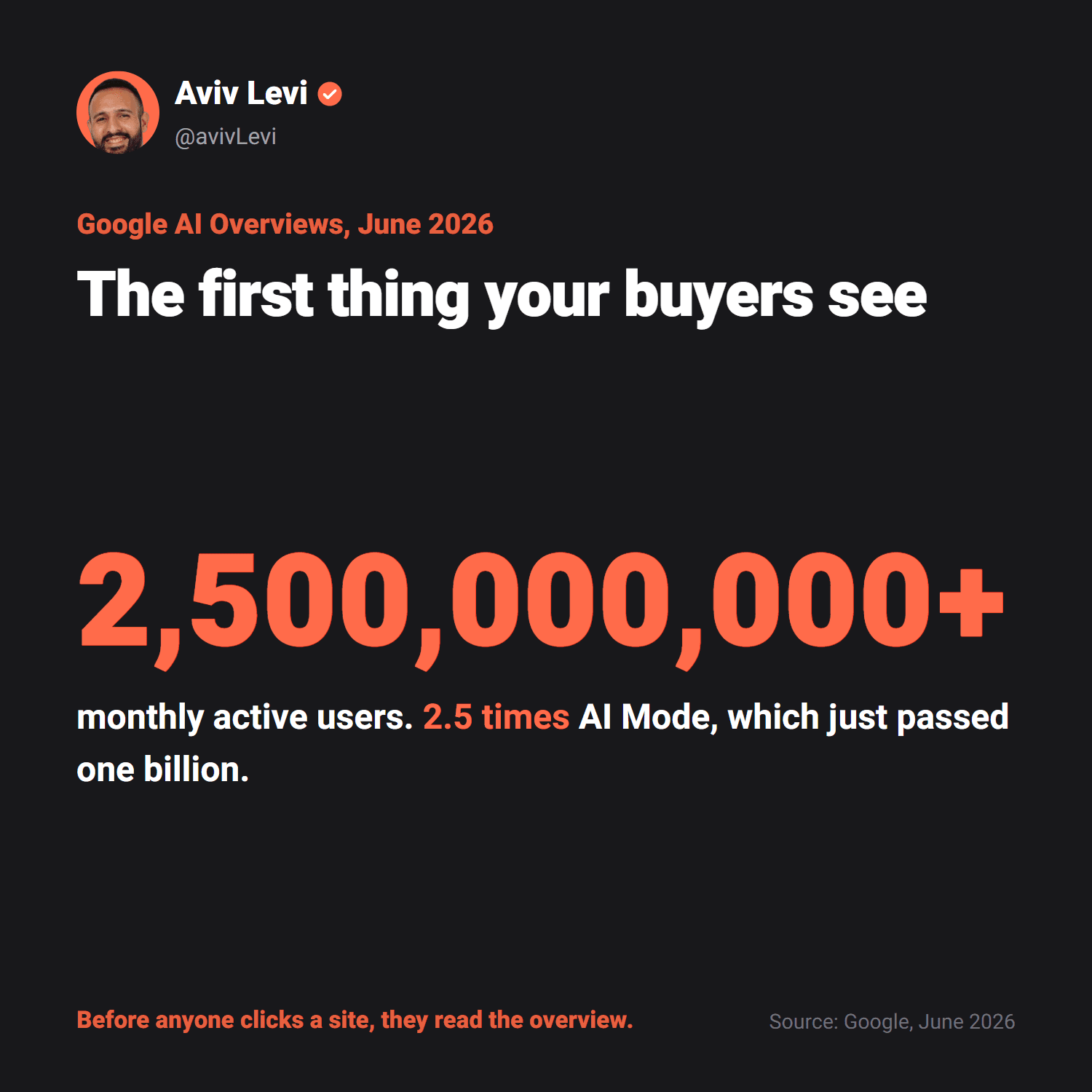
In June 2026 Google said AI Overviews had more than 2.5 billion monthly active users. AI Mode, for comparison, has one billion. That is Google's own number, but it explains why an AI Overview is the first thing most people see when they search.
One more detail worth knowing: users can't turn AI Overviews off. Google treats them as a core Search feature, like knowledge panels. People who only want links can choose the "Web" filter after searching.
How often do AI Overviews appear outside the US?
Most published data is from the US, so I ran my own test in a smaller, non-English market. On 6 October 2026 I ran 150 Hebrew searches on Google Israel, the kind a business owner or manager would run: 15 in each of ten areas, from marketing and sales through hiring, tax and cybersecurity to fundraising. I checked whether an AI Overview appeared, how long it was, who it cited, and whether its sources ranked in the top ten results.
The result: an AI Overview appeared on 141 of the 150 searches, 94%. It appeared on 96% of searches phrased as questions, and on 91% of short searches of one or two words. Across all ten areas the rate was between 87% and 100%, and the overview was almost always (96%) the first thing on the page.
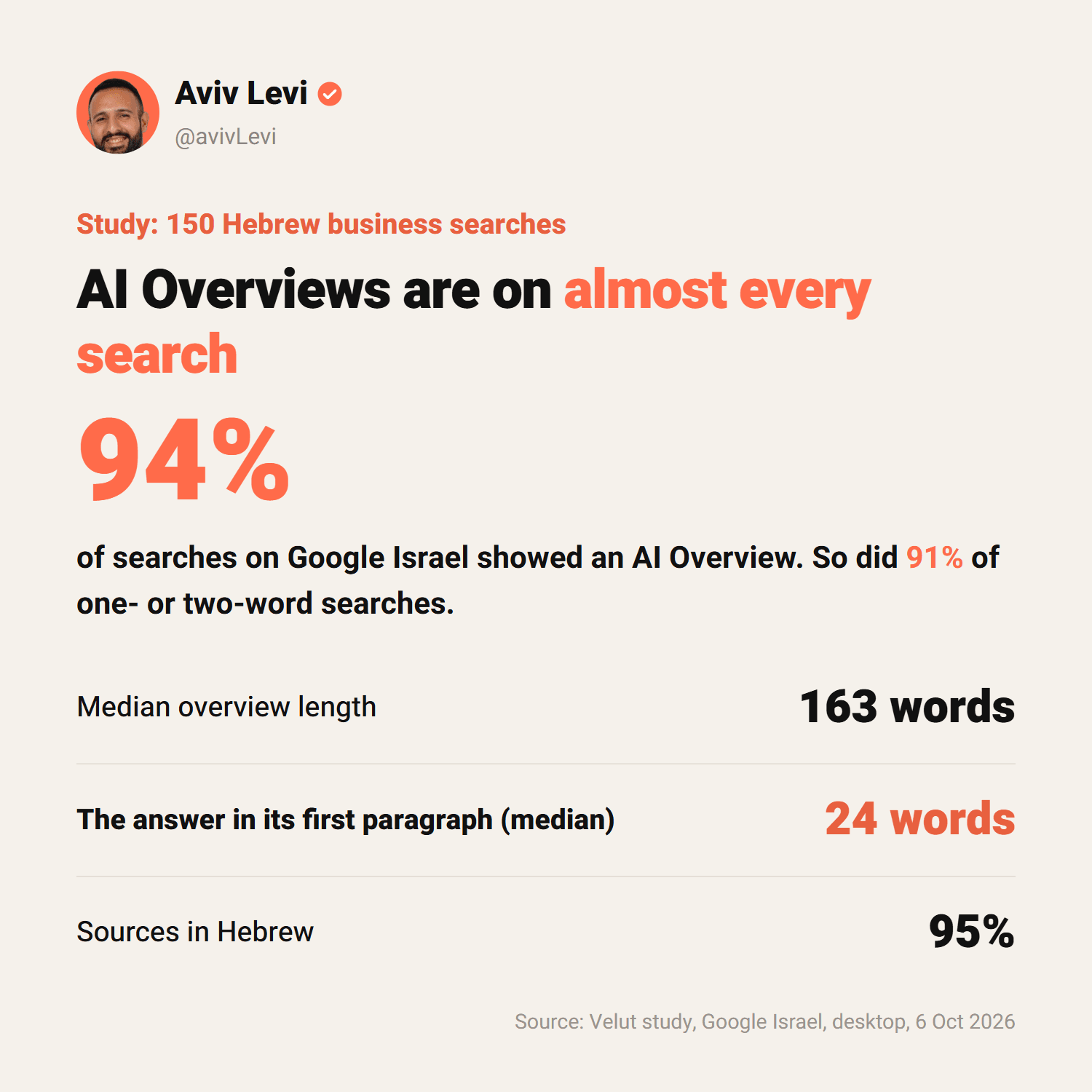
That is far higher than the US measurements. Pew Research found that only 18% of US users' searches showed an AI summary in March 2025, and Semrush found AI Overviews on 15.7% of the keywords in its database in November 2025. The comparison isn't exact: my sample is small, hand-picked, and made of informational business searches, exactly the type where Google tends to show an overview. But the takeaway is clear: when your buyers look for professional information, they increasingly meet the AI Overview first.
How are AI Overviews different from AI Mode and featured snippets?
Three Google features answer the question at the top of the page, and they are easy to confuse:
| AI Overviews | AI Mode | Featured snippet | |
|---|---|---|---|
| What it is | An AI-written answer from several sources | A full conversation with AI | A quoted passage from one page |
| Where | Above the regular results | A separate tab | Above the regular results |
| When | When Google thinks it helps | When the user chooses it | When a passage directly answers the query |
| Sources | Median of 6 (my Hebrew study) | ~7 unique domains on average (Semrush, 2025) | One |
| What it takes to appear | An indexed page eligible for a snippet | An indexed page eligible for a snippet | An indexed page eligible for a snippet |
The practical difference: a featured snippet copies a passage from one page. An AI Overview writes a new answer from several sources, so there is no single "first place" to win. There is a list of sources, and you need to be on it. Length has changed too: Pew measured a median AI summary of 67 words in March 2025, while in my study, after the move to Gemini 3, the median was 163. The market and method differ, so treat it as an indication, not an exact comparison.
How do AI Overviews choose who to cite?
In May 2026 Google published a new official guide for site owners on appearing in its generative AI features. It describes two techniques that work together:
- Retrieval from the index (RAG, or grounding). Google's core ranking systems retrieve relevant pages from its index, and the AI model reviews the specific information in them to build an answer with links.
- Query fan-out. The model runs several related searches at once. Google's example: someone asking how to fix a lawn full of weeds also triggers searches for the best herbicides, removing weeds without chemicals, and preventing weeds.
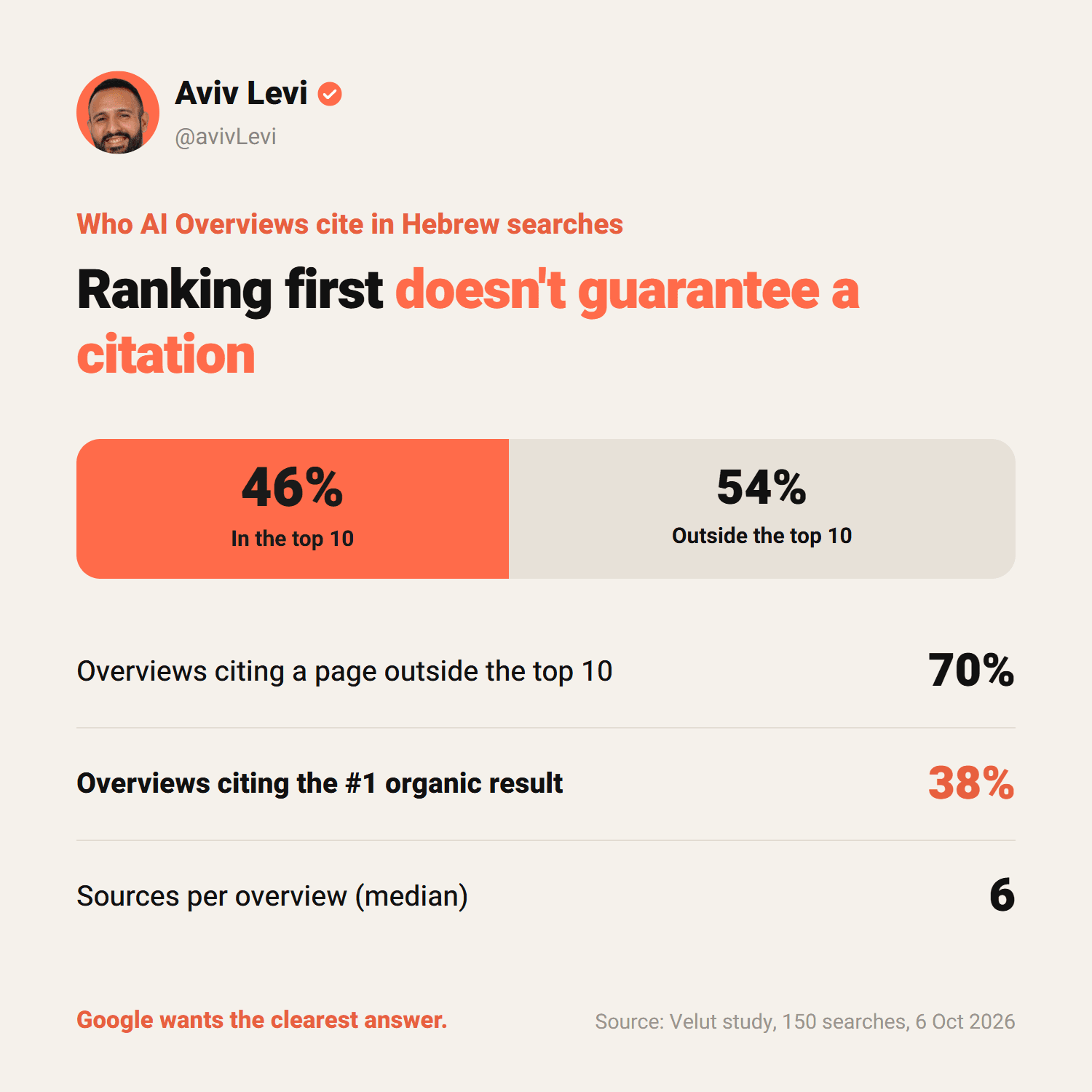
Fan-out is why ranking first no longer guarantees a citation. Ahrefs analysed 863,000 keywords in March 2026 and found that only 38% of AI Overview citations came from the top ten results. In July 2025, before the move to Gemini 3, it was 76%. About 31% of citations came from pages ranking 11 to 100, and another 31% from pages outside the top 100 entirely.
My Hebrew study shows a similar picture: 46% of the links the overviews cited ranked in the top ten for the same search. 70% of overviews cited at least one page outside the top ten, and the number one organic result was cited in only 38% of overviews.
And one finding I haven't seen in other studies: 95% of the sources the overviews cited were in Hebrew, and only 6% of overviews cited any source in another language. For a query in Hebrew, Google looks for an answer in Hebrew. For any company selling into a non-English market, that matters: a great English article will rarely get you cited when buyers search in their own language.
Do AI Overviews steal clicks?
Partly, yes. Pew Research tracked the browsing of 900 US adults in March 2025: when an AI summary appeared, they clicked a result on 8% of visits, versus 15% without one. They clicked a link inside the summary itself on only 1% of visits. Ahrefs found that by late 2025 the click-through rate of the top result was 58% lower when an AI Overview appeared.
But there is another side. Seer Interactive tracked 53 brands and 2.4 billion impressions and found that when a brand was cited in the overview, it earned 120% more organic clicks per impression than when it wasn't. That is still 38% below searches with no overview at all, and Seer stresses that this is correlation, not necessarily causation: strong brands are both cited more and clicked more. Google, for its part, says total organic click volume to websites is stable and that clicks are higher quality.
The bottom line for a business: the question isn't whether AI Overviews will take some clicks. They already do. The question is whether you are the source they cite, or one of the pages they skip. And when you are cited, your site's name appears inside the answer, even for people who don't click.
What is an answer block?
An answer block is a short paragraph, 30 to 80 words, that directly answers the question in the heading, at the start of the page and at the start of every section. Answer first, explanation second. Like the bold paragraph at the top of this article.
The idea isn't new. Journalists call it the inverted pyramid, and the US Army calls it BLUF, bottom line up front: the conclusion in the first line. What is new is that the reader of your first paragraph is no longer only a busy person, but also an AI model looking for an answer to quote.
It is worth being precise about what Google says. Its 2026 guide states that there is no need to "chunk" content into tiny pieces for AI, that there is no ideal page length, and that you should write for your audience, not for the engine. Google's Danny Sullivan was even blunter in January 2026 about advice to break content into bite-sized pieces for LLMs: "We don't want you to do that." An answer block isn't chunking. It is a complete, in-depth page that simply doesn't hide the answer in the sixth paragraph.
Why do answer blocks work?
Four findings, from four different directions:
- Google writes this way itself. In my study, the opening paragraph of the AI Overview had a median length of 24 words, and in 94% of overviews it was shorter than 40 words. For example: "B2B sales is a process in which one business sells products, services or information to another business rather than to a consumer." An answer sentence, then headings and bullets. The model is looking in your pages for exactly what it needs to write.
- Models read the beginning first. Kevin Indig analysed 18,012 ChatGPT citations and found that 44% came from the first third of the text. Cited passages contained almost twice as many clear definitions ("X is..."), and 78% of question-related citations came from headings.
- Google cites passages, not just pages. Pillarbase counted 15.7 million AI Mode citations. Almost half jumped to a specific passage on the page and highlighted it. The median highlighted passage was 117 words, and in a sample of more than a thousand passages, 80% opened with the answer in the first sentence.
- Every section counts, not just the top. SALT.agency checked where on the page the passages AI Mode highlights sit, and found no advantage for text at the top of the page. What kept coming up: a clear subheading, and the first line after it.
A caveat: Indig studied ChatGPT, and Pillarbase and SALT studied AI Mode, not AI Overviews. Pillarbase also sells a content platform. But when four different sources point to the same structure, a clear answer at the start of every section, that is enough reason to write this way. Especially since it is also what readers want.
How do you write an answer block? Seven rules
- A heading phrased as the real question. Not "Our advantages", but "How long does it take to see results from LinkedIn?". Exactly how a buyer would ask Google or ChatGPT.
- The first sentence answers. "X is...", "Yes, but only if...", "Usually between... and...". No "In today's business world" and no warm-up.
- 30 to 80 words. Two or three sentences: the answer, the reason or condition, and one number or example.
- It stands on its own. Someone who reads only this paragraph should understand it. No "as mentioned above", and the subject named explicitly instead of "it" or "this".
- Specific. A number, a date, a name, a source. Princeton's GEO study found that adding statistics raised visibility in AI engine answers by 31%, and citing sources by 28%.
- An answer, not an ad. The block answers the reader's question. Put your offer after you have shown you know what you are talking about.
- Depth comes next. The explanation, the field example, the caveats and your own experience. Google distinguishes "commodity" content anyone could write, like "7 Tips for First-Time Homebuyers", from content that brings first-hand experience. The block helps you get picked. The depth is the reason to pick you, and it is what turns a click into a customer.
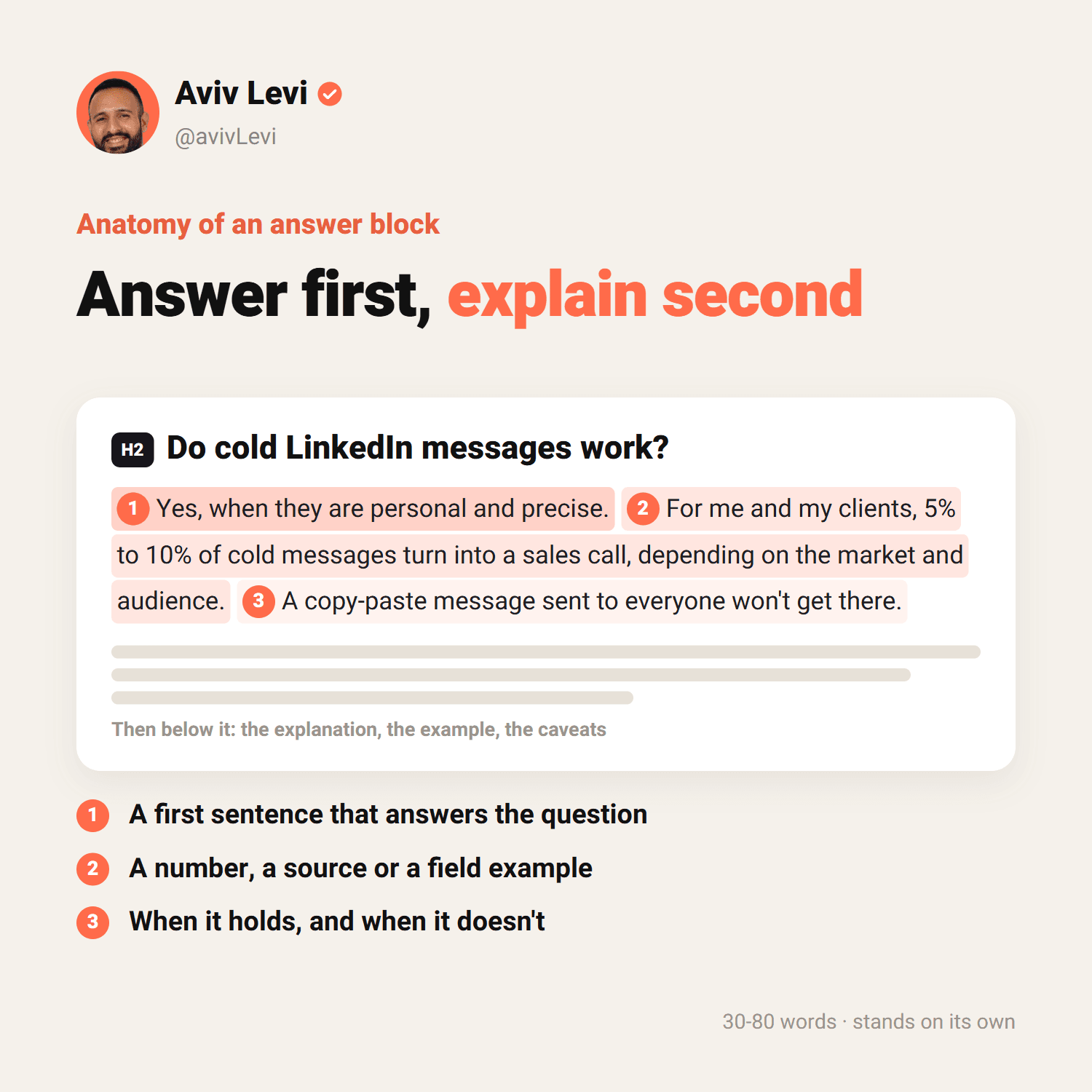
Here is an example from my field. A question CEOs ask me a lot: do cold LinkedIn messages work?
Before: "In the digital age, LinkedIn has become a central business tool, and more and more companies are realising the potential of reaching out to customers directly. In this article we'll try to understand..."
After: "Yes, when they are personal and precise. For me and my clients, 5% to 10% of cold LinkedIn messages turn into a sales call, depending on the market and the audience. A copy-paste message sent to everyone won't get there: the message has to show you looked at the person and their business."
The first sentence answers, the second gives a first-hand number, the third says when it holds. About 50 words, and from there you go on to explain how to write that message.
How do you build a whole page AI Overviews can cite?
One answer block at the top isn't enough, because fan-out sends Google looking for answers to sub-questions. This is how I build a page:
- An answer block at the top that answers the main question.
- A heading for each sub-question buyers ask: what it is, what it costs, how to choose, how it compares, common mistakes. Each section opens with its own short answer.
- A table when you compare, because it reads faster than a paragraph.
- Data with a source and a date, and experience of yours nobody else has.
- An FAQ at the end, with the questions buyers actually ask.
- A visible updated date and author.
And what not to do: don't create a separate page for every phrasing of the same question. Google's guide says that creating separate content for every variation or fan-out query, to manipulate the answers, violates its spam policy. One strong page per core question, with all of its sub-questions inside.
What does Google say you don't need to do?
Google's May 2026 guide has a whole section on myths. It names AEO and GEO explicitly and says many of the "hacks" circulating online aren't effective. According to Google, you don't need:
- An llms.txt file or any "special" AI file or markup. Google says its Search doesn't use them.
- Chunking your content into tiny pieces.
- Rewriting content just for AI, or trying to cover every possible phrasing of a keyword.
- Inauthentic mentions of your brand across the web.
- Special schema. Structured data isn't required for generative AI features, though it is still useful for rich results.
What you do need, technically: the page indexed and eligible to show with a snippet, so no nosnippet or max-snippet limiting it. And since August 2026 there is one more condition: the site must be "included" in Search Console's new control.
What is the new Search Console control?
On 31 August 2026 Google finished rolling out a control called Search generative AI to all websites worldwide. It sits in Search Console under Settings and decides whether your site can appear in AI Overviews, AI Mode and Discover's generative AI features:
- Include (the default): your site can appear as a link and help ground answers.
- Exclude: your site won't appear in these features and won't get traffic or impressions from them. According to Google, excluding doesn't affect ranking in regular search or AI training.
For most businesses the advice is simple: check that your site is set to Include. It is worth checking especially if someone on your team or at an agency touched the setting, because an exclusion takes effect within a day or two.
Where does LinkedIn fit in?
AI Overviews cite LinkedIn too, mostly articles. OtterlyAI analysed 1.3 million LinkedIn citations in AI engines between January and June 2026. Google AI Overviews alone accounted for 291,000 of them, more than twice AI Mode. 72% were LinkedIn articles and 25% posts. Across all engines, 92% of citations went to named individuals rather than company pages.
In my Hebrew study, LinkedIn articles were cited too, and in both cases where the article was in Hebrew (searches for "what is a KPI" and "LinkedIn company page"), it did not rank in the top ten. And for "what is AEO" in Hebrew on Google Israel, a LinkedIn post ranks first and the overview cites LinkedIn twice.
In May 2026 Google also added a section of first-hand perspectives to AI Overviews and AI Mode, drawn from public discussions and social media, with the creator's name. The takeaway: write your LinkedIn articles with the same structure. A question as the title, an answer block as the first paragraph, and subheadings that answer the sub-questions. LinkedIn's editor supports headings, and that is all you need.
How do you check whether you appear in AI Overviews?
- The Generative AI performance report in Search Console. Available to all sites since August 2026 (once they have enough impressions), it shows how often links to your site appeared in AI Overviews and AI Mode, by page, country, device and date. Impressions only, no clicks.
- The regular Performance report. Clicks from AI Overviews count under "Web". Note that every link in an overview gets the same position, the position of the overview itself, so a good average position doesn't mean you were first inside it.
- A monthly manual check. A fixed list of 10-20 questions your buyers ask, run in Google, AI Mode and ChatGPT. Note who gets cited and whether you are there. In AI Mode, when a link jumps to a highlighted paragraph on your page, you can see exactly which passage was picked.
What does this mean for smaller and non-English markets?
When I searched in Hebrew for "how to appear in AI Overviews", none of the top ten results answered the question directly, and the overview itself cited seven English sources and only one in Hebrew. When there aren't enough good answers in the local language, Google falls back to English. And for the Hebrew term for AI Overviews, most results were about reviews of AI tools.
That is the gap. AI Overviews appear on almost every business search in Hebrew, they look for Hebrew sources, and in many areas there aren't enough good, current answers. A company that writes the answers to its buyers' questions now, in their language, with an answer block at the start of every section, can become the source Google cites. Even without ranking first.
The bottom line
AI Overviews are the first thing your buyers see on Google, and they no longer settle for the page that ranks highest. They look for the clearest answer to each sub-question. An answer block is the simplest way to give them that: answer first, depth after, in your own voice, on your site and on LinkedIn.
Frequently asked questions
What are Google AI Overviews?
AI Overviews are answers Gemini writes at the top of Google's results, with links to their sources. They are available in more than 200 countries and 40 languages, and Google says they have more than 2.5 billion monthly active users (June 2026).
How do I get my site into AI Overviews?
The page must be indexed and eligible for a snippet, and the site must be "included" in the Search generative AI control in Search Console. Beyond that: answer your buyers' questions with a direct answer at the start of each section, first-hand data, and experience others don't have.
What is an answer block?
A 30-80 word paragraph that directly answers the question in the heading, at the start of the page and of every section. The first sentence answers, the second gives a reason or a number, and the third says when it holds. The full explanation follows.
If I rank first on Google, will I appear in AI Overviews?
Not necessarily. According to Ahrefs (March 2026), only 38% of AI Overview citations come from the top ten results. In my study of 150 Hebrew searches, the number one organic result was cited in only 38% of overviews.
Can AI Overviews be turned off?
As a user, no. Google doesn't let you switch them off, but the "Web" filter shows links only. As a site owner, you can exclude your site with the Search generative AI control in Search Console. Google says this doesn't affect regular ranking, but you also won't get traffic from AI Overviews.
What is the difference between AEO and SEO?
AEO (answer engine optimization) is a name for writing aimed at getting into AI engines' answers. According to Google's May 2026 guide, for Google Search it is still SEO: the same ranking systems and the same fundamentals, with no special tricks.
How long is an AI Overview?
In my study of 150 Hebrew searches (October 2026), the median length was 163 words with 6 sources. The opening paragraph, the answer itself, had a median of 24 words.