
Employer branding on LinkedIn: how leadership and employees build it

Published: · Updated: · 11 min read
Quick answer
Key takeaways
- Candidates check you before they apply: 86% of job seekers research company reviews and ratings (Glassdoor). On LinkedIn, they read your people.
- The median personal-profile post gets 1,006 impressions, against 659 for a company page (AuthoredUp, 2026). When several leaders post, the company reaches each of their networks.
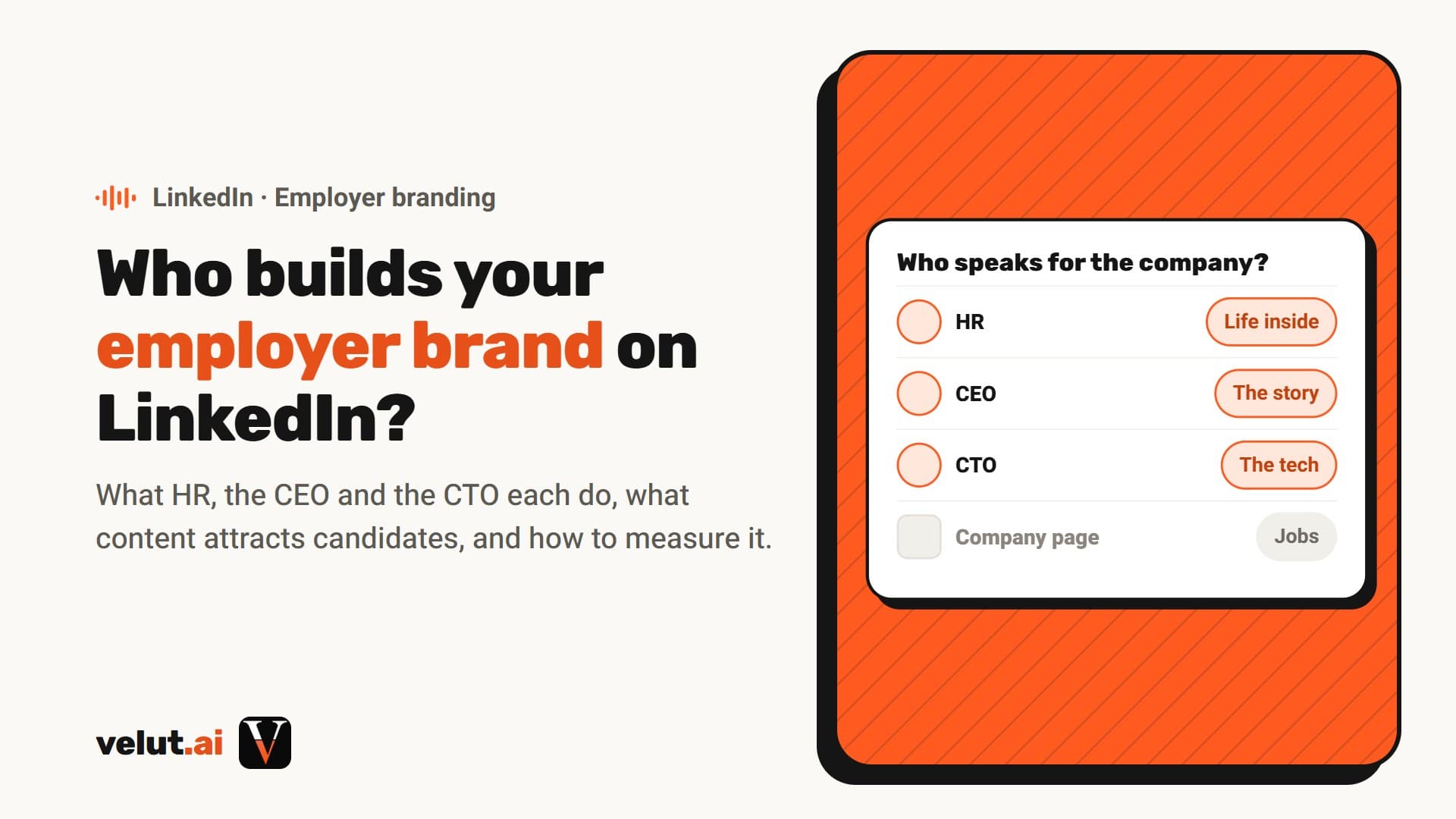
- Every ambassador has a role: HR on life at the company, the CEO on the story and the pains the company solves, the CTO on the technology.
- What attracts candidates: leaders' personal stories, and technical content about a breakthrough or a creative fix.
- Measure by the goal: reach among the right job titles, inbound messages, site traffic or candidates. The report's top line follows the goal.
What is employer branding on LinkedIn?
Employer branding is the work on a company's reputation as a place to work: what candidates, employees and the market think about working for you. Tim Ambler and Simon Barrow of London Business School defined "the employer brand" in 1996, and there is a short definition in our glossary. On LinkedIn, that reputation is built from what people see in the feed: the company page, the leadership team's posts, and what employees share.
It changes what candidates decide. According to Glassdoor, 86% of job seekers are likely to research company reviews and ratings before deciding where to apply. LinkedIn says on its employer branding resources page for recruiters that a strong online brand leads to 50% more qualified applicants. And a 2011 LinkedIn survey linked a strong employer brand to a 50% saving in cost per hire (via Glassdoor). The number is old, but the direction has not changed: a company that looks like a good place to work pays less to find people.
Why isn't the company page enough?
Because LinkedIn shows people more than it shows pages. Organic company-page content is only about 2% of what appears in the feed (AuthoredUp). And according to AuthoredUp, which analyzed almost 900,000 posts from July 2025 to June 2026, the median personal-profile post gets 1,006 impressions, and the median company-page post gets 659.
- People's networks are bigger. According to LinkedIn's official guide to employee advocacy, employee networks have on average 10x more connections than a company has followers.
- People get more clicks. In the same guide: the click-through rate on content is 2x higher when an employee shares it than when the company does.
- A few people do a lot. Only 3% of employees share content about their company, and their shares drive a 30% increase in the total engagement the company sees (LinkedIn).
- Candidates check the leaders. In Brunswick's Connected Leadership survey (2019), most employees said they would check a CEO's social media before joining a company, and twice as many preferred to work for a CEO who uses social media as part of the job.
This is how I explain it to clients. If only the CEO and the company page post, the company leans on their two networks. When ten more leaders or employees post, the company also reaches each of their networks. And those are different audiences: CEOs follow a CEO, tech people follow a CTO, other roles follow a COO, and engineers or lawyers bring their own audiences. It is a huge force multiplier. Not every audience is unique, and some people will see several of the profiles, but the potential reach grows far beyond the CEO's profile and the company page.
That does not mean closing the page. The page is the base: a candidate who checks you lands there and finds the jobs, the photos and the basics. But people tell the story.
Who does what: HR, the CEO, the CTO and employees
When a company comes to me about LinkedIn for its leadership team, it is almost never one need. It is a mix of hiring, bringing in clients and building the brand. Those goals are split between the people who are active on LinkedIn:
| Who | Talks about | Attracts |
|---|---|---|
| HR, employee experience or employer branding | Life at the company, the work environment, open roles and the people inside. One consistent language that makes people want to work there | Candidates |
| The CEO, COO or a co-founder | The story behind the scenes: founding the company, clients' pains and the solutions | Usually clients (founder-led marketing), and candidates who connect with the story |
| The CTO | What is unique about the technology and the work, in words non-technical clients understand too | Tech people, and sometimes clients, depending on the audience |
| The company page | Jobs, announcements, events and the basics | People who are already checking you |
Some companies come prepared: they already know HR will talk about life at the company and the CTO about technology. Then my job is to run the activity and make sure each ambassador speaks in the language that fits them, with the messages the company wants out. Others come and say: "Aviv, I want to succeed on LinkedIn." So I ask: what does success mean? Hiring? Investors? Clients? Each goal has a different language, and that decides which profiles I suggest activating, what each person says and how. Before that, I review the existing profiles: activity, followers, job titles and each person's audience.
For the CEO, it is the same logic as founder-led marketing: the CEO is the marketing channel. In employer branding, the CEO is also one of the voices candidates read before they decide.
What content makes a good candidate want to work for you?
Two kinds, and they are very different:
- Personal stories. People want to know the real person: who you are, how you got to what you do, and why you do it. As with podcasts, people connect with life stories, not only with a professional solution. A candidate reading that kind of story can think: "I want to work with this person, I connect with their values and I want to learn from their experience." The story shows layers a professional post or a job description does not.
- Interesting technical content. A breakthrough, a big achievement, or a creative fix for a technical problem. That kind of post makes people say: "I want to work on things like this."
Next to both, there are HR's posts: the open roles, but also the experience and what makes the company and its people unique. Show the people and the company from the inside. A "We're hiring!" post on its own is an ad. A post that shows who works there and what they do is a reason to apply.
If you want to understand why posts with ideas and a point of view work better than updates, I wrote about it in the article on LinkedIn thought leadership.
What does it look like in practice? A B2B example
We worked with a large B2B company on two profiles: the CEO and an HR and recruiting lead. Each had a different role.
- The CEO: through him we reached the exact target audience and the job titles the company wanted. He got inbound messages from people who wanted to learn about the services, the company and working together.
- The HR lead: on her profile we posted jobs and talked about the open roles, and also about the experience and what makes the company and its people unique. We showed the people and the company from the inside.
Candidates who came to interviews said they had read the content and liked it, and that it affected how much they wanted to work there. Some contacted the recruiter directly, or commented on her post and asked to interview. To be honest about it: not all of them came from her profile. Some found the company through the CEO and some through the company page, and what we know about where a candidate saw us, we know because they told us. That is exactly the point: the voices work together.
This matches what LinkedIn itself describes. In its employee advocacy guide, it cites the engineering firm CH2M, which realized that its employees' relationships were the engine of its recruiting, especially for engineers. Once employees started sharing, they drove 4x more job views and 3x more job applications.
How do you run an employee advocacy program on LinkedIn?
Run it as a small ambassador program, not a reshare campaign: a few people with clear roles, each posting original content in their own voice, on a fixed weekly rhythm with approval. You don't need everyone: according to LinkedIn, the 3% of employees who share company content drive a 30% increase in the engagement the company sees.
Many employee advocacy programs work the other way: the company writes a post, and employees are asked to reshare it, often through an advocacy tool that sends them a queue of company content. That gets reach for a day. It doesn't tell anyone what it is like to work with these people. This is the difference:
| Reshare program | Ambassador program | |
|---|---|---|
| Who posts | As many employees as possible | A few ambassadors with a clear role: the CEO, HR, the CTO |
| What they post | The same company post, shared by everyone | Original posts in each person's voice, on the topics they know |
| What it builds | A spike of reach around one announcement | Voices candidates and clients follow over time |
| How it runs | A reminder to share | A fixed meeting with each ambassador, once or twice a week, and approval before anything goes out |
| How it is measured | Shares and likes | By the goal: reach among the right job titles, inbound messages, candidates |
Running the program comes down to four things. A goal for each ambassador, because hiring, clients and investors each need a different language. Topics that don't overlap, so HR talks about life at the company and the CTO about the technology. A rhythm: one meeting to collect material and write, one to approve. Clear red lines, set with the company before the first post: nothing invented, nothing that could hurt the company, and nothing published without approval. The company is my client, so when a post could hurt it, it doesn't go out.
Most companies don't have time to run this inside the leadership team. That is what I do in LinkedIn for leadership teams: an employee advocacy program for a company's executives, where I write each person's posts by hand, in their voice, and keep one message for the company.
How do you keep a personal voice for each leader and one message for the company?
By getting to know two things. The first is the company: its values, what it stands for and what it won't do, its ICP and its clients' pains, the people it wants to hire, and how the organization lives and works. All of that before I write a word.
The second is the person: I sit with them as long as it takes, read their earlier content, and listen not only to what they say but to the words they choose, their tone and how they want to sound. From those two, I build a personal content voice for each ambassador that fits the company's values and doesn't contradict them. In most cases people's own values already match the organization's, so my job is to bring their voice out.
The hard part of writing for several leaders is splitting attention. You have to know each one deeply, divide time and attention between them, and keep track of each one's meetings, content, approvals and satisfaction. It is easier to sit with one person and write everything for them. Still, several ambassadors give a company value and influence one person can't. To run it, I have a fixed meeting with each ambassador once or twice a week, depending on the company's pace: in one we collect material and write, in the other we approve. That keeps continuity and control.
The red line: nothing invented, nothing posted without approval
I don't write unless I am given the story. I write only true information the company gives me, or information it wants to rely on, such as an article it sends me and asks to respond to. Everything follows the company and needs its approval, and nothing goes out without approval. I write the posts by hand, in each ambassador's voice. The bottom line: I don't make things up.
What if a leader wants to post something that would hurt the company?
My client is the company. I see myself as a lawyer who represents it. If a leader or an employee wants to write something that could hurt the company or its employer brand, I won't write it or approve it as part of the work I run. I explain why it is a problem and suggest another topic or a wording that doesn't hurt the brand. And if it simply isn't right for an employee to write it on the company's behalf, it doesn't go out.
"I don't have time": how do you convince a skeptical leader?
I tell the CEO something simple: if you don't write on LinkedIn and your competitor's CEO does, they are building visibility with your target audience while you are not. If visibility matters to you for sales, for your brand or for hiring, you are at a disadvantage.
- Well-known brands keep posting too, to stay top of mind.
- Even a company that isn't selling yet needs a reputation. Even a company in stealth can post glimpses and "coming soon" and build anticipation before launch.
- LinkedIn is where businesses are. A company that wants to grow has to take it seriously.
I also tell them they don't have to work with me. They can do it themselves or with someone else, but it matters that they do it. For anyone still unconvinced, I offer to put them in touch with CEOs whose profiles I manage. Some of them were skeptical, and later saw reach, comments, inbound messages and leads. As for time: after the onboarding period, it is 30 to 60 minutes a week of a CEO's time on content. I compared writing it yourself, AI tools and a ghostwriter in the ghostwriter vs AI article.
How do you measure employer branding on LinkedIn?
By the goal. I ask this at the very start: who do you want to reach? What you measure follows from that:
| Goal | What to measure | Note |
|---|---|---|
| Awareness | Reach, and the job titles of the people reached: CEOs, COOs, CMOs | Awareness itself is hard to measure directly. Reach among the right audience is not |
| Leads | How many inbound messages came in | Spontaneous inbound messages are a good signal, even when they are not the main metric |
| Site traffic | UTM links in posts | That shows which post brought which visit |
| Hiring | Candidate messages, and what candidates say in interviews about where they saw you | You only know where a candidate saw you when they say so |
Followers interest me less as a main metric, unless the goal is very broad reach. I send the report monthly, quarterly or at another rhythm, depending on the company. And there is no fixed top line: if leads matter most, the number of leads goes at the top. If reach matters, the combined monthly reach of all the profiles. The main metric always follows the goal we set.
Course, consultant or hands-on management: what fits your company?
Many people searching for employer branding are looking for a course, a workshop or a consultant for their company. I don't teach courses, but the honest answer is that each option fits a different situation:
| Course or workshop | Consultant | Hands-on (writing and management) | |
|---|---|---|---|
| What you get | Knowledge and tools for HR or employees | Strategy, messages and feedback | Someone who writes, coordinates, approves and measures, every week |
| Who writes the posts | Employees and leaders | Employees and leaders | The writer, in each ambassador's voice, with their approval |
| Fits when | People want to write and need direction | A team will execute, but there is no plan | The leadership has no time to write, but has things to say |
| The risk | Enthusiasm fades after the workshop | The plan stays in a slide deck | A writer who doesn't learn the people writes generic posts |
At Velut I do the third column: LinkedIn for leadership teams, writing and management for several executives in one company, each in their own voice, with one message for the company. If you have a team that already writes and only needs direction, a course or a consultant may be enough.
How do you start? Three first steps
- Define what success means. Hiring? Clients? Investors? Each goal has its own language, and its own number at the top of the report.
- Pick ambassadors and review their profiles. You don't have to start with everyone: in the example above we worked on two, the CEO and an HR lead. Check activity, followers, job titles and audience, and split topics so each person talks about what they know.
- Set a rhythm. A fixed meeting with each ambassador once or twice a week: one to collect material and write, one to approve. And nothing goes out without approval.
What not to do: ask every employee to share the same company post on the same day. It looks coordinated, and it says nothing about the people. A few people telling real stories is better.
Frequently asked questions
What is employer branding on LinkedIn?
It is a company's reputation as a place to work, as it is built on LinkedIn: the company page, the leadership team's posts and what employees share. The page is the base, but most reach comes from personal profiles: organic company-page content is only about 2% of the feed (AuthoredUp).
What is the difference between employer branding and employee advocacy?
Employer branding is the goal: the company's reputation as a place to work. Employee advocacy is one way to get there: employees sharing company content with their networks. I prefer original content from each leader, in their own voice, over everyone sharing the same post.
What is an employee advocacy program?
A structured way for employees to share the company's story on their own LinkedIn profiles. The common version asks everyone to reshare company posts. The version I run is smaller: a few ambassadors with clear roles, original posts in each person's voice, a fixed weekly rhythm and approval before anything goes out.
Should every employee post on LinkedIn?
No. Start with a few ambassadors with a clear role, such as the CEO, someone from HR and the CTO. According to LinkedIn, only 3% of employees share content about their company, and they drive a 30% increase in total engagement. A few active people make a big difference.
How much time does it take each leader?
With me, one or two fixed meetings a week with each ambassador, depending on the company's pace: one to collect material, one to approve. After onboarding, it is 30 to 60 minutes a week of a CEO's time on content.
Who writes the posts?
At Velut, I write them by hand, in each ambassador's voice, only from true stories and information the company gives me. Nothing goes out without the person's and the company's approval.
How do you know employer branding on LinkedIn is working?
Measure by the goal: reach among the right job titles, inbound messages, site traffic with UTM links, or candidates who say in the interview that they read the content. Follower count is a secondary metric.