
Founder-led marketing: what it is, examples, and how a CEO becomes the marketing channel
Published: · Updated: · 14 min read
Quick answer
What is founder-led marketing?
Founder-led marketing is when the founders, or some of them, choose to write and share real content, and use it to build the company's brand and name. They publish on their own channels, in their own voice, with their own experience, opinions and lessons. The company page doesn't disappear. It just stops being the main voice.
How is it different from personal branding? Personal branding is about the person: their career, their reputation, their next move. Founder-led marketing uses the same tools for a business goal. The founder's voice is the channel, and the company is the story. When I build a CEO's content, I start with a narrative for the company, and only then choose which of the CEO's stories serve it.
The term has a few relatives that are often used as if they were the same thing. This is how I separate them:
| Term | What it means | Main goal |
|---|---|---|
| Founder-led marketing | The founder's own content is the company's main marketing channel | Awareness, trust and pipeline |
| Founder-led content | The content itself: posts, articles and videos in the founder's name | A consistent presence in the feed |
| Founder branding / personal branding | The founder's reputation as a person | Authority, opportunities and career |
| Founder-led sales | The founder sells personally, usually in the early stage | Closing the first customers |
| Founder-led growth | The founder's audience drives the company's growth | Growth through the founder's network |
Searches for "founder led marketing" are still small, about 480 a month worldwide, but in the US they rose from about 50 to 90 a month over the past year (DataForSEO, October 2026). The term is growing because more founders are seeing what it does.
Why does founder-led marketing work in B2B?
Three reasons, and each one has data behind it:
- LinkedIn shows people more than pages. According to AuthoredUp, which analyzed almost 900,000 posts from July 2025 to June 2026, the median post from a personal profile gets 1,006 impressions, and the median company page post gets 659. Organic company page content is only about 2% of what appears in the feed.
- Your people have a bigger network than your page. According to LinkedIn's own data, employee networks have, on average, 10 times as many connections as the company page has followers, and an employee's share gets twice the click-through rate of the same content shared by the company.
- Buyers trust ideas more than marketing. In the 2024 Edelman-LinkedIn report, 73% of decision-makers said an organization's thought leadership is a more trustworthy basis for judging its capabilities than its marketing materials. In the 2025 report, 41% of buyers said a C-suite executive had encouraged them to consider a vendor after engaging with that vendor's content.
There is one more reason that gets less attention: timing. According to the 95:5 rule from the LinkedIn B2B Institute, based on research by John Dawes of the Ehrenberg-Bass Institute, only about 5% of B2B buyers are in the market at any given moment. The other 95% will buy later. An ad reaches the 5%. A CEO who posts every week stays in the minds of the 95% until their moment comes. That is also why a B2B buyer needs to meet you many times before they buy.
How much more reach does a CEO get than the company page?
The clearest way to see it is the same post on both channels. In March 2026, monday.com announced it was opening its platform to AI agents. The announcement went out on the company page, with 337,410 followers, and on the profile of CEO Roy Mann, with 5,166 followers. 65 times fewer.
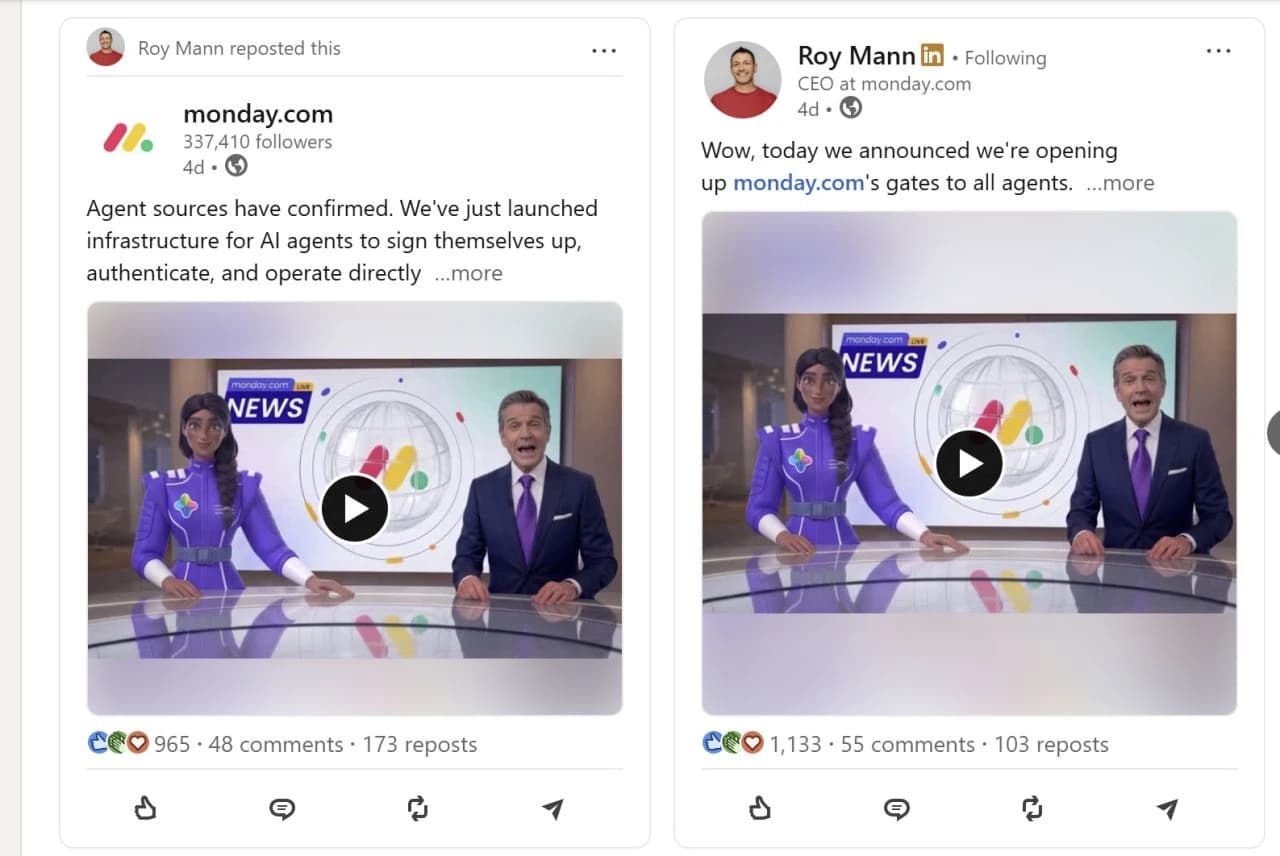
| Followers | Reactions | Comments | Reposts | |
|---|---|---|---|---|
| monday.com company page | 337,410 | 965 | 48 | 173 |
| Roy Mann, CEO | 5,166 | 1,133 | 55 | 103 |
With 65 times fewer followers, Roy got more reactions and more comments. The page got more reposts, which makes sense: the company page is the official source people share. This is a public example (monday.com is not a client of mine), and reactions are not reach. But it matches what I found when I checked 702 posts by five CEOs from LinkedIn Top Startups 2026: in all four cases where the same news went out on both channels, the CEO's post got more reactions and comments, even with a quarter of the page's followers.
Here is the full comparison:
| Personal profile (founder) | Company page | |
|---|---|---|
| Median impressions per post (AuthoredUp, 2026) | 1,006 | 659 |
| Network size (LinkedIn) | Employees together: about 10x the page's followers | Followers only |
| Click-through on the same content (LinkedIn) | 2x | Baseline |
| Share of LinkedIn citations in AI engines (Meltwater, 2026) | 75% | 25% |
| What it carries best | The thesis, people, lessons and big news | Product, customers, events, hiring and ads |
The conclusion is not to close the company page. It is a division of labor: the page is the official source, and the founder is the voice.
Founder-led marketing examples: what do top startup CEOs post?
In October 2026 I read 702 LinkedIn posts by five CEOs from the LinkedIn Top Startups Israel 2026 list: Bar Winkler (Wonderful), Rafael Broshi (Notch), Zohar Einy (Port), Yotam Segev (Cyera) and Shai Morag (Oak). Three things stood out:
- News gets the reactions, but news is rare. For all five, the top post was company news: a funding round, a launch or a record quarter. But only 19% of their posts are news.
- Ideas fill the rest of the feed. More than half of the posts are opinions, analysis, how-tos and lessons from the field. That is what builds the voice between announcements.
- Each CEO has a source of their own. One writes about decisions that come with a cost, another about problems customers discover only after they buy, a third writes in series. None of them sound alike.
That is the main lesson for anyone starting out: you don't need a funding round every month. You need a point of view, and a steady way to share it. The full analysis, with each CEO's top posts, is in the study of 702 CEO posts. How to find a point of view people wait for is in the guide to LinkedIn thought leadership.
How do you build a founder-led marketing strategy?
This is how I do it with the CEOs I work with. Before the first post there is a strategy, and without one I don't start:
- Understand the company. What it does, what hurts its customers, what they care about, what they need to know, and what is unique about the product or service.
- Understand the founder. What is their thesis about the market? What will they never do, and what will they? Why are they doing this at all? What is their personal story, and how did they get where they are today?
- Build the narrative. From those two, I build a narrative for the company and choose which stories to show the target audience: what the customer will want to hear, and what they won't.
- Choose four content pillars: three professional and one personal. The professional pillars are the areas the founder wants to be known for, for example the market thesis, technical depth and the quality of the work. The personal pillar is the story: how they got here, what they learned, what happened this week. Every month I make sure the posts are split correctly between the pillars.
- Upgrade the profile. The profile is the background check. It gets updated before the first post.
- Publish consistently, and show up in the feed. Two to three posts a week, plus smart comments on the posts of the people you want to know you.
One good idea can feed weeks of posts. If you want to work this way on your own, I described the method in the content waterfall: one idea, 28 pieces of content.
Founder-led video and podcast series: how do you run one?
You choose one recurring show with a fixed name, a fixed structure and a topic your buyers care about, publish it on a cadence you can keep, and cut every episode into LinkedIn clips, posts and an article. The show is the source. LinkedIn is where most of your buyers will actually meet it. A series gives people a reason to come back next week, and it gives the founder one recording session instead of a blank page every day.
Two public examples (neither is a client of mine). Harry Stebbings started The Twenty Minute VC podcast at 18, while studying law in London. By July 2020 it had about 80 million downloads, and when he raised his first fund, 20VC, about 64 of its investors were founders, executives and investors who had been on the show or knew him through it (TechCrunch, July 2020). Dave Gerhardt, founder of the B2B marketing community Exit Five, has published more than 400 episodes of The Exit Five Podcast, weekly (Apple Podcasts, November 2026). In both cases the show is the company's front door, and the founder is the host.
| Decision | What works | Why |
|---|---|---|
| Format | A video podcast (interviews or solo episodes), or a short video with the same name and structure every time | 51% of Americans 12+ have watched a podcast, and YouTube is the service weekly podcast listeners use most (Edison Research, 2025) |
| Cadence | Weekly or every two weeks, on a fixed day. Only what you can keep up for months | Of 3.8 million podcasts on Listen Notes, only about 15% published an episode in 2026 |
| Guests | The people you want to sell to, partner with or hire | Every recording is a conversation with someone you want to know |
| Reuse on LinkedIn | From each episode: short vertical clips with captions, two or three text posts from the strongest ideas, and one LinkedIn article from the transcript | In Google AI Overviews, 72% of LinkedIn citations are articles (OtterlyAI, 2026) |
| What to measure | Watch time, average watch time and who watched, then inbound leads and meetings | LinkedIn shows the job titles and companies of your video viewers once a video passes 25 impressions |
LinkedIn is pushing video. In early 2025 it reported video viewership up 36% year over year (TechCrunch, February 2025), and in its 2026 B2B Marketing Outlook, 81% of B2B CMOs said they believe video shortens sales cycles more than other formats (LinkedIn and YouGov, 1,299 B2B marketers). That is a belief, not a measurement, but it shows where attention is going.
The reuse is where most of the value is. One episode is exactly the kind of big idea the content waterfall starts from: the transcript becomes an article, the best answers become posts, and the sharpest moments become clips. Measure it like any founder-led marketing. LinkedIn video analytics show views (more than 2 seconds), watch time, average watch time, and the job titles, companies and locations of the viewers, for up to 400 days. Then look at inbound leads, replies and meetings, the same numbers I describe in how to measure founder-led marketing.
When is a series not worth it? When you can't keep the cadence: most shows stop, and a show that stopped is visible to everyone. When the founder doesn't enjoy the camera or the mic: consistent text posts do the same job for much less. And when nobody plans the distribution: a podcast that is never clipped and posted depends on people finding it in a podcast app. In my work I use every format: text, images, carousels, video to camera and in a studio, and articles. No single format always works. A series is a format, not a strategy. It still needs the narrative and the pillars above.
How much time does founder-led marketing take a CEO?
Less than most CEOs think, when someone else does the writing. Once I know a CEO, how they sound, what interests them and what the company does, it takes them no more than 20 to 40 minutes a week. In that time I hear what they want to talk about or what happened that week, and it includes approvals and feedback.
Sometimes there is some back and forth on WhatsApp. But most of the time it is a short call or voice notes they send me on WhatsApp, and I write the posts from them, by hand, in their voice. The CEO approves every post before it goes live. That is how I work in personal branding for CEOs.
The first weeks take more: the strategy, the narrative and the profile. Results take time too. In my experience it takes three to six months of consistent presence to get meaningful organic leads, so I ask clients to commit to at least 90 days.
What is the most common mistake founders make doing it alone?
They get stuck. They don't know what to write about, how to write consistently, or how much value to give. And sometimes they are afraid to share what they really think, so they write generic content, something everyone will be fine with.
Generic content is exactly what doesn't work. Nobody stops scrolling for a post any CEO in the industry could have written. What brings the right audience is the opposite: the real opinion, the story only you have, the lesson that cost you something. My job is to help founders do that consistently, bring out what is real and authentic in them, with better hooks and shorter, sharper posts.
What results can you expect? A case from my work
Today I do this with five CEOs. One example, without a name: a B2B CEO who started with about 1,000 followers. Within three months:
- From about 1,000 to 2,500 followers on LinkedIn.
- 100,000 impressions, 7% of them from the target audience. LinkedIn breaks down who saw your posts by job title, company and industry. 7% sounds small, but on LinkedIn it is a lot: most people who see any post are not your audience.
- Inbound requests to the CEO's own profile.
- Meetings with the ICP, which I booked through outreach.
That is the whole point. Not 100,000 views from irrelevant people, but the right decision-makers in the inbox.
Founder-led sales: when the CEO sells on LinkedIn
Founder-led sales is when the founder sells personally: they start the conversations, run the first calls and close the first customers. On LinkedIn it works best on top of founder-led content, because the prospect already knows the CEO from the feed: on my profile and my clients', 5% to 10% of cold messages turn into a sales call, depending on the market and the audience.
Marketing and sales here are two sides of the same profile. The posts make the founder familiar; the messages turn that familiarity into a meeting. This is how they differ:
| Founder-led marketing | Founder-led sales | |
|---|---|---|
| Who starts the conversation | The reader, after a post | The founder, with a personal message |
| What it looks like | Posts, comments, articles, video | Comments on the prospect's posts, a connection request, a personal message, a call |
| What you measure | Inbound leads, and who viewed and commented | Replies, sales calls and meetings booked |
| The CEO's time | A short weekly call or voice notes for the posts | Separate time for leads and outreach, sometimes with someone else at the company |
I tested it on myself first: in three months I met more than 100 CEOs, only from content and LinkedIn messages. The order matters. Before a message, I follow the prospect's posts and comment on them, so the name is familiar when the message arrives. Then one personal message, not a template.
Does the founder have to send every message? No, but the messages have to sound like them and come from their profile, because that is what makes founder-led sales work. In Velut's LinkedIn lead generation service, I write at least 100 personal messages a month from the CEO's profile, 5 new prospects every working day, manage every conversation and book the meetings into their calendar. How to do it yourself, step by step, is in the LinkedIn outreach guide.
How do you measure founder-led marketing?
Clients see the work as it happens, in real time. After three months, these are the numbers I review with them:
- Inbound leads: people who reached out after reading.
- Outbound leads: replies to personal messages. They go up when the prospect already knows the CEO from the feed.
- Meetings booked with the right people.
- Impressions, and who they came from. LinkedIn has a unique advantage here: you can see the job titles of the people who engaged with your content. That is how I check that every post brings the relevant ICP, not just numbers.
What I don't measure success by: likes. A post with 20 likes and three comments from the right decision-makers is worth more than a viral post with nobody you will ever sell to.
How does founder-led marketing affect AI search?
Founder-led marketing used to be only about the LinkedIn feed. In 2026 it is also about what ChatGPT, Gemini and Google's AI answers say about you. And AI engines cite people more than companies:
- According to Meltwater and LinkedIn, who analyzed 9.5 million AI citations, 75% of LinkedIn citations in AI engines come from content posted by individual members, and 25% from company pages.
- According to OtterlyAI, which analyzed 1.3 million LinkedIn citations in the first half of 2026, 92% went to named individuals rather than company pages, and in Google AI Overviews 72% were LinkedIn articles.
I see it on myself. My LinkedIn articles show up in Google search results and in AI answers. In a check on October 27, 2026, my LinkedIn article about Google AI Mode appeared above my own site's version for the same search. And it is not only articles: posts build the body of knowledge too. How to build it step by step is in the guide to getting ChatGPT to cite you.
When is founder-led marketing the wrong choice?
It is not for everyone. It doesn't fit founders who are afraid of exposure or don't want it, who don't feel like sharing every week what is happening to them, what they did and what is going on at the company. That is legitimate. But then someone else in the company should be the voice, or the company should invest in other channels.
It does fit people who like to talk and share, for whom it matters to share their real voice and talk about what interests them. It also takes patience: anyone who expects leads in the first week will be disappointed.
The bottom line
Building a unique, high-quality personal brand is part of a CEO's job. A CEO who doesn't do it gives up the huge reach other CEOs get, and those CEOs take the attention and the customers. If you want to do it without spending your week on it, that is exactly what I do in personal branding for CEOs: strategy, posts written by hand in your voice, and meetings with the right people.
Frequently asked questions
What is founder-led marketing?
Marketing where the founders become the company's main marketing channel: they write and share real content in their own voice, mostly on LinkedIn, and build the company's brand through it. The company page stays, but the founder is the main voice.
What is the difference between founder-led marketing and personal branding?
Personal branding is about the person and their reputation. Founder-led marketing uses the founder's voice for a business goal: awareness, trust and pipeline for the company. The content starts from the company's narrative, and only then picks the personal stories that serve it.
Does founder-led marketing work in B2B?
Yes. The median LinkedIn post from a personal profile gets 1,006 impressions against 659 for a company page (AuthoredUp, 2026), and 73% of decision-makers trust an organization's thought leadership more than its marketing materials (Edelman-LinkedIn, 2024).
What is founder-led sales?
The founder sells personally: they start the conversations, run the first calls and close the first customers. On LinkedIn it works best on top of founder-led content, because prospects already know the founder from the feed. On my profile and my clients', 5% to 10% of cold messages turn into a sales call.
Is it still founder-led if someone else writes the posts?
Yes, as long as the ideas, stories and opinions are the founder's. I write from calls and WhatsApp voice notes, by hand and in the founder's voice, and the founder approves every post. What doesn't work is generic content nobody at the company would actually say.
Is a video or podcast series a good format for founder-led marketing?
It can be, if the founder enjoys talking on camera, can keep a weekly or biweekly cadence, and every episode is cut into LinkedIn clips, posts and an article. Most shows stop: of 3.8 million podcasts on Listen Notes, only about 15% published an episode in 2026. If the cadence or the camera is a problem, consistent text posts do the same job for less.
How long does founder-led marketing take to show results?
It usually takes three to six months of consistent presence to get meaningful organic leads, so commit to at least 90 days. With one of the CEOs I work with, there were inbound requests and meetings with the ICP within three months.
Should we stop posting on the company page?
No. Split the work: the page is the official source for product, customers, events and hiring, and the founder is the voice of the thesis, the people and the lessons. Organic company page content is only about 2% of the feed (AuthoredUp), so the page alone is not enough.