
LinkedIn thought leadership for CEOs: what it is, examples, and how to build it

Published: · Updated: · 15 min read
Quick answer
Key takeaways
- Thought leadership is not just professional content. It is content that changes how the audience thinks, which is why they wait for it.
- 64% of B2B buyers spend more than an hour a week on this kind of content, and 41% said a C-suite executive encouraged them to consider a vendor because of it (Edelman-LinkedIn, 2025).
- In 156 posts by five CEOs from LinkedIn Top Startups, 52% were ideas and expertise. News got most of the reactions, but news is rare.
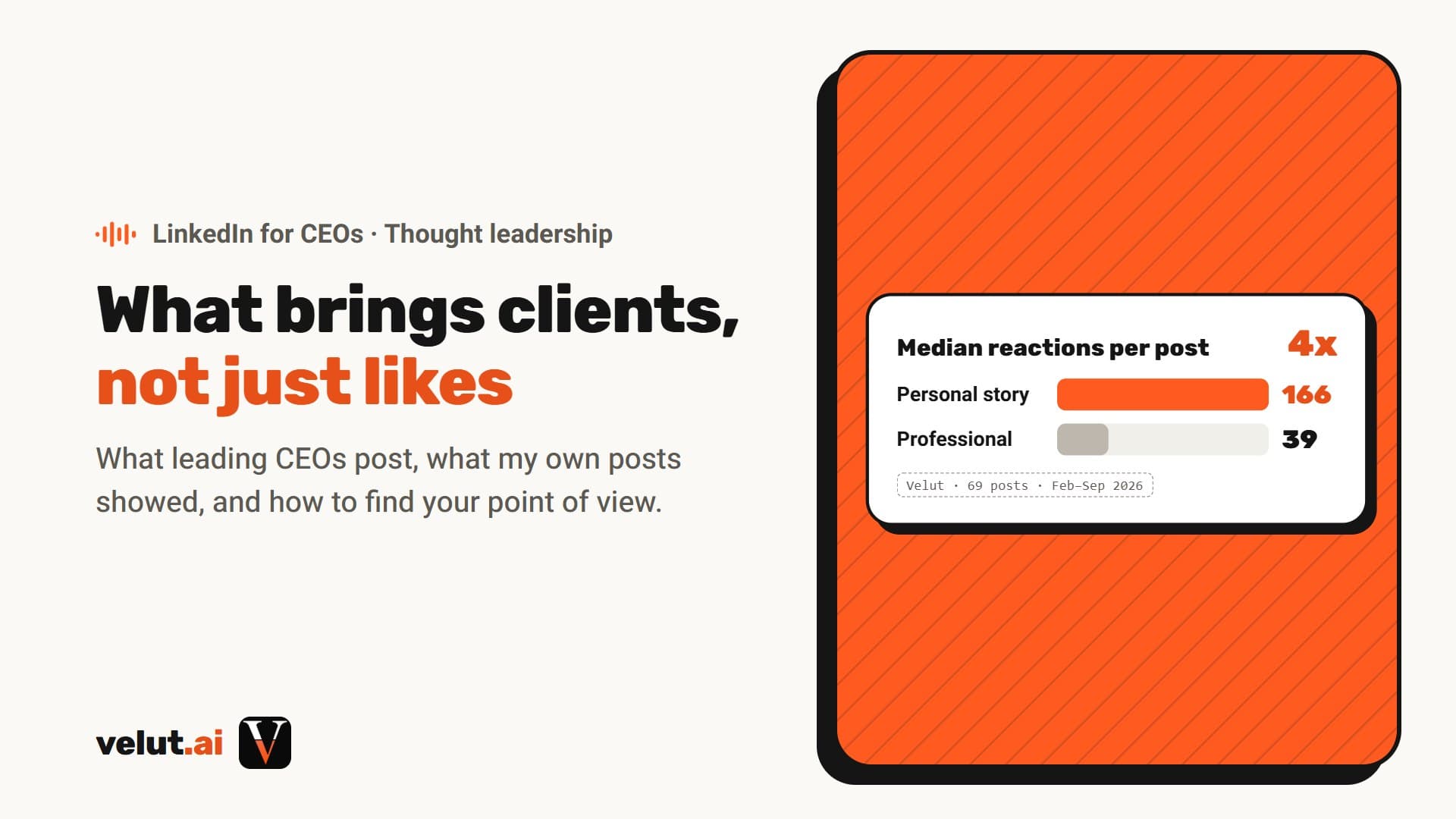
- In my own posts, a personal story got 4 times the reactions of a professional post. The story brings the audience; the expertise turns it into inbound.
- The most common mistake is self-censorship. And the line: go against a method, not a person, and never against your audience.
What is thought leadership on LinkedIn?
The Cambridge Dictionary defines thought leadership as "the activity of influencing other people with your ideas and opinions on a particular subject". LinkedIn frames it as a result rather than an activity: "the outcome of being a trusted and respected voice with a strong point of view". The term "thought leader" spread in business after 1994, when Joel Kurtzman, editor of strategy+business, described a thought leader as someone peers, customers and industry experts recognize as deeply understanding the business, its customers and the wider market.
My definition is simpler. Thought leadership is not just professional content. It is professional content people actually wait for, week after week, or post after post. Professional content answers a question. Thought leadership changes how the audience thinks about it, and that is why they come back. There is also a short definition in our glossary.
| Term | What it is | Main goal |
|---|---|---|
| Professional content / content marketing | Explains a topic or product, answers a question | Traffic and leads |
| Thought leadership | An original point of view from a named person that changes how the audience thinks | Trust and influence on decisions |
| Personal branding | How people perceive the person | Reputation and opportunities |
| Founder-led marketing | The founder is the company's marketing channel | Awareness and pipeline |
The differences matter because they change how you write. Personal branding can be a good photo and a sharp headline. Thought leadership requires an opinion. And founder-led marketing is where both work for the company: it has its own guide.
Why does a CEO's thought leadership matter in B2B?
Because it reaches people salespeople don't. Every year Edelman and LinkedIn survey executives on how thought leadership affects buying decisions. The 2025 report, based on 1,934 executives in the US, focused on "hidden buyers": people in the buying organization who influence the decision, for example in finance, procurement or legal, even if they won't use the product. What they found:
- They read. 64% of target buyers and 63% of hidden buyers spend more than an hour a week, on average, on thought leadership.
- They judge you by it. 56% of target buyers and 55% of hidden buyers use it to evaluate vendors.
- They are hard to reach otherwise. 71% of hidden buyers say they have little or no interaction with salespeople. And 95% of them say strong thought leadership makes them more receptive to sales and marketing outreach.
- They trust it more than your marketing. 65% of target buyers and 64% of hidden buyers trust an organization's thought leadership more than its marketing materials and product sheets.
- It travels up. 41% of target buyers and 35% of hidden buyers said a C-suite executive encouraged them to consider a vendor after engaging with its thought leadership.
Why the CEO in particular? Because people want to hear from a person. According to LinkedIn, 67% of decision-makers prefer thought leadership with the point of view of an identifiable author rather than a faceless brand. And in the feed, the median post from a personal profile gets 1,006 impressions against 659 for a company page (AuthoredUp, 2026). More than 40% of B2B deals stall because of misalignment within the buying group, and a good CEO post is one of the few ways to reach that whole group before there is a meeting.
Thought leadership examples: what do top CEOs post on LinkedIn? (702 posts)
In October 2026 I read 702 LinkedIn posts by five CEOs from the LinkedIn Top Startups Israel 2026 list: Bar Winkler (Wonderful), Rafael Broshi (Notch), Zohar Einy (Port), Yotam Segev (Cyera) and Shai Morag (Oak). I classified the 156 posts they published between March 16 and October 7, 2026 by hand, each by its main purpose:
| Post type | Share of posts | What it contains |
|---|---|---|
| Ideas and expertise | 52% | A stance on the market, analysis, a how-to, a lesson from the field |
| Events and media | 22% | A conference, panel, podcast or interview |
| Company news | 19% | A funding round, customer, launch or record quarter |
| People and team | 8% | Employee recognition, hiring, culture |
For all five, the post with the most reactions was company news: a funding round, a launch or a record quarter. At the median, a news post got 1.46 times that CEO's median, and an ideas post 0.94 times. But news is rare: 29 announcements in 7 months across five unusually fast-growing companies, less than one a month per company.
That is the lesson. Thought leadership is what fills the weeks between the news, and builds the voice that makes people read the news when it comes. And there is no single template. These are five thought leadership examples from the study, one per CEO, each from a different source:
| CEO | The source of the idea | An example post | What you can borrow |
|---|---|---|---|
| Bar Winkler (Wonderful) | A decision that has a cost | Most platform bets are really bets on switching costs, and Wonderful chose the opposite (June 2026) | Explain a choice your company already made, and what it gave up |
| Rafael Broshi (Notch) | The problem buyers discover after they buy | Most AI implementations in insurance don't reduce work, they relocate it, with a test for buyers (June 2026) | Start from friction your customers meet after the sale, and give them a way to check |
| Zohar Einy (Port) | A series, not a post | An experiment, and a week later a follow-up: how to build a context lake in four steps, with the numbers (July 2026) | Break one professional question into an experiment, a result and a how-to |
| Yotam Segev (Cyera) | Achievements belong to specific people | Announcing that the engineering leader will be recognized as a co-founder (March 2026, 1,336 reactions) | Turn a milestone into a story about who made it happen |
| Shai Morag (Oak) | Experience that explains the decision | Three acquired companies, one lesson, and why he is building a fourth (July 2026) | Use what you have already built to explain what you are building now |
None of these is a funding announcement, and none is a sales pitch. Each one gives the reader a way to think about the problem, in a voice that belongs to one person. The full analysis, with screenshots of each CEO's top posts, is in the study of 702 CEO posts.
What brings clients: personal posts or professional posts?
I ran the same check on my own posts. My profile export has 190 original posts from February 2024 to September 2026. Since February 2026 I have written mostly about LinkedIn for CEOs, and in that period I published 69 posts:
| Post type | Posts | Share | Median reactions | Median comments |
|---|---|---|---|---|
| Ideas and expertise | 36 | 52% | 39 | 17.5 |
| Humor and shares | 15 | 22% | 29 | 5 |
| Announcements and promotion | 8 | 12% | 15 | 4 |
| Personal story | 7 | 10% | 166 | 35 |
| People | 3 | 4% | 9 | 1 |
Without planning it, ideas make up 52% of my feed too, exactly as with the five CEOs. And for me too, they are not what gets reactions: a personal story got 4 times more at the median.
So what brings clients? Both, in a certain order. About half the people who reached out to me first came across me in a personal post that took off. But before they reached out, they consumed my professional content. The other half found me only through the professional content, and reached out after it. One post I wrote for a CEO got only 20 likes, but brought him 50,000 shekels within 8 hours.
This is how I work with CEOs: personal posts, about the story, the character, what makes them different and the hard parts, bring a big echo and a lot of people who are not necessarily the target audience. But they carry the professional posts to the target audience. That is why I build content on three professional pillars and one personal one, not on one of them alone.
How do you build a thought leadership strategy? (step by step)
Choose the audience you want to influence, find the point of view only you hold, turn it into three professional pillars and one personal one, and publish on a fixed rhythm for at least 90 days, measuring who reads you rather than how many like you. Protect the share of ideas: in the five Top Startups CEOs' feeds, and in mine, ideas and expertise make up 52% of the posts.
This is the order I follow with the CEOs I work with:
- Define who you want to influence. The ICP and the people around the decision: in the 2025 Edelman-LinkedIn report, 71% of hidden buyers have little or no interaction with salespeople, so the strategy has to reach them through content.
- Find your point of view. Start with the questions in the next section. The strongest one: what do people in your industry believe is true, but is actually a mistake?
- Set three professional pillars and one personal one. The professional pillars are what you want to be known for; the personal one is your story, which brings the audience to the professional posts. Every month, check that the posts are split between them.
- Plan the mix. Mostly ideas and expertise, personal stories now and then, and company news when there is news. Don't wait for news: across the five CEOs, it came less than once a month per company.
- Mix formats. Text, carousels, video and LinkedIn articles, because no single format wins every week (formats below).
- Set the line in advance. What you won't write: customer names you can't disclose, sensitive or internal information, and attacks on your audience or a named competitor (details below).
- Publish consistently for at least 90 days. In my experience, meaningful organic leads take three to six months of consistent presence.
- Measure the right things. Who viewed and commented, inbound messages, invitations and meetings, not likes (how to measure).
With someone writing for you, it takes most CEOs I work with 30 to 60 minutes a week: a call or WhatsApp voice notes, and I write the posts by hand, in their voice. If you are building this strategy for the company, not only for yourself, the founder-led marketing guide shows how the CEO's voice becomes the company's marketing channel.
How do you find your point of view?
Thought leadership starts with an opinion, and an opinion starts with questions. These are the questions I ask a CEO at the start, before the first post:
- What don't you do? What are you not willing to do, and who won't you work with?
- Who is the perfect customer, and who is a bad one?
- Why did you start the company? Why do you do what you do, and where do you want to get to?
- What do your competitors look like, and where are you better?
- What is your vision for the industry? What do you see that others don't?
- What do people in your industry believe is true, but is actually a mistake?
There are many more questions and exercises, but the goal is one: to get inside the CEO's head until I can write content that sounds like them. The last question is usually the strongest, because the answer to it is already thought leadership.
If you are doing this on your own: answer the questions in writing, without editing. Every answer is a post. And one good answer can feed weeks of content, as I described in the content waterfall: one idea, 28 pieces of content.
What separates a good thought leadership post from a bad one?
Very often, a bad post is simply a CEO censoring themselves. They try to stay on everyone's good side, to come across fine, and to share an opinion that isn't really theirs. When I go over a draft like that, I tell them: "here you're making it up" or "here you're not saying what you really think". You have to say what you actually think, with the hard parts, the good points, the downsides, the failures and the wins. Every post should come from your real opinion, not from what is politically correct.
B2B readers feel the difference. In the 2024 Edelman-LinkedIn report, based on 3,484 executives, only 48% said the quality of the thought leadership they read is good, and only 15% called it very good or excellent. In the 2025 report, they write that hidden buyers favor ideas that challenge assumptions, not content that just checks boxes.
| Good | Bad | |
|---|---|---|
| The opinion | Your real one, even if not everyone agrees | Whatever everyone will be fine with |
| The experience | Includes hard parts, downsides and failures | Only wins |
| The topic | Something only you could write | Something any CEO in the industry could write |
| The selling | The value is the post itself | The post is an ad for the product |
What should a CEO not write, even if it is their real opinion?
A real opinion doesn't mean writing everything. A CEO doesn't write things that will hurt them, or things they are not allowed to say. This is how I draw the line:
| Yes | No | |
|---|---|---|
| Customers | An insight from working with customers, without identifying details | A customer's name you can't disclose |
| Sensitive information | Write it once it is approved | For example, a security flaw you found that isn't fixed yet |
| Your audience | Their pain, and what they are missing | Going against them. A company that sells to CFOs doesn't write that all CFOs get it wrong |
| Competitors | Going against a method: "some people sell to CFOs without understanding their pain", and explaining what you do differently | Naming a competitor, or claiming they can't do their job |
| Numbers | What you are allowed to publish | The company's internal numbers |
The rule in short: go against a method, not a person. And against those who sell to your audience without understanding it, never against the audience itself.
Which format should you use for thought leadership on LinkedIn?
No single format works best, so every CEO needs a bit of everything. Nobody knows what will work this week: there are periods when text works best, and periods for images, carousels or video. The audience differs too: some want video, some want value in a carousel, and some want an interesting article. What matters is that people see your point of view in different forms:
- Text, with a small image. The easiest way to share an opinion or a personal story, without ten takes in front of a camera.
- Carousel. Every swipe is a few more seconds of reading, and time spent on a post is a signal the algorithm measures. According to AuthoredUp, a carousel gets 1.39 times the median reach of a personal profile. The details are in the LinkedIn algorithm guide.
- Video. Sometimes just talking to the camera, sometimes a quality studio video. In video people see the person, not only the idea.
- LinkedIn article. Very important, because articles are what AI models cite. According to LinkedIn's guide, articles account for about 60% of content citations from the platform and posts for about 40% (details here).
In every format, the same condition: something different, a personal point of view and real value, or a real story that connects people to you as a person. What makes a CEO's thought leadership unique is that people connect not only to the value they give, but also to their personality and their life story.
And there is a search bonus. My LinkedIn articles show up in Google and in AI answers faster than the same content on my own site, because LinkedIn and a personal profile carry a lot of authority, and their posts get more reach and traffic. According to Meltwater and LinkedIn, 75% of LinkedIn citations in AI engines come from individuals and 25% from company pages. I published our screenshots and numbers in our SEO and GEO case study.
What is a LinkedIn Top Voice, and do you need the blue badge?
Top Voices is the program in which LinkedIn officially marks thought leaders. Members get a blue badge on their profile. According to LinkedIn's help page:
- You can't apply; you get invited. LinkedIn's editorial team reviews content and chooses. You can nominate yourself or others through LinkedIn's official nomination form, and LinkedIn reviews nominations every quarter.
- The badge is reviewed twice a year. Members stay for at least six months, and keep it as long as they meet the requirements.
- What LinkedIn looks at: consistent presence, quality and originality ("a distinctive voice and unique perspectives"), subject matter expertise, professionalism under the community policies, and prominence in a market or industry.
- What rules you out: members who primarily or exclusively promote paid services are not considered.
The gold badge, Community Top Voice, which members earned automatically by contributing to collaborative articles, was retired in October 2024. The blue badge remains.
How do you nominate someone for LinkedIn Top Voice?
Through LinkedIn's Top Voice nomination form, linked from the program's help page. You can nominate yourself, a colleague, or someone whose voice you admire. What the form asks for:
- The nominee's name and profile link, and their industry or area of expertise.
- A region. The list covers North America, the UK, India, Latin America, several European countries, and Europe (English) and Asia (English). Israel is not listed on its own.
- Why they should be a Top Voice: examples of their impact and thought leadership, up to 300 words.
- One or two posts from the past month that best show their work.
- What makes their contributions impactful: consistent presence, quality and originality, subject matter expertise, or prominence in their industry.
Three things to know before you send it: according to the form, a nomination doesn't guarantee selection, several nominations for the same person don't raise the odds, and you can nominate yourself once every six months. And since it asks for posts from the past month, send it after a strong month, not a quiet week.
The badge is a nice confirmation, but it is not the goal. The real signs that a CEO is seen as a thought leader come before it: people start quoting them, reposting their posts with "listen to what this person says", and inviting them to speak as an expert.
How long does it take to become a thought leader?
It takes time, and there is no shortcut. In my experience it takes three to six months of consistent presence to get meaningful organic leads, so I ask CEOs to commit to at least 90 days. For most of the CEOs I work with, it takes 30 to 60 minutes a week: a call or WhatsApp voice notes, and I write the posts from them, by hand, in their voice.
You can shorten the way to your audience with paid promotion (more on that next), but you can't shorten the way to trust. Trust is built post by post, as the audience finds out again and again that you have something to say.
Can you promote thought leadership with paid ads?
Yes, and today there are two ways:
- Boosting a personal post. LinkedIn lets you boost a post straight from your personal profile, without a company page. According to LinkedIn, members who boosted their personal posts "grew followers up to 2x faster". That is LinkedIn's own claim, with no published methodology.
- Thought Leader Ads. The company sponsors a post by the CEO or an employee, with their permission, from Campaign Manager, and the ad keeps their name and words. Since March 2024, companies can also sponsor posts by people who don't work there.
I don't run paid promotion yet, and I get high reach from my personal profile. But I see it as the next step. Without promotion, it takes one, two or three months until LinkedIn learns who the right audience is and starts showing them your posts. With promotion, you tell LinkedIn who the audience is from day one. What matters is to promote a post that already works without paying. Money amplifies a good post; it doesn't rescue a weak one.
Can you write thought leadership with AI or a ghostwriter?
Not with AI alone. According to Originality.ai, by July 2026 81.2% of 5,000 long-form LinkedIn posts were classified as likely AI. Thought leadership is the opposite: a point of view nobody else has. A language model can phrase things, but it can't know what the CEO thinks their industry gets wrong.
With a ghostwriter, yes, as long as the ideas, stories and opinions are the CEO's. For my managed clients I write by hand: I ask, listen, write in their voice, and the CEO approves every post. When each option is right is in ghostwriter vs AI vs writing it yourself.
How do you measure thought leadership?
Not by likes. These are the metrics I check:
- Who viewed. LinkedIn shows the job titles, companies and industries of the people who viewed your posts. Check that your target audience is there.
- Who commented. Three comments from the right decision-makers are worth more than a hundred likes.
- Inbound messages. People who write "I follow your posts" before they ask for a call.
- Quotes and invitations. Reposts with a recommendation, invitations to panels and podcasts as an expert.
- Meetings. In the end, this is the number that matters.
The bottom line
Thought leadership is not one more professional post a week. It is the voice your audience waits for: a real opinion, real experience, and enough of your personal story that they want to hear it from you. The company's news will come every few months. What you write in the weeks between decides whether anyone reads it. If you want to build this without spending your week on it, that is exactly what I do in personal branding for CEOs.
Frequently asked questions
What is thought leadership on LinkedIn?
Professional content with an original point of view, from a named person, that their audience waits for from one post to the next. On LinkedIn it is usually posts, carousels, videos and articles by the CEO or the company's experts, from their own profiles.
What is the difference between thought leadership and content marketing?
Content marketing explains a topic or product and answers a question. Thought leadership brings an original point of view that changes how the audience thinks about the question. According to Edelman and LinkedIn (2025), 65% of B2B buyers trust an organization's thought leadership more than its marketing materials.
What is the difference between thought leadership and personal branding?
Personal branding is how people perceive you. Thought leadership is one of the strongest tools for building that perception, and it requires an opinion, not just presence. You can build a personal brand without thought leadership, but it will be shallow.
How do you become a thought leader on LinkedIn?
Find a point of view (for example: what people in your industry believe is true but is a mistake), write it without self-censorship, mix professional posts with personal stories, and publish consistently for months. In my experience, meaningful organic leads come after three to six months.
How do you build a thought leadership strategy?
Choose the audience you want to influence, find a point of view only you hold, set three professional content pillars and one personal one, mix formats, decide in advance what you won't write, and publish consistently for at least 90 days. Measure who views, comments and reaches out, not likes.
How do you get the LinkedIn Top Voice badge?
You can't apply. Top Voices is an invite-only program run by LinkedIn's editorial team, and the badge is reviewed twice a year. You can nominate yourself, once every six months, through LinkedIn's nomination form, with one or two posts from the past month. LinkedIn looks at consistency, originality, expertise and professionalism, and members who mainly promote paid services are not considered.
What are LinkedIn Thought Leader Ads?
An ad format in which a company sponsors a person's post, for example the CEO's, with their permission, and the ad keeps their name and words. Since March 2024 companies can also sponsor posts by people who don't work there. It is best to promote a post that already works organically.