
The content waterfall: how to turn one idea into 28 pieces of content in one working week

Published: · Updated: · 7 min read
Quick answer
Why do most CEOs start every post from zero?
If I were a CEO with 30 free minutes a day for LinkedIn, this is the first thing I would stop doing: waiting for inspiration. Most people treat LinkedIn like a daily chore. They get up, stare at the keyboard, try to invent something unique from scratch, and end up with nothing.
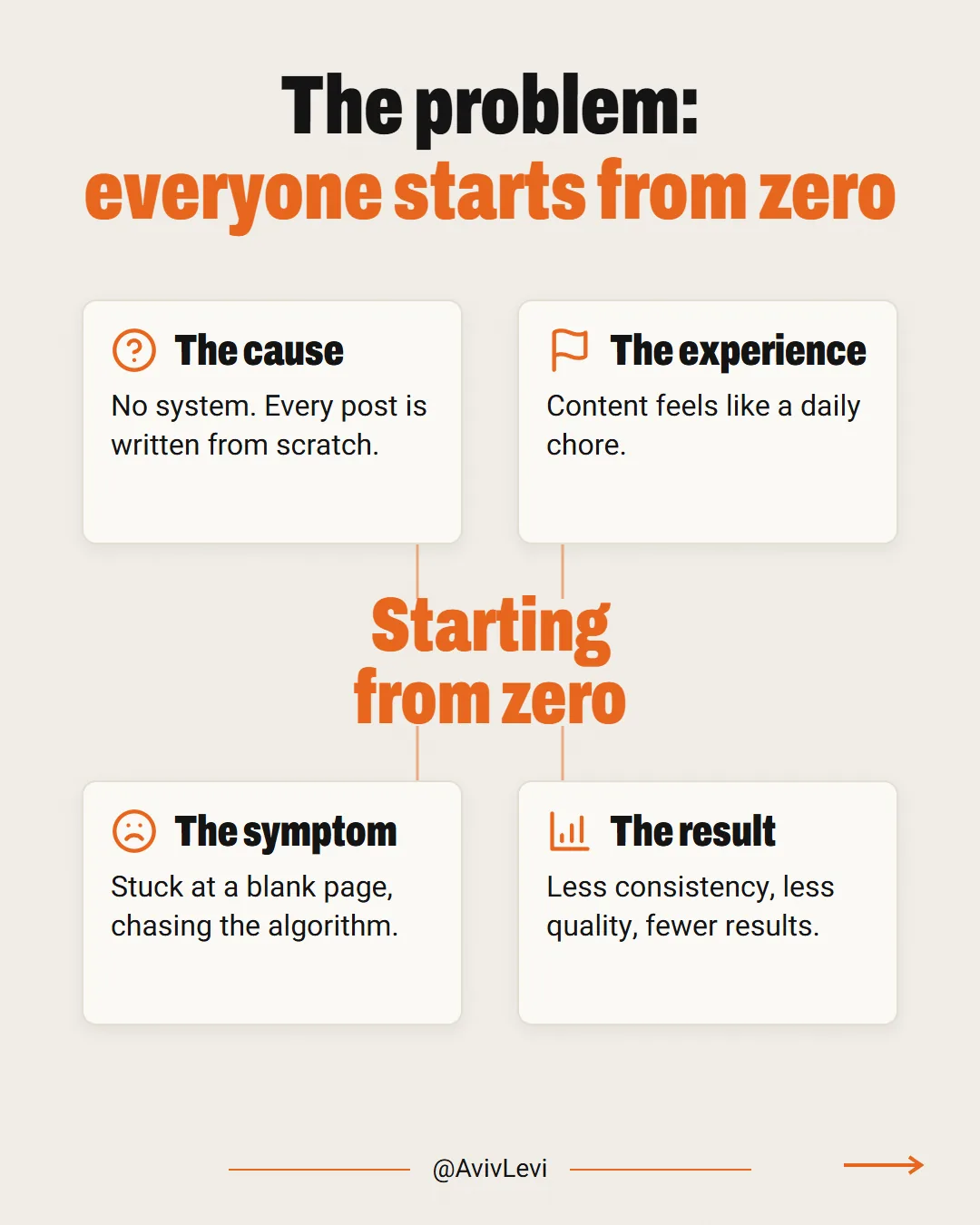
- The cause: there is no system, so every post is written from scratch.
- The experience: content feels like a daily chore, and you get stuck at a blank page.
- The result: less consistency, less quality and fewer results. Weak messages that don't move your audience.
Starting from zero every day is draining, and it doesn't last. And consistency is exactly what both the algorithm and buyers reward: a B2B buyer needs to meet you many times, from different angles, before they buy. The CEOs who get results on LinkedIn don't wait for the muse. They work with a system.
What is a content waterfall?
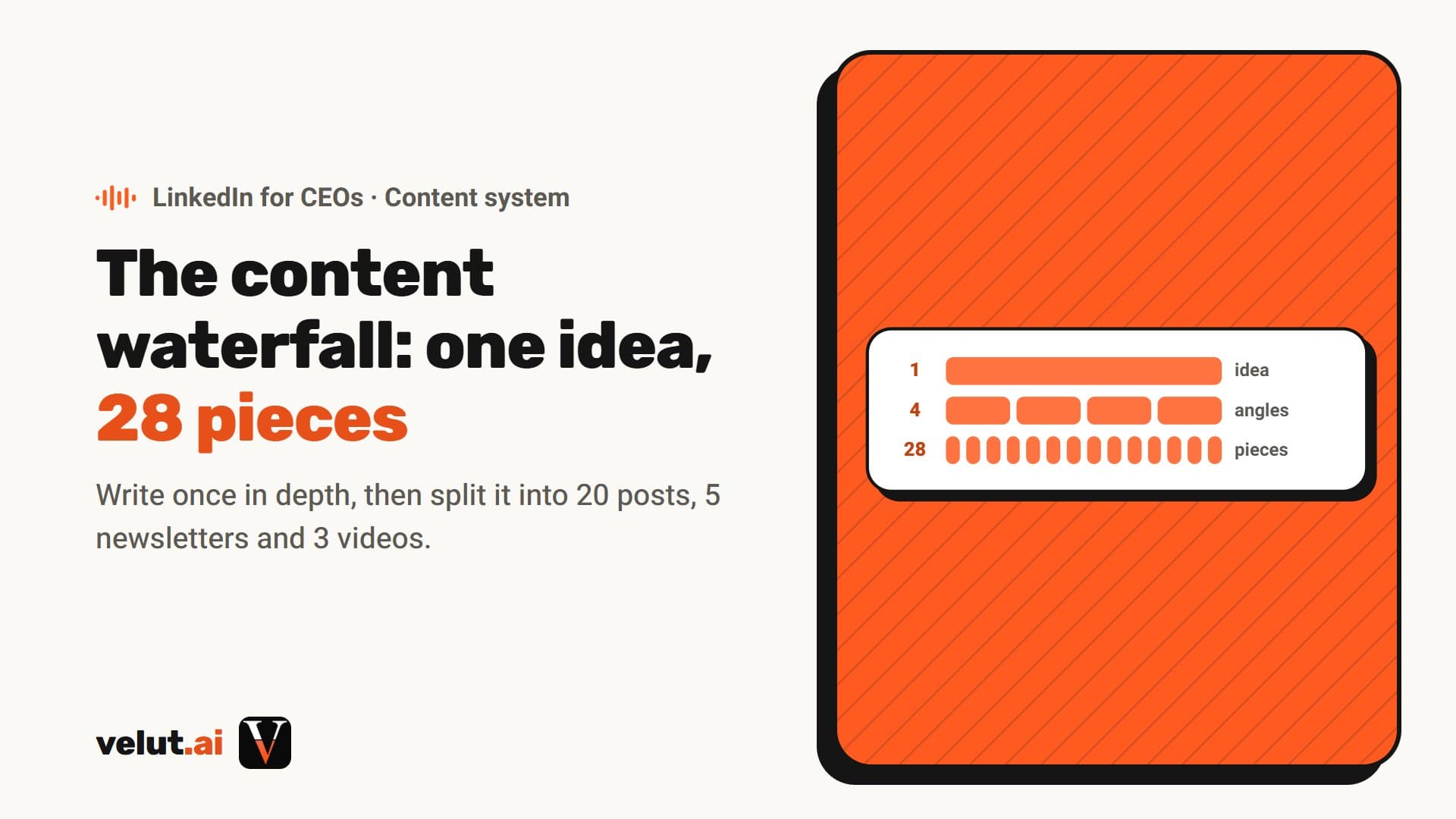
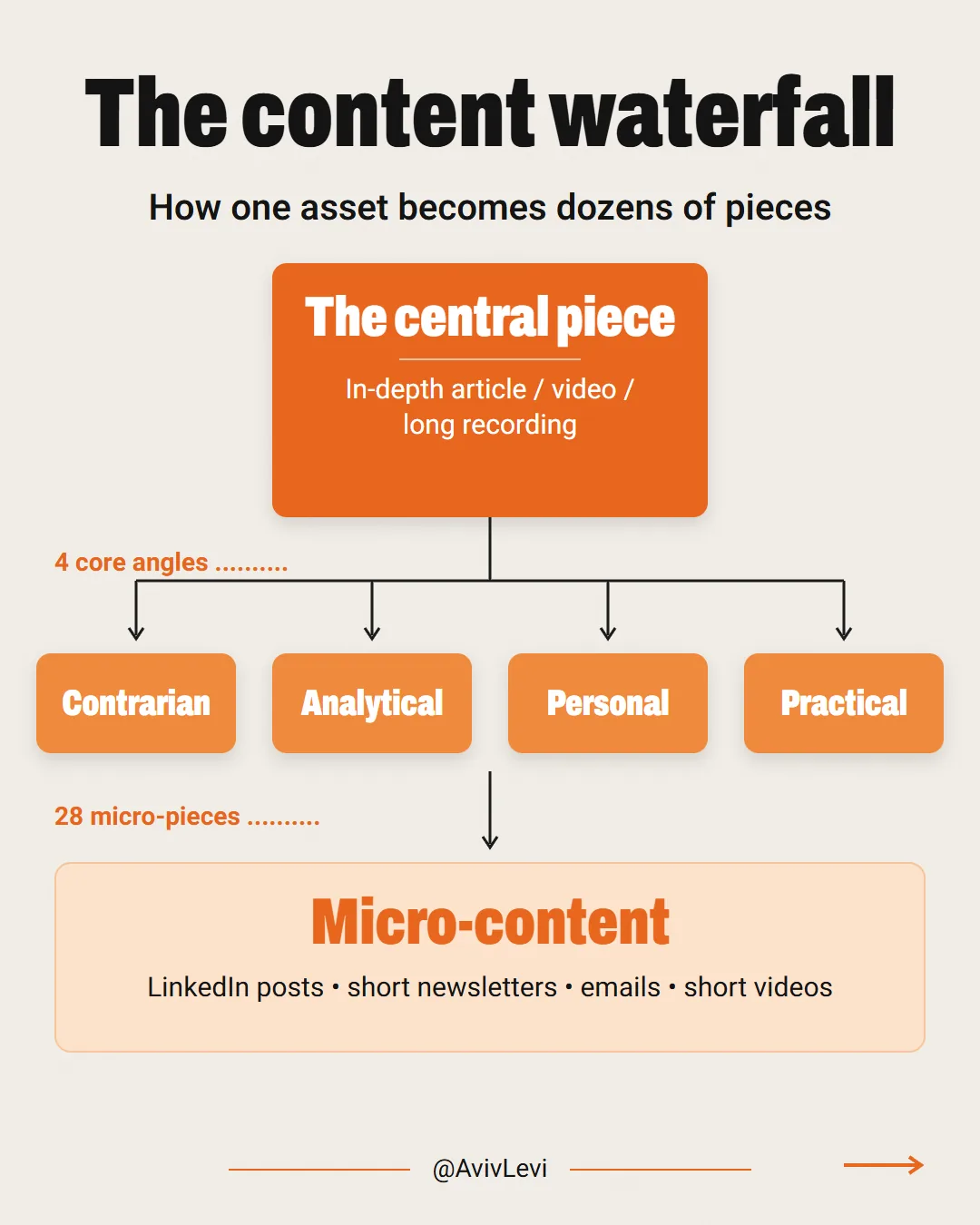
A content waterfall is a system where one content asset flows down into dozens of smaller pieces. At the top is a central piece: an in-depth article, a long video or a recorded conversation. Below it, four core angles. At the bottom, 28 micro-pieces: LinkedIn posts, newsletters and short videos.
It isn't "recycling" content. Each angle hits a different pain for the reader, and each platform gets what works on it. It also helps in the age of AI search: the central article is the asset models cite, and the posts spread it. I wrote about how the two work together in the guide on how to get ChatGPT to cite you, and what happened when we did it on our own site, with the numbers, in our SEO and GEO case study.
Step 1: write the central piece
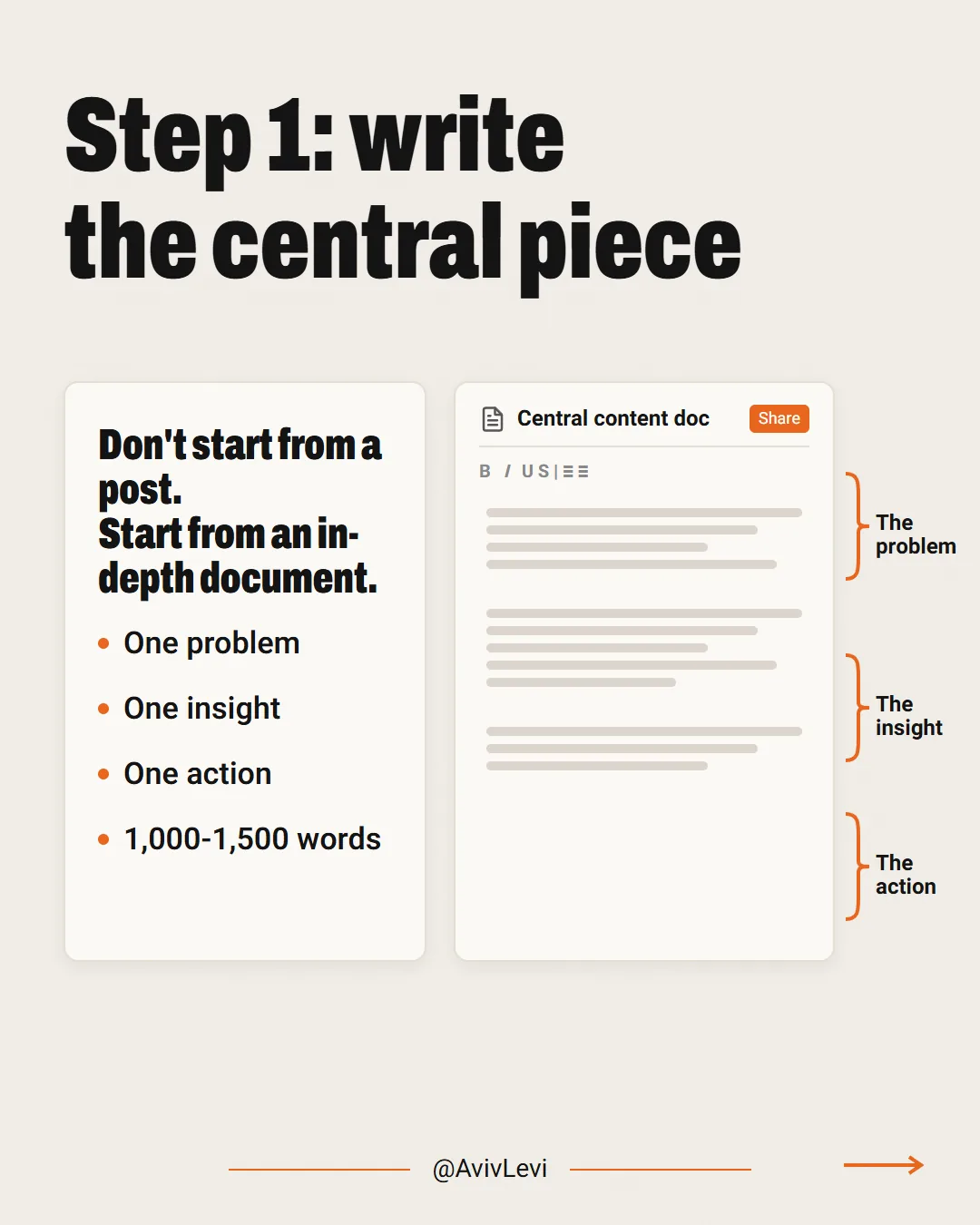
Don't start from a post. Start from one in-depth document, and everything after it comes from it:
- One problem your audience has right now.
- One insight that is deep and true, something you understand better than anyone.
- One action the reader can take when they finish.
- 1,000 to 1,500 words, or a video of at least 20 minutes if talking is easier for you than writing.
A tip if you have no time to write: start by talking. A 45-minute recorded conversation, or voice notes, brings up the raw material: the breakdown of a deal you won, a strategy that doubled your pipeline, a mistake the whole industry makes that only you see. That is also how I work with my managed clients: they drop an idea in a voice note or in our sync, and I write from it by hand, in their voice.
Step 2: turn one idea into four angles
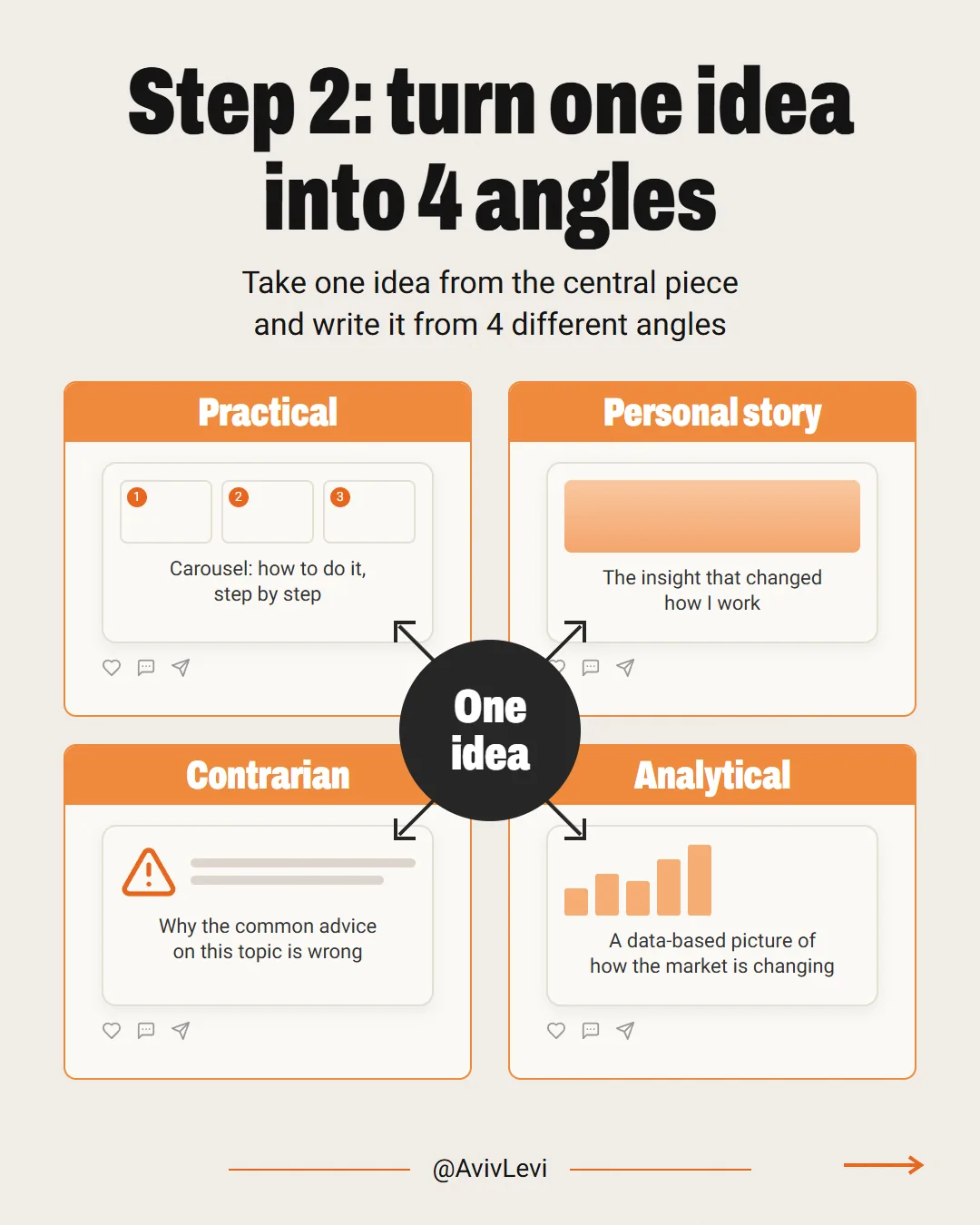
Don't invent new topics. Take the central idea and write it from four different angles:
- Practical: a step-by-step "how to do it" guide. It works especially well as a carousel.
- Personal story: the insight that made you change how you work.
- Analytical: the data and the mechanism behind the scenes, a data-based picture of how the market is changing.
- Contrarian: why the common advice on this topic is simply wrong.
These four angles work because each one speaks to a different reader. Someone looking for tools stops at the practical one, someone who connects with people stops at the story, and someone who has to convince their leadership stops at the data.
Step 3: adapt it for every platform
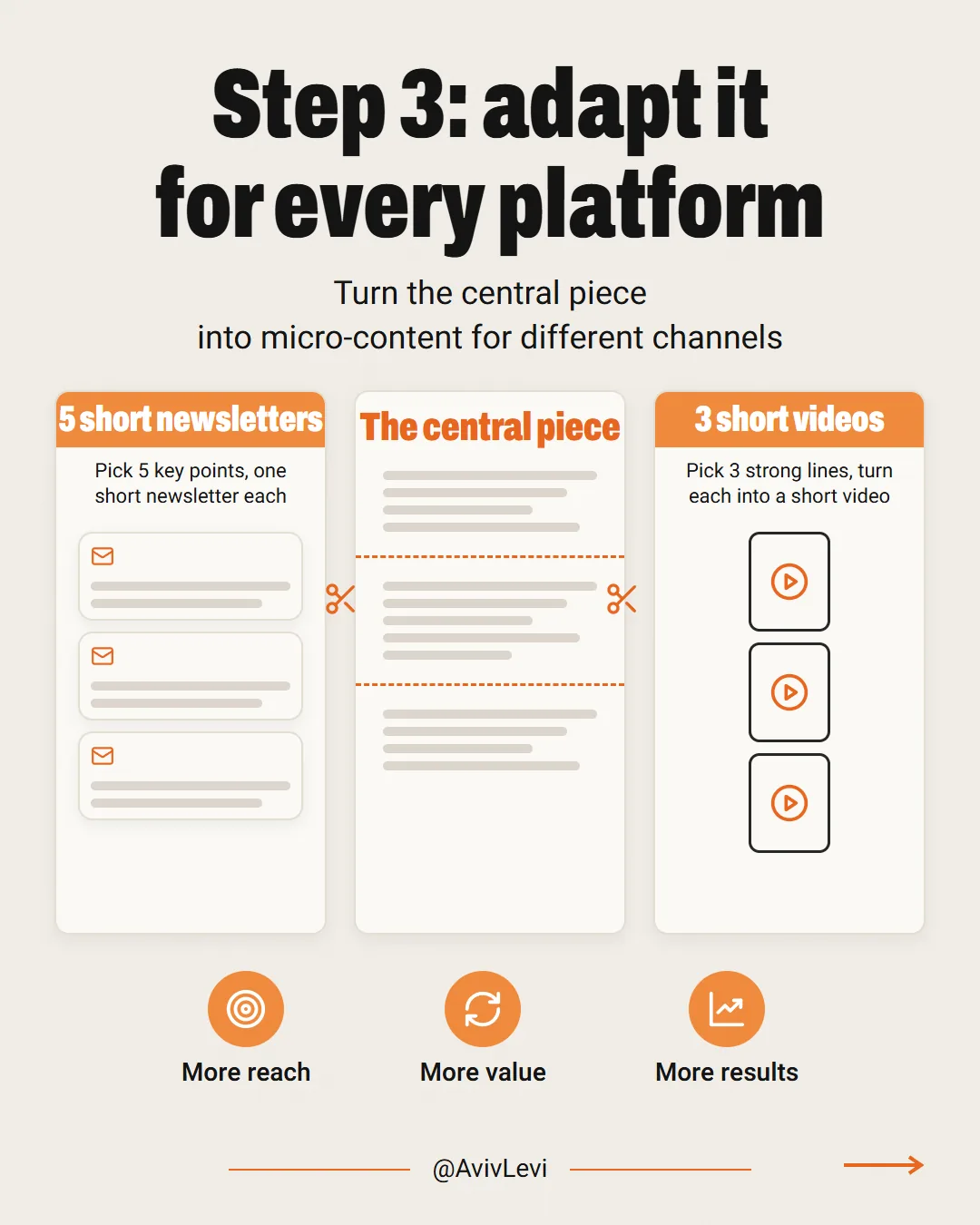
Now break the central piece and its four angles into micro-pieces:
| Asset | How many | How |
|---|---|---|
| LinkedIn posts | 20 | Each angle breaks into several posts, and each post handles one idea only |
| Newsletters | 5 | Pick five key points, one short newsletter each |
| Short videos | 3 | Pick three strong lines and turn each into a short video |
You can keep going: each video can become a carousel, and each carousel several long posts. One idea, 28 assets. It is still work, but it is much easier once the substance exists.
What it looks like in one working week
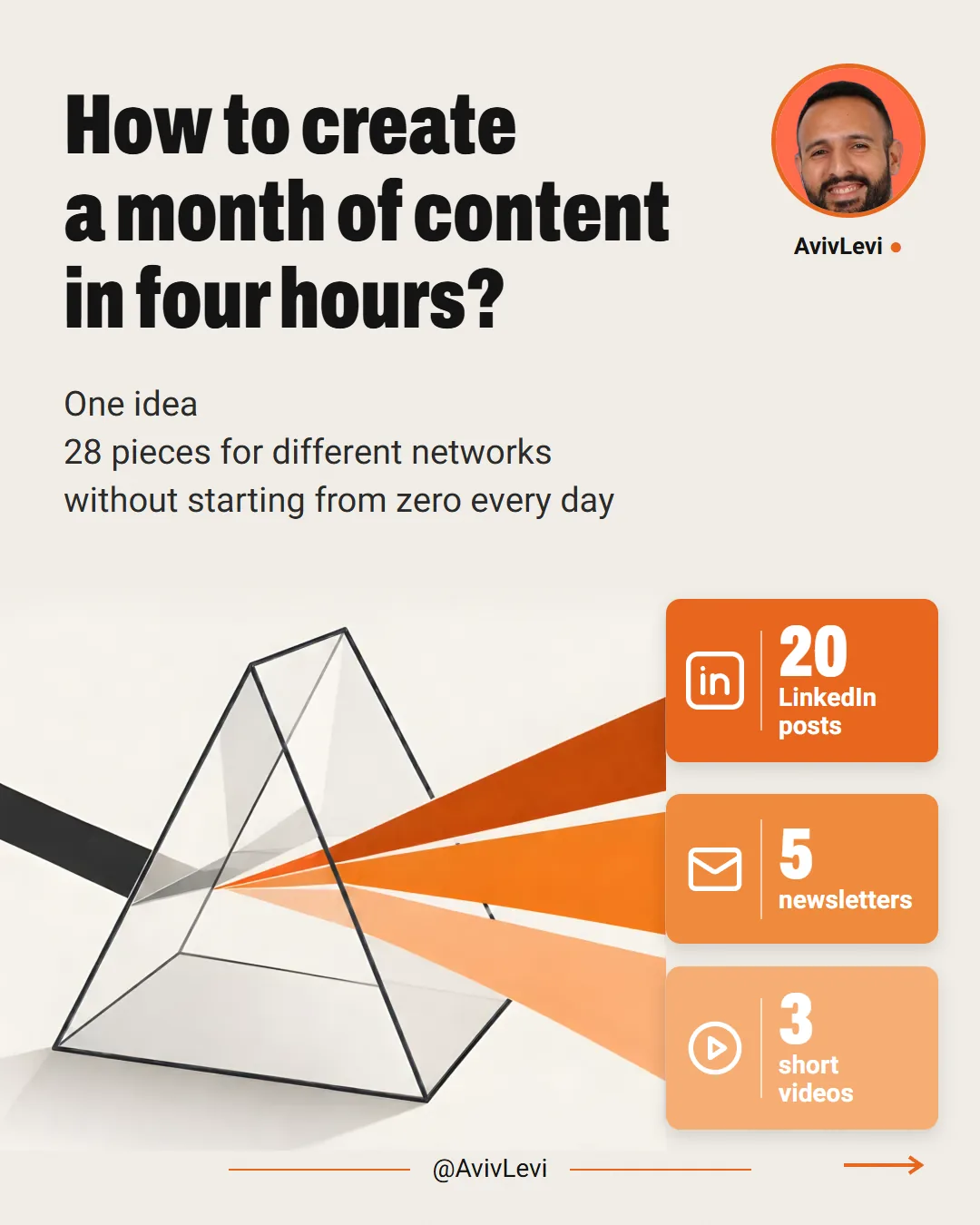
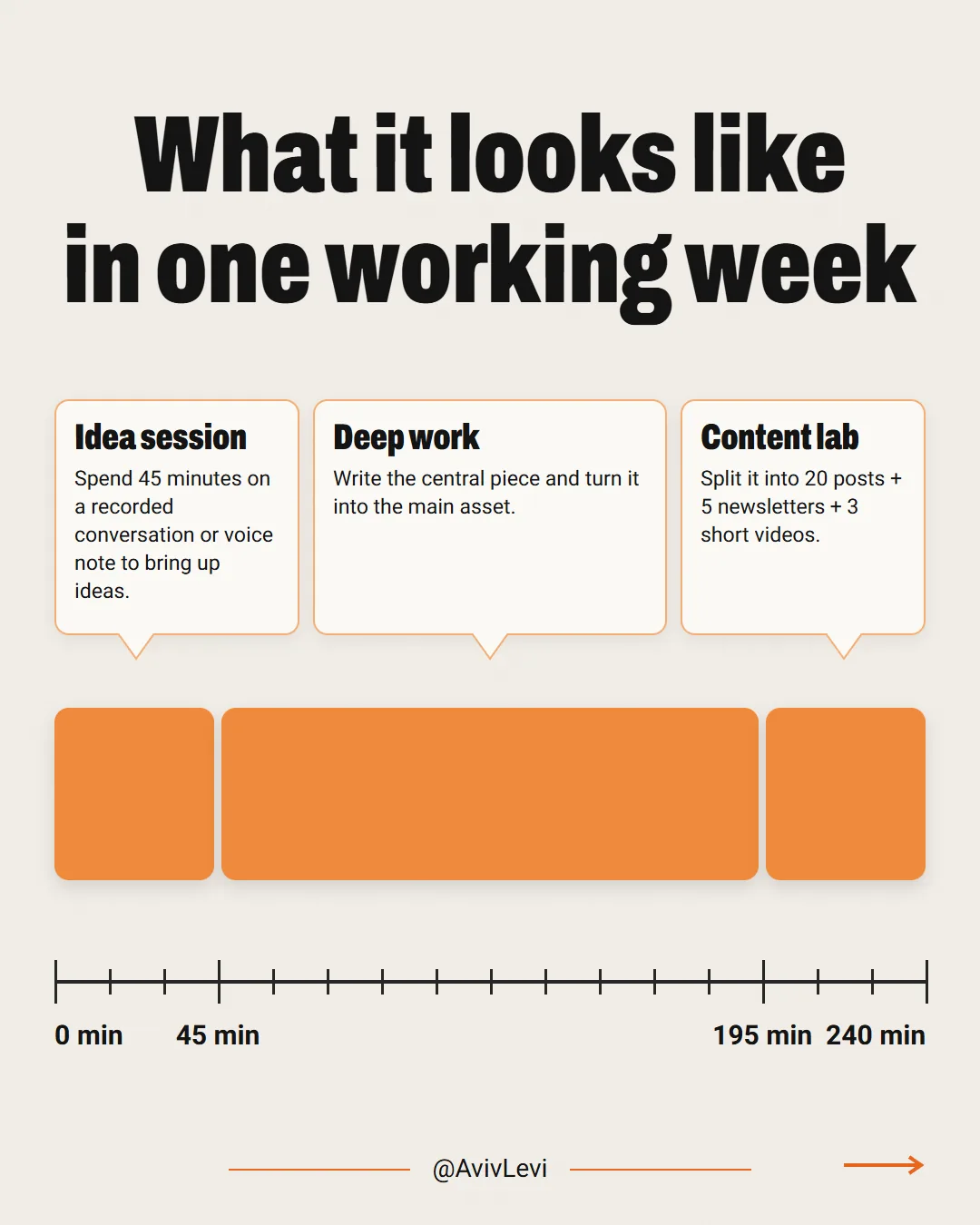
In the carousel I broke it into three time blocks, about four hours in total:
- 45 minutes: a recorded conversation or voice recording to bring up ideas. The raw material.
- About two and a half hours: deep work. Write the central piece and turn it into the main asset.
- 45 minutes: the content lab. Split it into 20 posts, 5 newsletters and 3 short videos.
And to be honest: those last 45 minutes are the split, meaning the list of ideas and an outline of each. Fully writing 20 posts is extra work. That is where CEOs usually hand it to their team, or to me.
Do you need to publish all 28 in a month?
No. The 28 pieces are a bank, not a publishing calendar. According to AuthoredUp, four to five posts a week give the highest engagement rate, and above eight a week both engagement and reach per post drop sharply. For the CEOs I write for it is two to three posts a week. So 20 posts from one central idea last seven to ten weeks.
That is the big advantage of a content bank: when life happens, a busy week, a crisis or a holiday, the system keeps working. And if you disappear for a few weeks, you feel it in your reach. I saw it on my own profile in August 2026, after two weeks without posting regularly. I cover the right pace and what else drives reach in the LinkedIn algorithm guide.
The mistakes that ruin the waterfall
- Uploading a transcript and calling it a post. A video transcript is raw material, not a post. Every post needs an opening, one idea and an ending.
- Twenty-eight versions of the same sentence. If every post says the same thing, readers scroll past. Each angle has to hit a different pain.
- Starting from shallow posts. Without depth at the top of the waterfall, there is nothing to break down. Dig into one real problem.
- Copying the same text to every platform. A newsletter, a post and a short video are three different formats. Adapt.
- Splitting without a strategy. If the central idea doesn't sit on one of your content pillars and on what matters to your buyer, you get 28 pieces that move nothing. Three questions before you start.
The cycle: how the waterfall keeps working
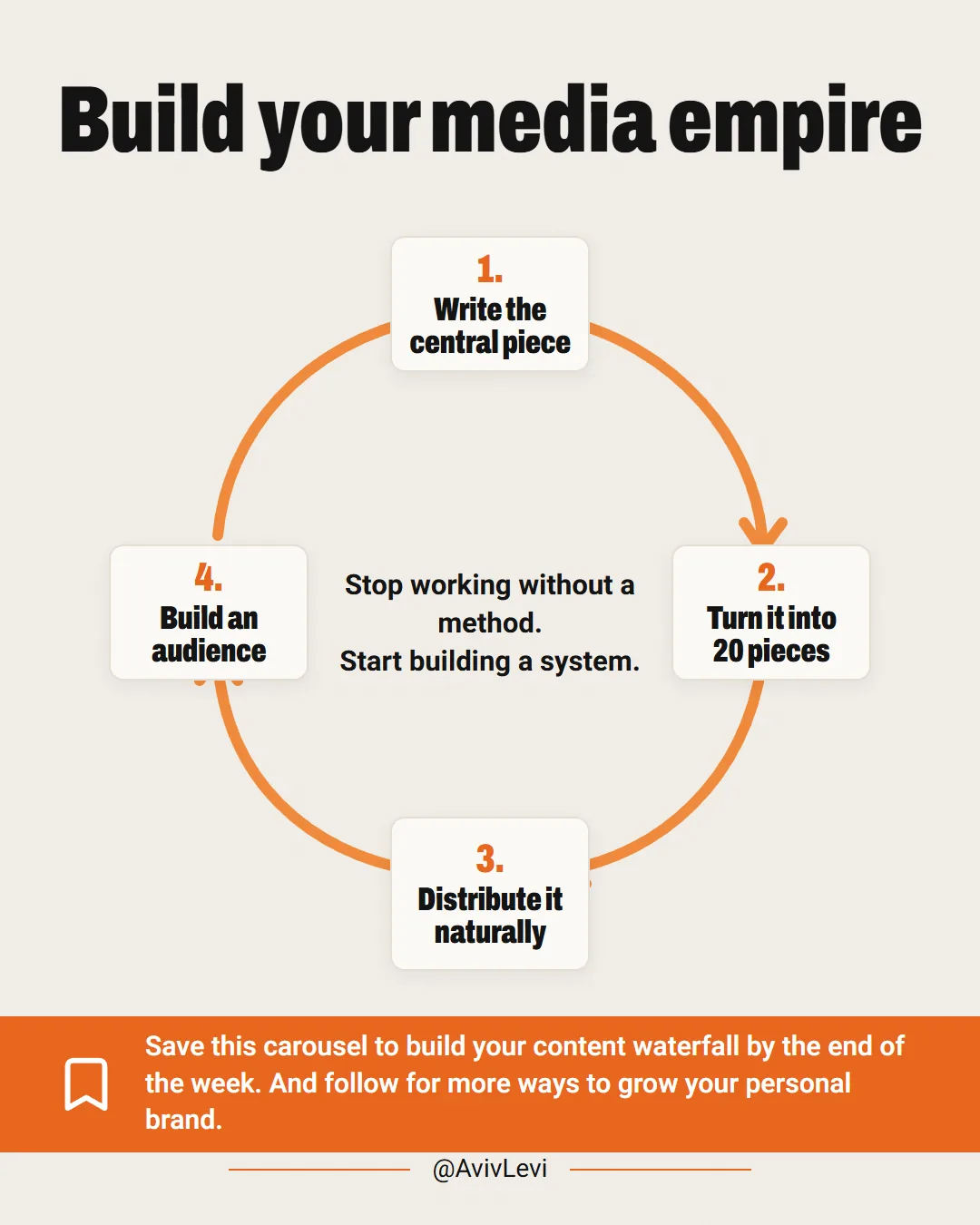
A content waterfall isn't a one-off project. It is a cycle: write the central piece, turn it into 20 pieces, distribute them naturally, and build an audience. Then check which angles started comments and conversations, and feed what you learned into the next central idea. Stop working without a method. Start building a system that works for you.
The bottom line
You are a CEO, not a full-time influencer. You don't need to invent content from scratch every 24 hours. You need one good idea a week or a month, an hour of conversation, and a system that turns it into many touchpoints with the right audience. And if you don't have time even for that, that is exactly what LinkedIn ghostwriting does: writing in your voice, on a fixed calendar, after a strategy. When to write it yourself, when an AI tool is enough and when you need a ghostwriter, I compared in ghostwriter vs AI vs writing it yourself.
Frequently asked questions
What is a content waterfall?
A method where you create one central piece in depth, an article or a long video, and break it into different angles and formats: posts, newsletters and short videos. Write once, distribute many times.
How many pieces of content can you get from one article?
In my method, 28: 20 LinkedIn posts, 5 newsletters and 3 short videos. It isn't a fixed number, just what usually comes out of a 1,000 to 1,500 word asset written from four angles.
How long does a content waterfall take?
About four hours of focused work: 45 minutes of recorded conversation, about two and a half hours writing the central piece and 45 minutes splitting it. Fully writing each post is extra work.
What is the difference between a content waterfall and content repurposing?
Repurposing takes existing content and publishes it again. A content waterfall is planned up front: the central asset is written to be broken into angles, and each angle hits a different reader pain and is adapted to its platform.
How many times a week should you post on LinkedIn?
According to AuthoredUp, four to five posts a week give the highest engagement rate, and it drops above eight. For CEOs I recommend two to three posts a week, a pace you can keep up over time.