
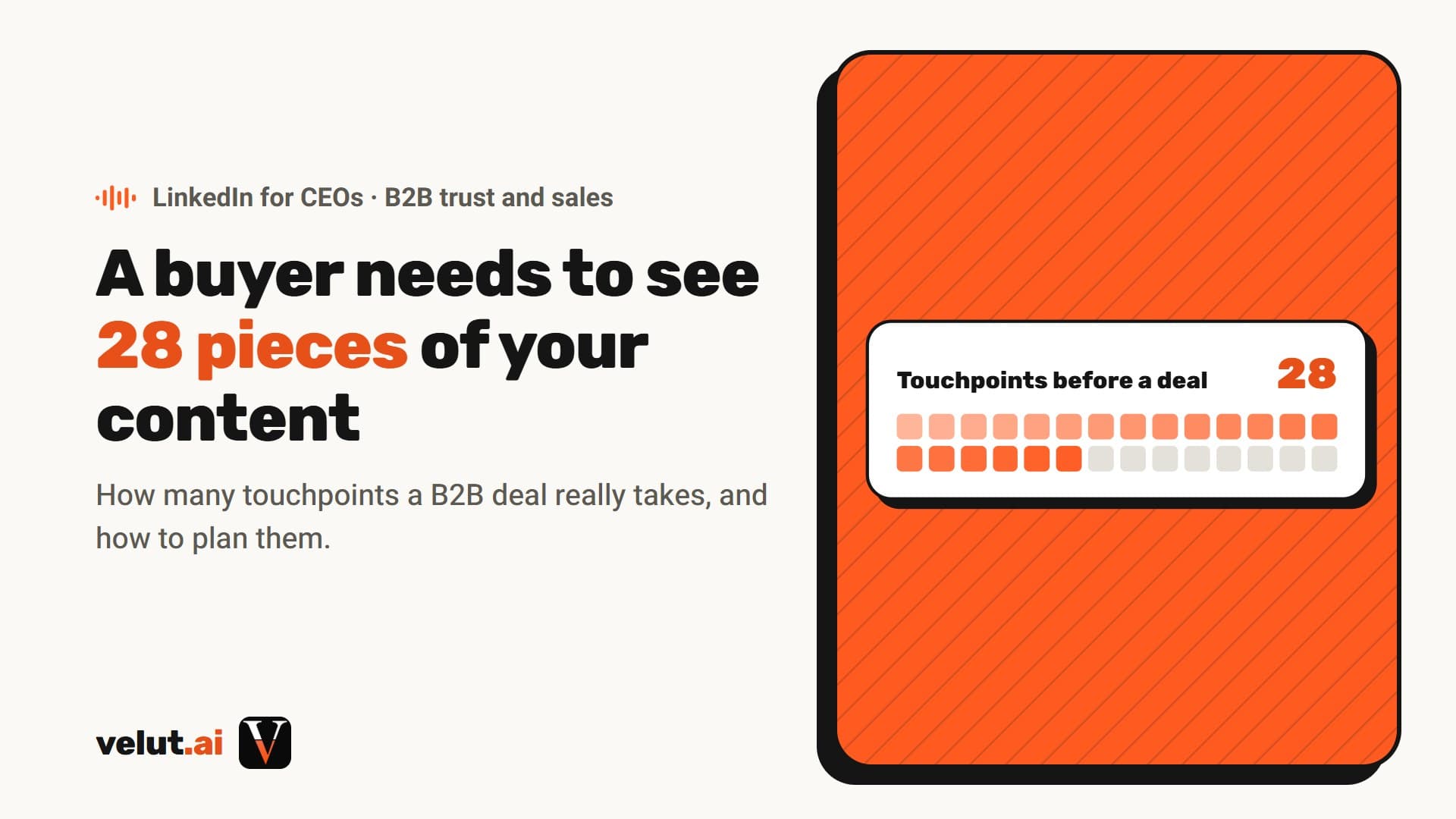
Does a buyer need to see 28 pieces of your content? How many touchpoints a B2B deal really takes

Published: · Updated: · 11 min read
Quick answer
What is the "rule of 7", and why isn't it enough anymore?
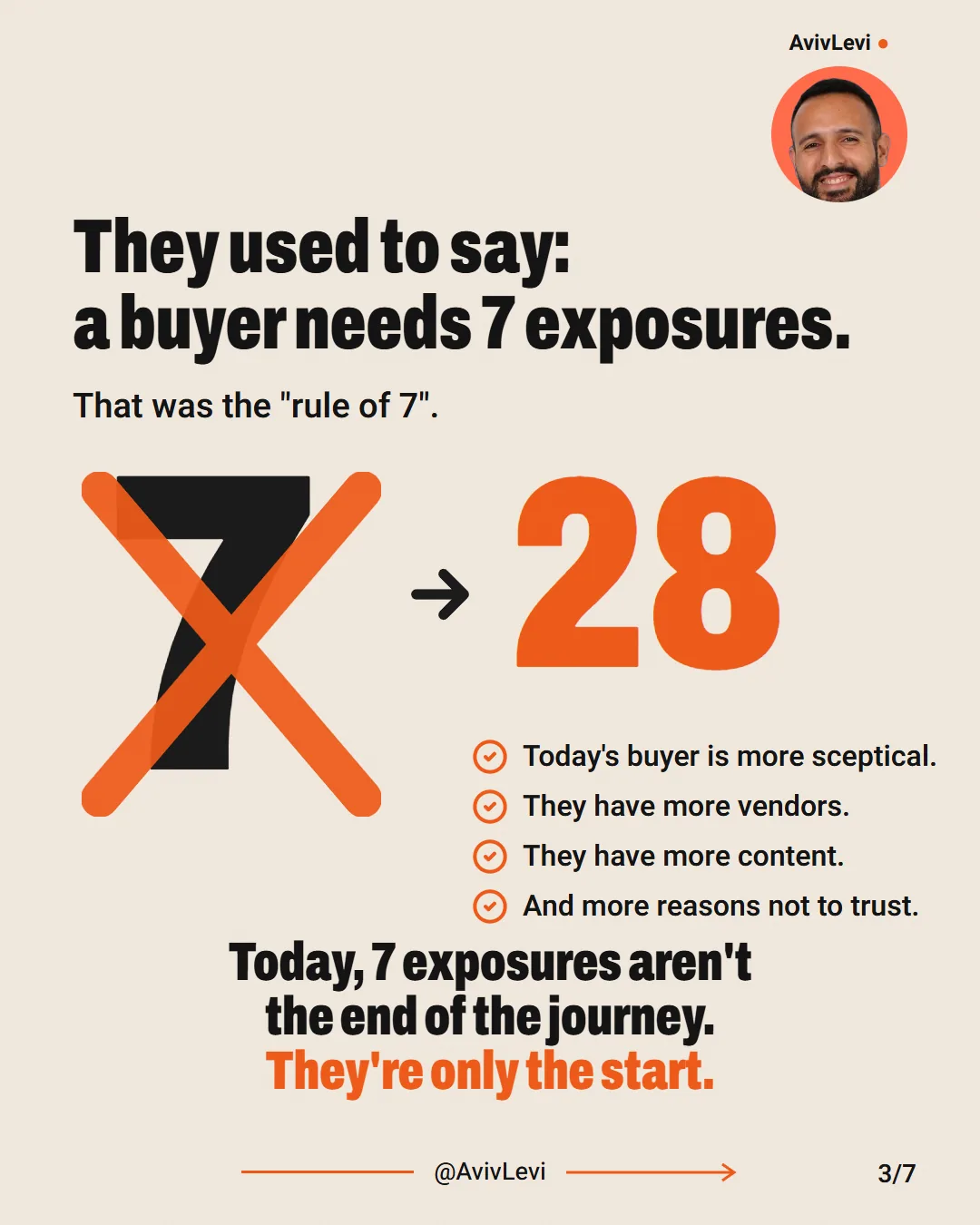
The "rule of 7" is an old advertising rule of thumb: a buyer has to be exposed to your message seven times before they buy. It isn't the finding of any single study, just a way of saying one exposure is not enough. The direction is right. The number no longer is.
Today buyers are more sceptical, have more vendors to choose from, more content competing for their attention, and more reasons not to trust. Especially for an expensive service, consulting, a retainer, a B2B product or any decision with risk in it. Seven exposures are not the end of the journey. They are the start.
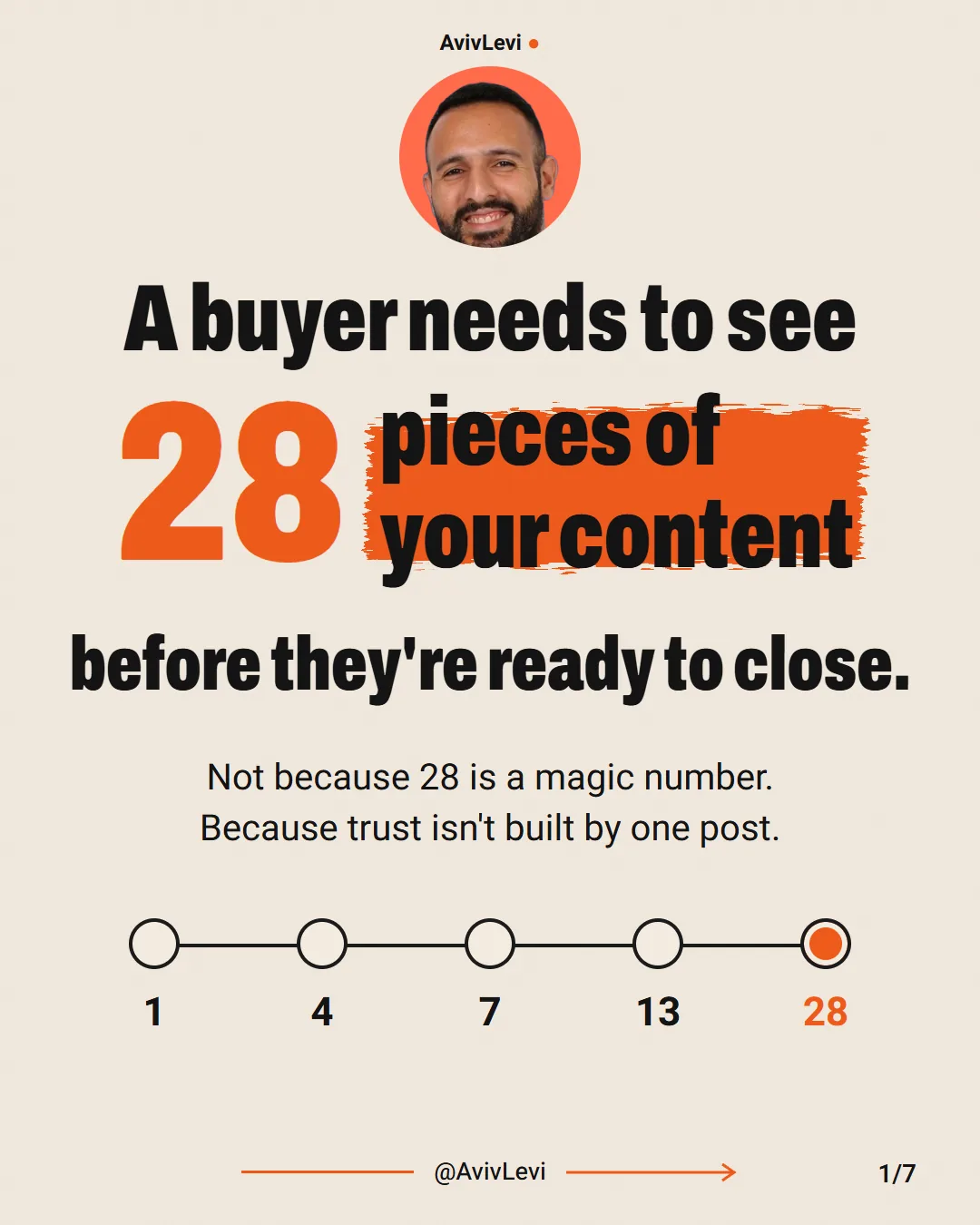
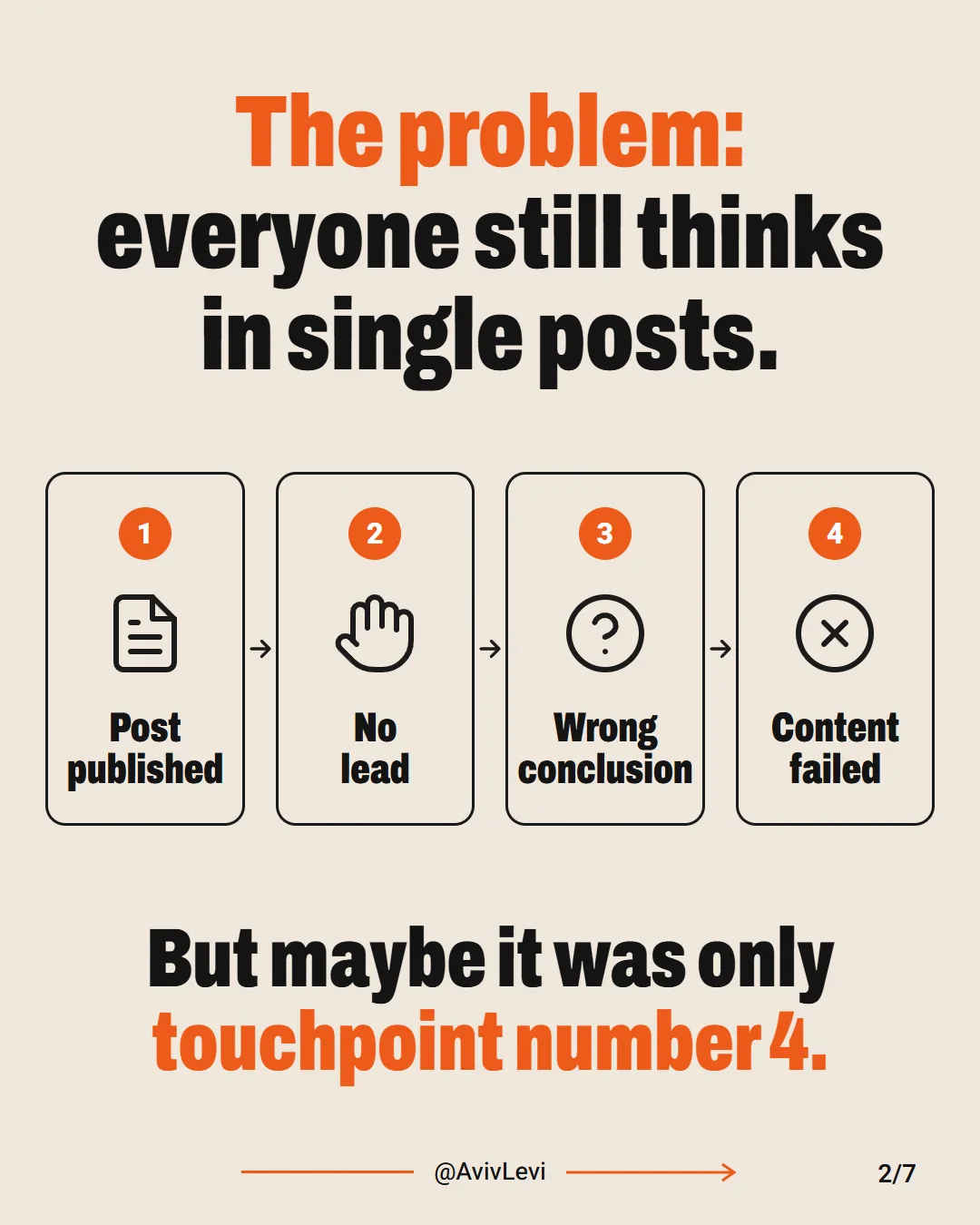
That is why I wrote on LinkedIn that a buyer needs to see 28 pieces of your content before they are ready to close. And I want to say it here too: 28 is not a magic number. It is meant to break the illusion that one post brings a client. Many CEOs publish a post, get no lead and conclude that content failed. But maybe it was only touchpoint number 4.
What does research say about touchpoints before a purchase?
No single study sets the number. Several studies measure different things, and they all point the same way: far more than seven.
| Study | What was measured | Finding |
|---|---|---|
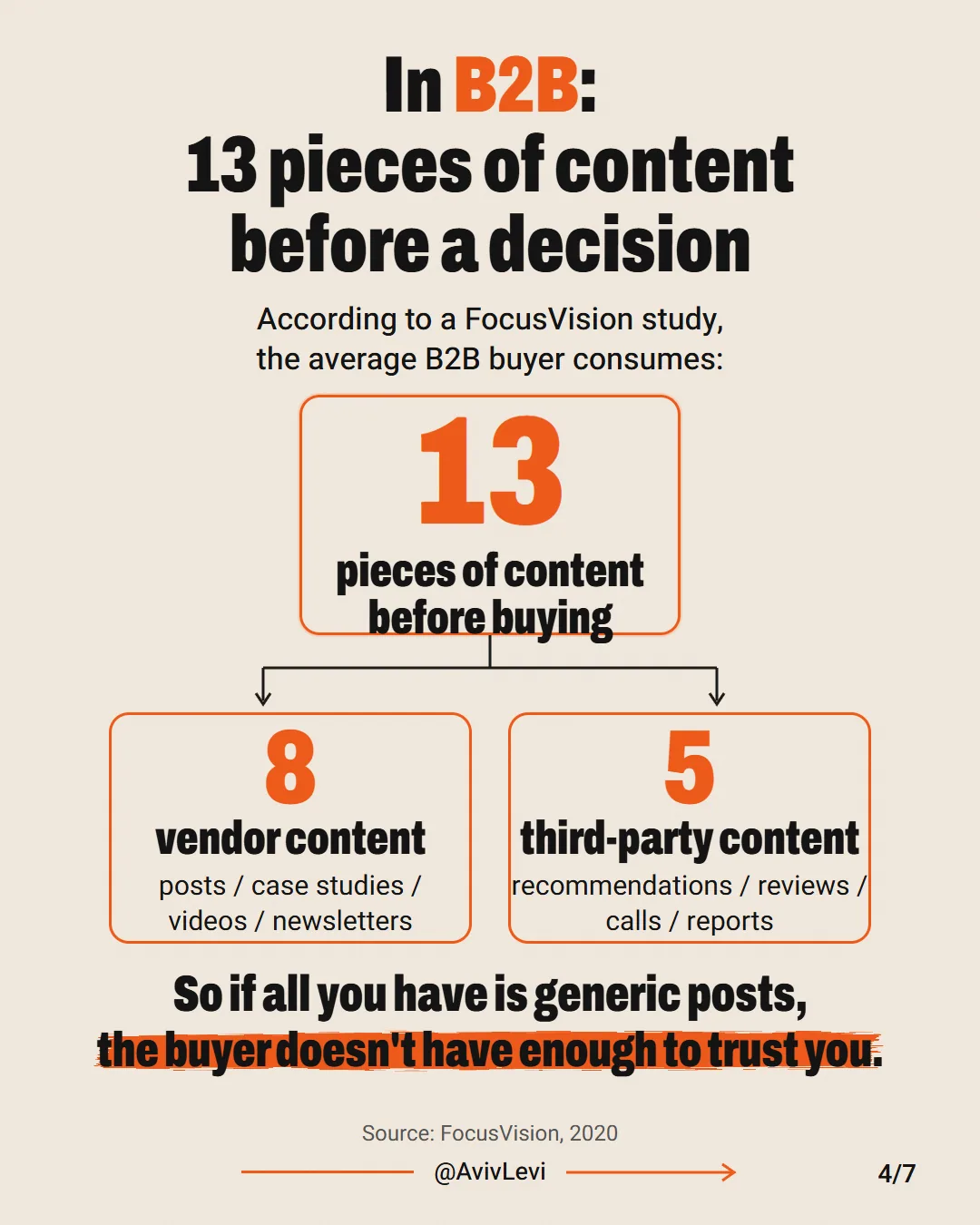
| FocusVision, 2020 | Pieces of content a B2B buyer consumes before choosing a vendor | 13 on average: 8 from the vendor and 5 from third parties |
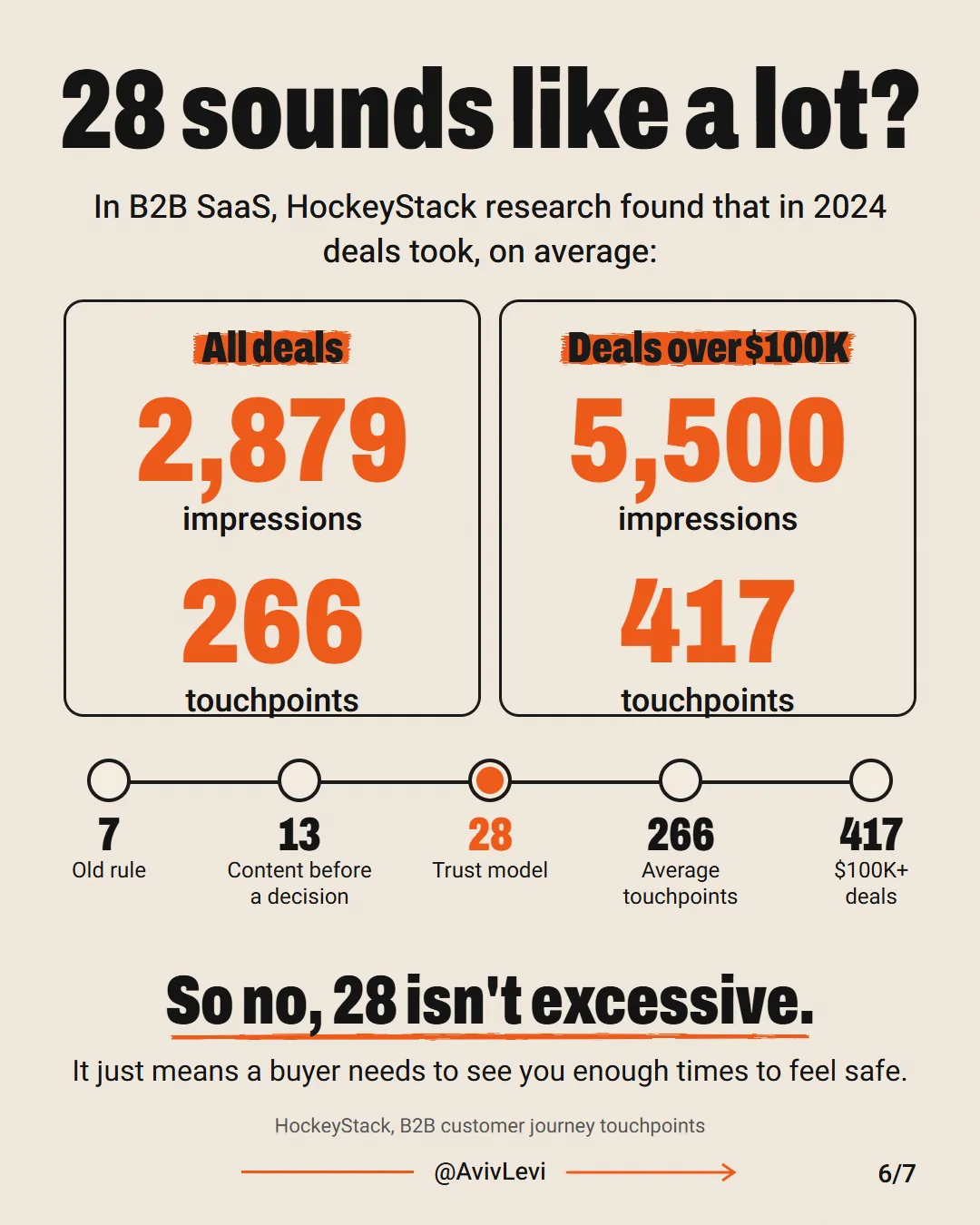
| HockeyStack, 2024 data | Touchpoints and impressions to a closed deal at 150 B2B SaaS companies | 266 touchpoints and 2,879 impressions on average |
| HockeyStack, 2024 data | The same, for deals of $100,000 or more a year | 417 touchpoints and nearly 5,500 impressions |
| Google and Shopper Sciences, 2011 | Sources consumers checked before a big purchase (not B2B) | 10.4 sources, nearly double the year before |
Why are the numbers so different? Because a HockeyStack "touchpoint" includes every measurable interaction, from an ad impression to an email open, while FocusVision counts only content the buyer consumed. But the conclusion is the same: seven is too few, 28 sits in the middle, and in complex deals even 28 touchpoints are nowhere near enough.
Note FocusVision's split: 5 of the 13 pieces didn't come from the vendor at all. Reviews, articles, someone who mentioned you. That is exactly where an active personal LinkedIn profile helps: people comment on, tag and share a person far more than a logo. Why the CEO's voice outperforms the company page, with the numbers, is in the guide to founder-led marketing.
Why do buyers decide before they talk to you?
Because most of the buying journey happens without a salesperson. According to 6sense's 2025 Buyer Experience Report, buyers first contact a vendor on average 61% of the way through the journey (down from 69% a year earlier), and about 80% of the time the vendor they contact first wins the deal.
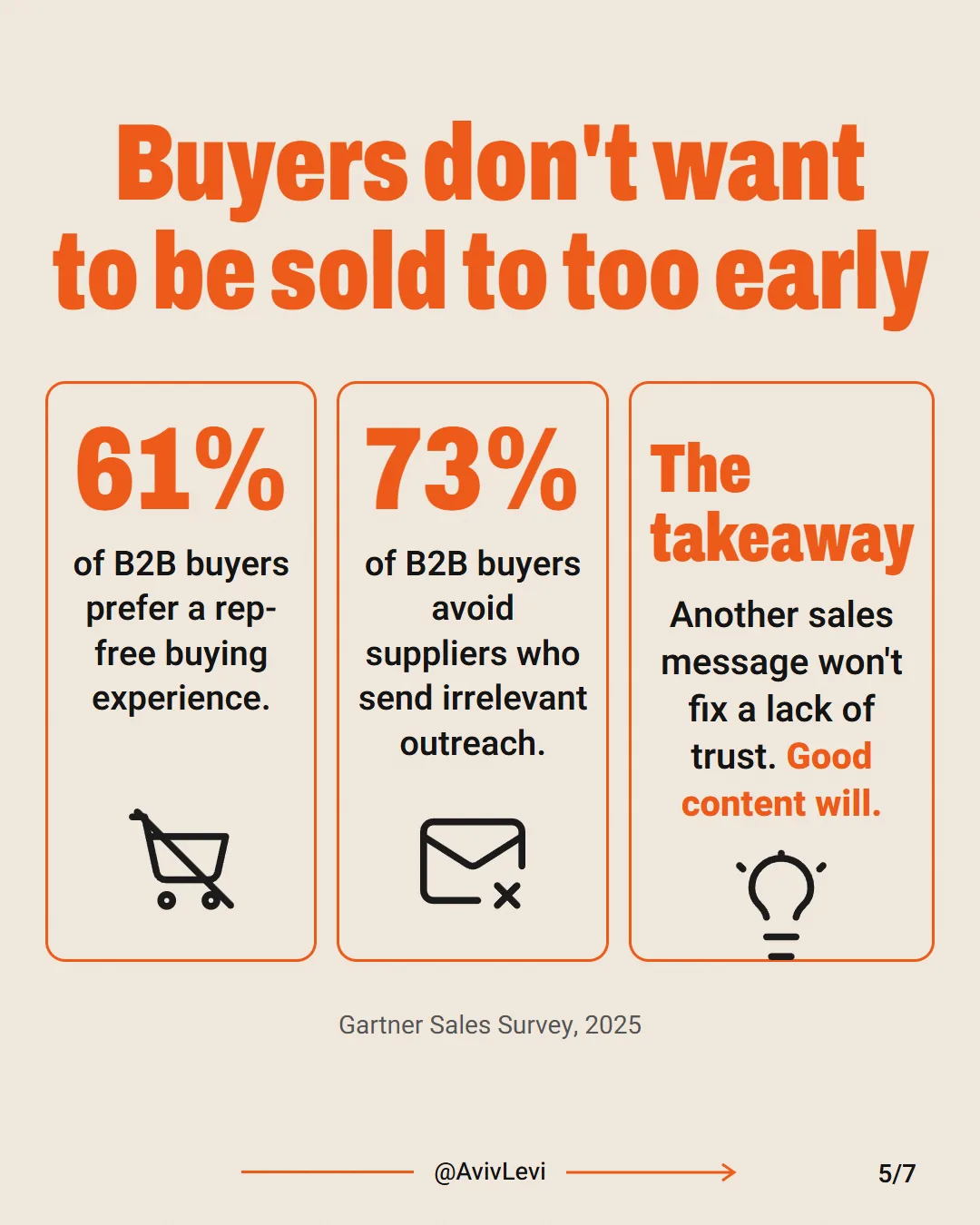
Gartner adds the emotional side. In a survey published in June 2025 (632 buyers), 61% of B2B buyers said they prefer a rep-free buying experience, and 73% said they actively avoid suppliers who send irrelevant outreach. In the next survey, published in March 2026 (646 buyers, August to September 2025), the share preferring to buy without a rep rose to 67%, and 45% said they used AI during a recent purchase. So some of the touchpoints already happen inside ChatGPT and Google's answers, and I cover how to show up there in the guide on how to get ChatGPT to cite you.
The meaning is simple: the sales call no longer starts the persuasion. It is there to confirm or refute the trust your content has already built quietly. That is also why outreach works only when it is relevant and lands on a profile that tells a clear story, which I cover in the LinkedIn outreach guide.
What do 28 touchpoints look like in practice?
Those 28 touchpoints are not 28 identical "buy from me" posts. Nobody would read that. The buyer meets you in different situations and from different angles:
- Background noise. They see a comment you left on someone else's post, a post of yours they scroll past without reading, your name in a professional discussion. They don't know who you are yet, but the name starts to feel familiar.
- The stop. They read one of your in-depth posts to the end, or see how you broke down a problem they have right now. They don't like it, because senior buyers usually read quietly, but they think: "this person knows what they're talking about".
- Outside validation. An industry colleague tags you, they come across a client story or a result you delivered, or they hear you on a podcast. Now it isn't just nice writing. There are receipts.
- The deep dive. They visit your profile on their own, go through your Featured section and your website, and check what you offer. They send your profile to their partner with "I think this is what we need".
Only then, in the last touchpoints, does a message arrive. Here is the same journey in stages, with what to publish at each one. The touchpoint ranges are an illustration, not a measurement:
| Stage | Touchpoints (roughly) | What the buyer needs | What to publish |
|---|---|---|---|
| Awareness | 1 to 5 | To know you exist | Strong opinions and a precise definition of a problem your audience has |
| Relevance | 6 to 15 | To feel you are talking about them | An explanation of their pain, better than they could put it themselves |
| Trust | 16 to 21 | To see how you think | Frameworks and real case breakdowns, instead of "we are experts" |
| Proof | 22 to 25 | Evidence, not opinions | Client stories, before and after, results |
| Decision | 26 to 28+ | To know the next step | A clear offer: who it is for and how to start working together |
A buyer doesn't buy because they saw you once. They buy because they saw you so many times, from so many angles, that when the problem really started to hurt, you weren't a new option anymore. You were the natural choice.
Why do most CEOs give up at the sixth touchpoint?
Most business owners, founders and salespeople give up at exposure number six. They write three posts, send two messages, upload one video, see no inquiries and say "LinkedIn doesn't work". The content works. What is missing is patience.
That is why I commit to a minimum of three months with my clients, and measure them by the 90-day test: what to build in the first month, which patterns to look for in the second, and which business signals in the third. It usually takes 3 to 6 months of consistent presence before organic leads become meaningful.
How do you assign credit to touchpoints in a B2B buying journey?
You assign credit with an attribution model: a rule, or an algorithm, that decides how much of a lead or a deal each touchpoint gets, from 100% to the first or the last touch to a split across the milestones of the B2B funnel. No model is "true". Each one answers a different question, so in practice you pick one multi-touch model for your CRM and add one question to your forms: "How did you hear about us?".
| Model | What it credits | When it fits |
|---|---|---|
| First touch | 100% to the first interaction | You want to know which channels bring new people into the journey |
| Last touch | 100% to the last interaction before the conversion | Short, simple sales. In a long B2B journey it ignores everything that built the trust |
| Linear | Equal credit to every interaction | You want to see the whole journey, without deciding which touch mattered more |
| Time decay | More credit the closer a touch is to the conversion (HubSpot uses a 7-day half-life) | Short cycles and promotions. In a months-long journey the early touches get almost nothing |
| U-shaped (position-based) | 40% to the first touch, 40% to the touch that created the lead, 20% to the rest | The goal is leads (a form or a booked call), not closed deals |
| W-shaped | 30% to the first touch, 30% to lead creation, 30% to deal creation, 10% to the rest | B2B with a clear pipeline in a CRM. The usual starting point |
| Full path | 22.5% each to the first touch, lead creation, deal creation and the last touch before the deal closed, 10% to the rest | You track all the way to revenue, not only to pipeline |
| Data-driven | Machine learning on your own account data decides the weights | You have a lot of conversion data. The weights are not a rule you set or can easily explain |
In Google Analytics 4 and Google Ads only two of these are still built in: data-driven and last click. Google removed first click, linear, time decay and position-based in 2023, saying fewer than 3% of Google Ads web conversions used them. If you want a W-shaped view, it lives in your CRM, not in GA4.
Why LinkedIn and dark social are under-counted
Every software model has the same blind spot: it can only credit the touchpoints it sees. Most of the touchpoints a CEO creates on LinkedIn are invisible to it. A buyer reads your post in the feed without clicking, so there is no visit to track. They send it to a partner on WhatsApp or Slack. Three weeks later they type your company name into Google, and the CRM records "organic search" or "direct". Marketers call this dark social.
In SparkToro's test (April 2023), 100% of the visits from links shared on Slack and WhatsApp showed up in analytics as "direct", and about 14% of the visits from public LinkedIn posts lost their referral data too. Refine Labs ran both methods side by side for 12 months on its "Book a Strategy Call" form (published October 2024): software attribution credited web search with 78% of conversions, while customers named web search only 12% of the time. By the customers' own account, 85% came through dark social: social networks, podcasts, communities and word of mouth.
Self-reported attribution: ask the buyer
That is why B2B teams add self-reported attribution: one field on the demo or contact form, "How did you hear about us?". It records what the buyer remembers, which is usually where they discovered you, not the last click. In HockeyStack's analysis of 8,528 answers from prospects who booked demos (published December 2025), social media was the second source with 20% of answers, and 30% of those (508) named LinkedIn. Word of mouth came third with 18%. Compared with last-touch software attribution for the same people, the answers matched only 60% of the time for social and 53% for search.
Self-reported answers have their own bias. People forget, and some write "Google" because that is where they typed your name. HockeyStack itself says asking alone is not enough for serious decisions. So use both: software for what it can see, and the buyer's own words for what it can't.
What it means for a CEO on LinkedIn
- Make the question free text, and required. A drop-down with "LinkedIn" as one option leads the answer. A free-text field gets "I have been following your posts for a few months", which tells you far more.
- Ask it again on the first call. "What made you reach out now?" Write the answer in the CRM next to the deal. With a handful of deals a quarter, those notes tell you more than any model.
- Count what LinkedIn does show you. Profile views from your ICP, messages that mention a specific post, and people who arrive at the call already quoting you. No dashboard will credit those touchpoints, so log them yourself.
- Keep content and outreach apart in the CRM. If you also run LinkedIn lead generation, tag the meetings it books separately, so the last message doesn't take the credit for months of posts.
- Judge by quarter, not by post. When the credit for a deal is spread over months of touchpoints, a single post will almost never "get" the lead. That is the same reason for the 90-day test above.
Before 28 pieces of content: three strategy questions
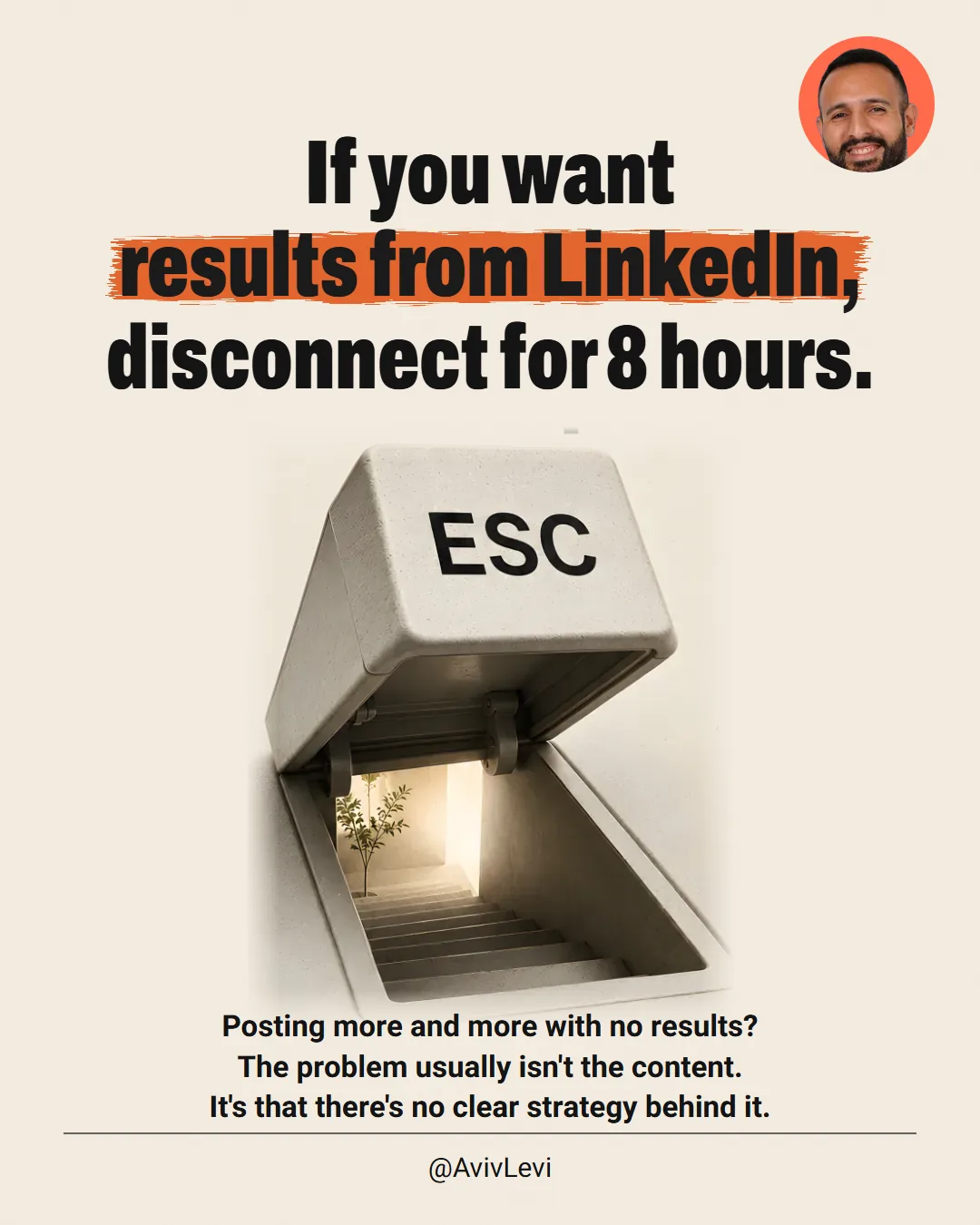
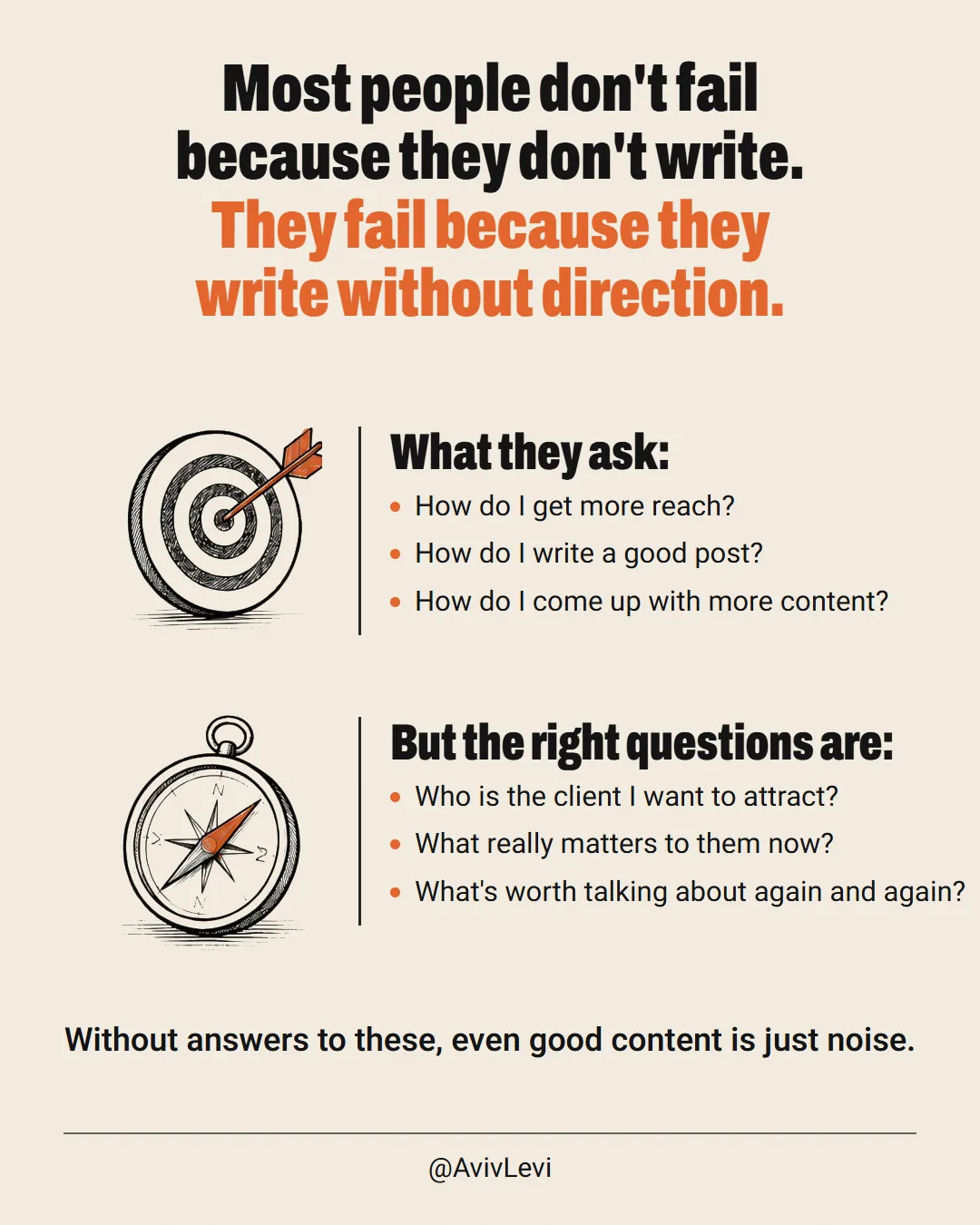
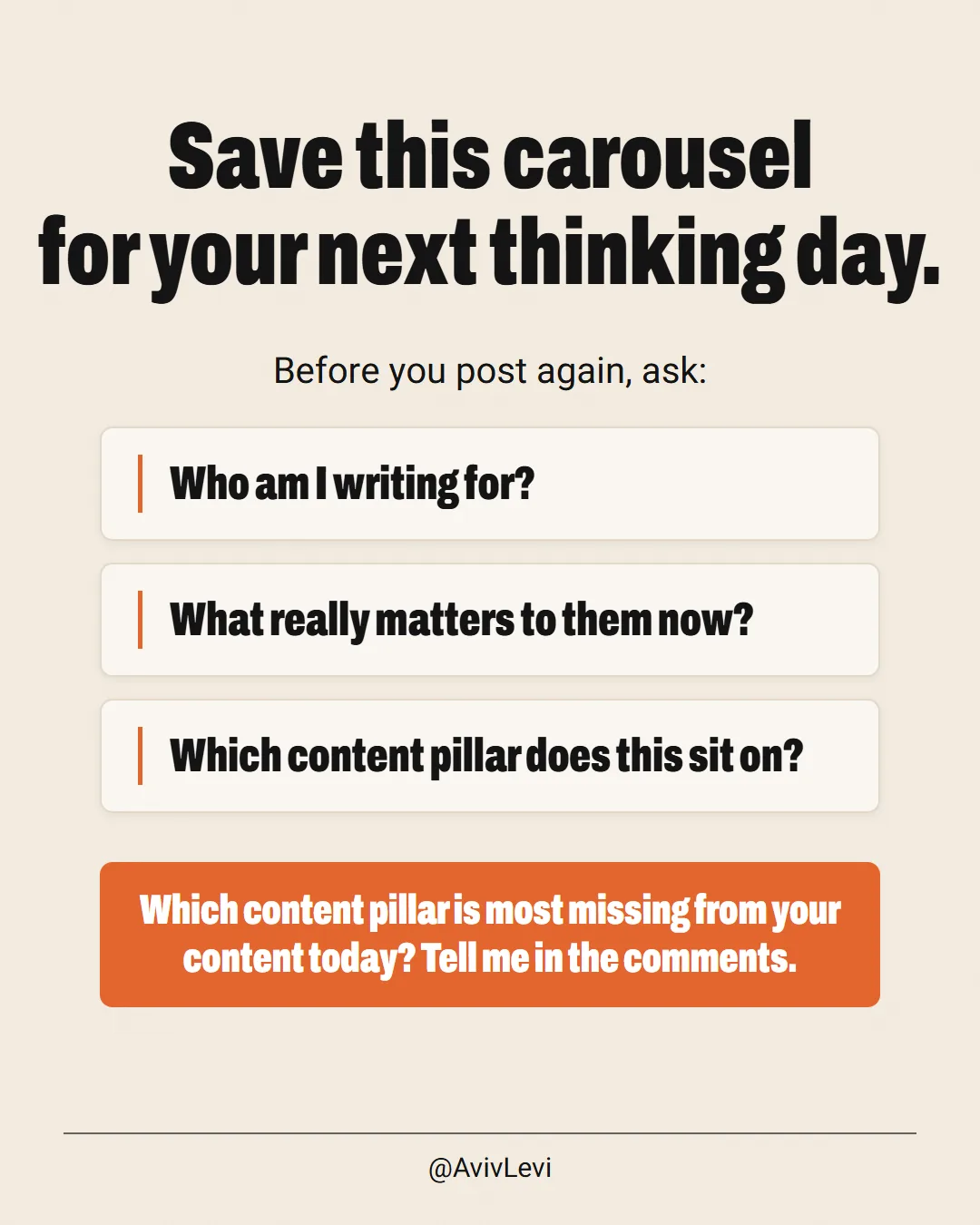
Twenty-eight touchpoints without a strategy are 28 random posts. Most people don't fail because they don't write. They fail because they write without direction. They ask how to get more reach, how to write a good post and how to come up with more content. In my carousel on this I wrote "disconnect for 8 hours": one thinking day with no posting, just to answer the three right questions:
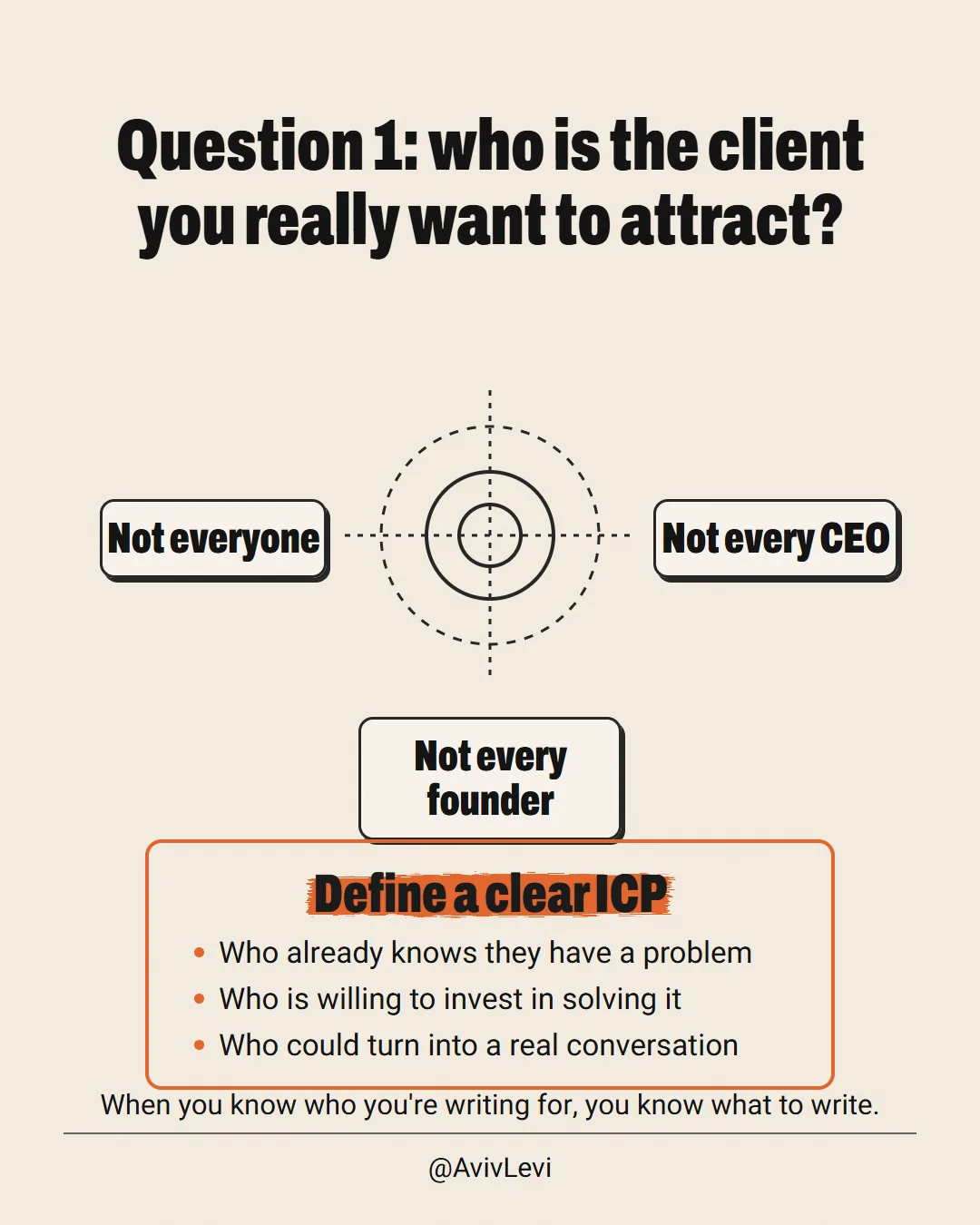
- Who is the client you really want to attract? Not everyone, not every CEO, not every founder. A clear ICP: who already knows they have a problem, who is willing to invest in solving it, and who could turn into a real conversation. When you know who you are writing for, you know what to write.
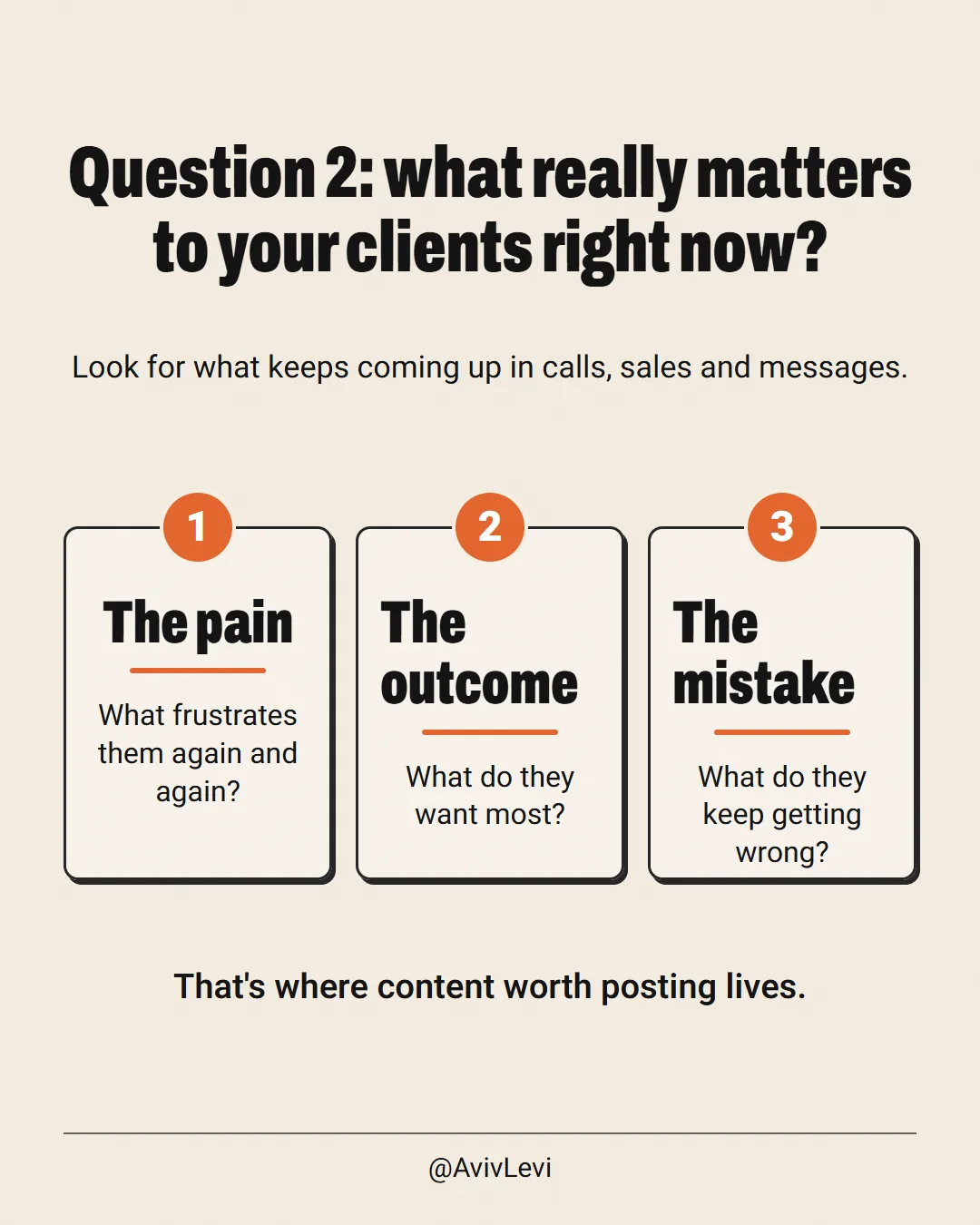
- What really matters to your clients right now? Look for what comes up again and again in calls, sales conversations and messages: the pain (what frustrates them), the outcome (what they want most) and the mistake (what they get wrong). That is where content worth posting lives.
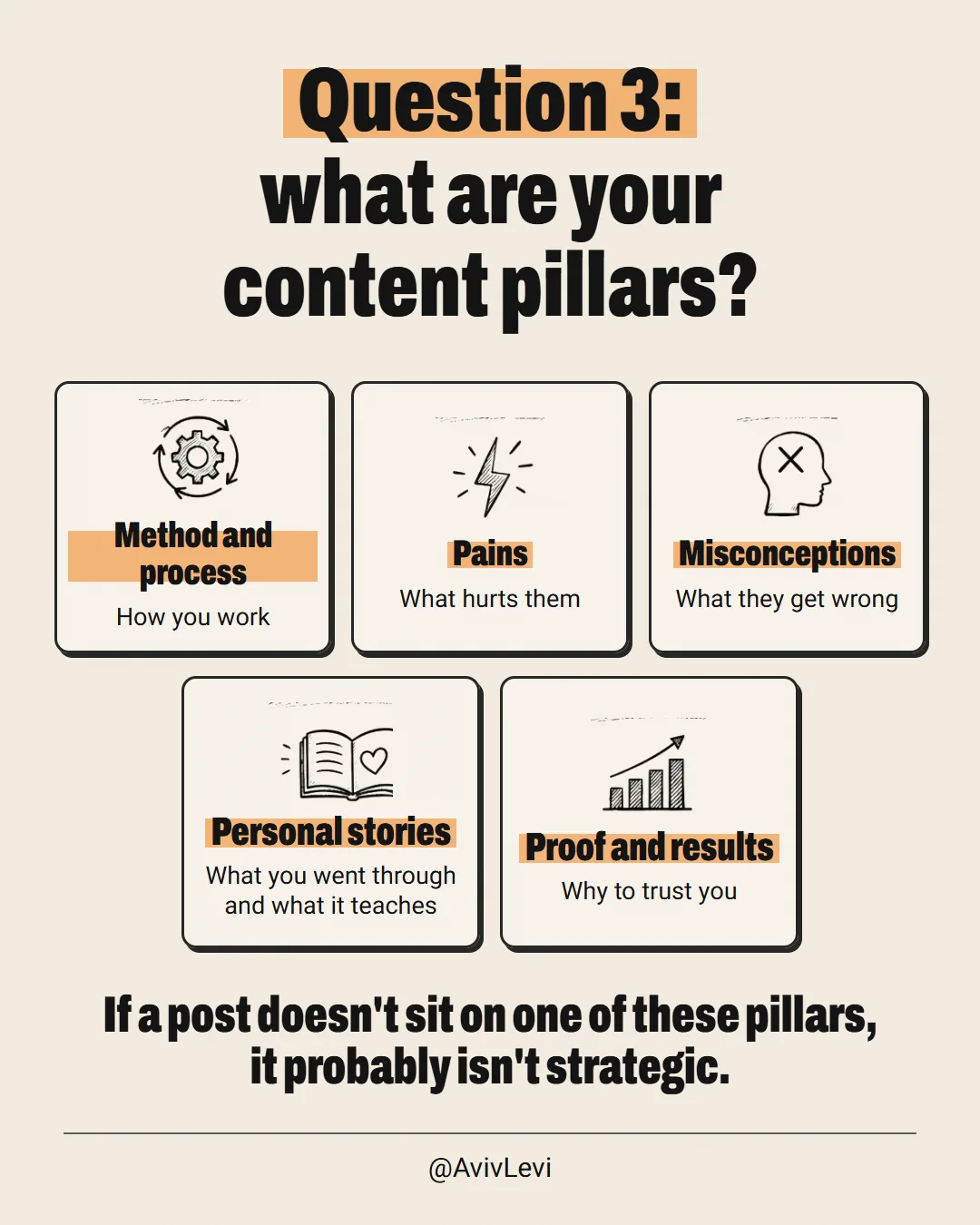
- What are your content pillars? Five pillars: method and process (how you work), pains (what hurts them), misconceptions (what they get wrong), personal story (what you went through and what it teaches) and proof and results (why to trust you). If a post doesn't sit on one of them, it probably isn't strategic.
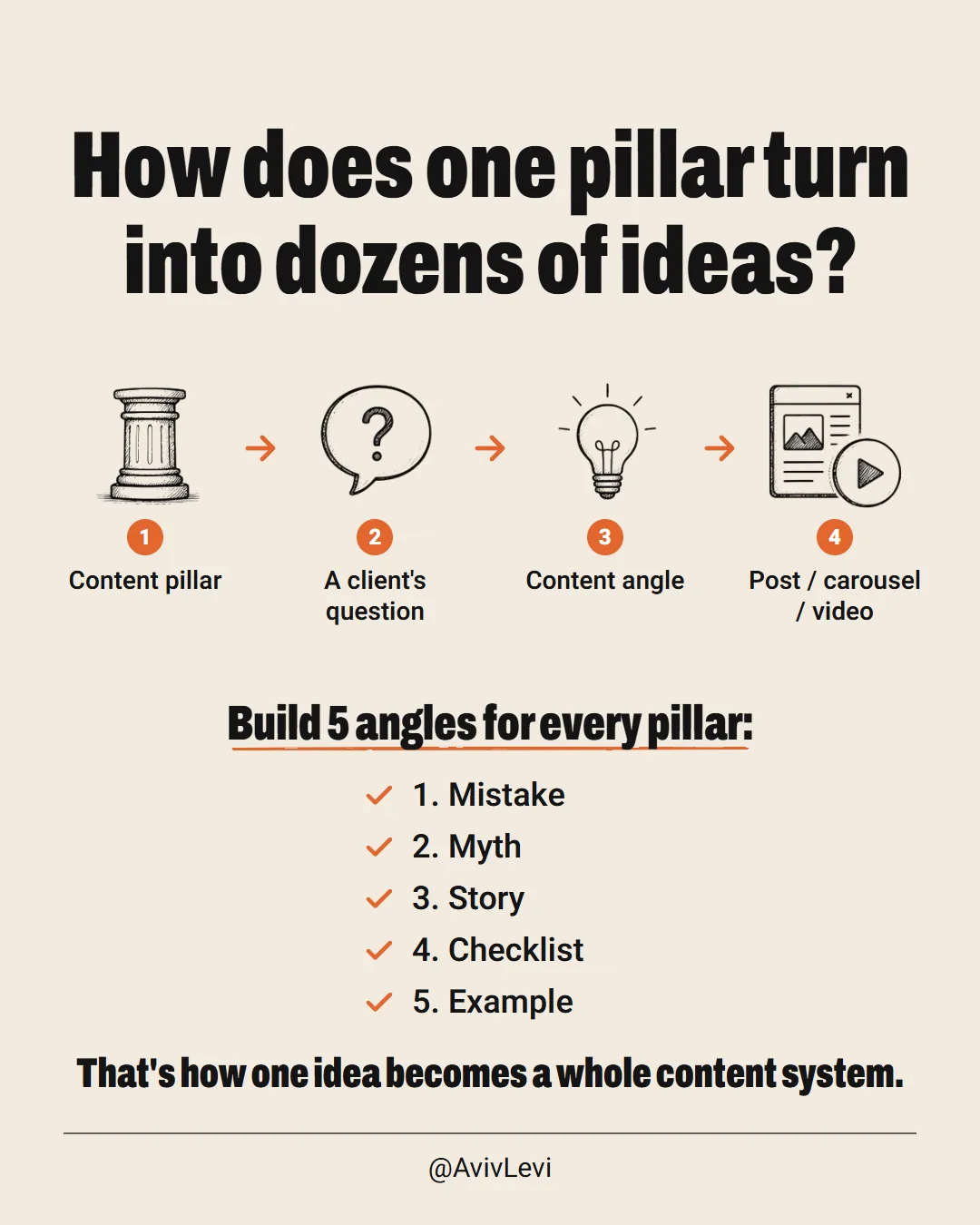
From there, each pillar turns into many ideas: pillar, a client's question, an angle, and only then a post, a carousel or a video. Every pillar has at least five angles: a mistake, a myth, a story, a checklist and an example. That is how one idea becomes a whole content system, and I lay out the full method in the content waterfall guide.
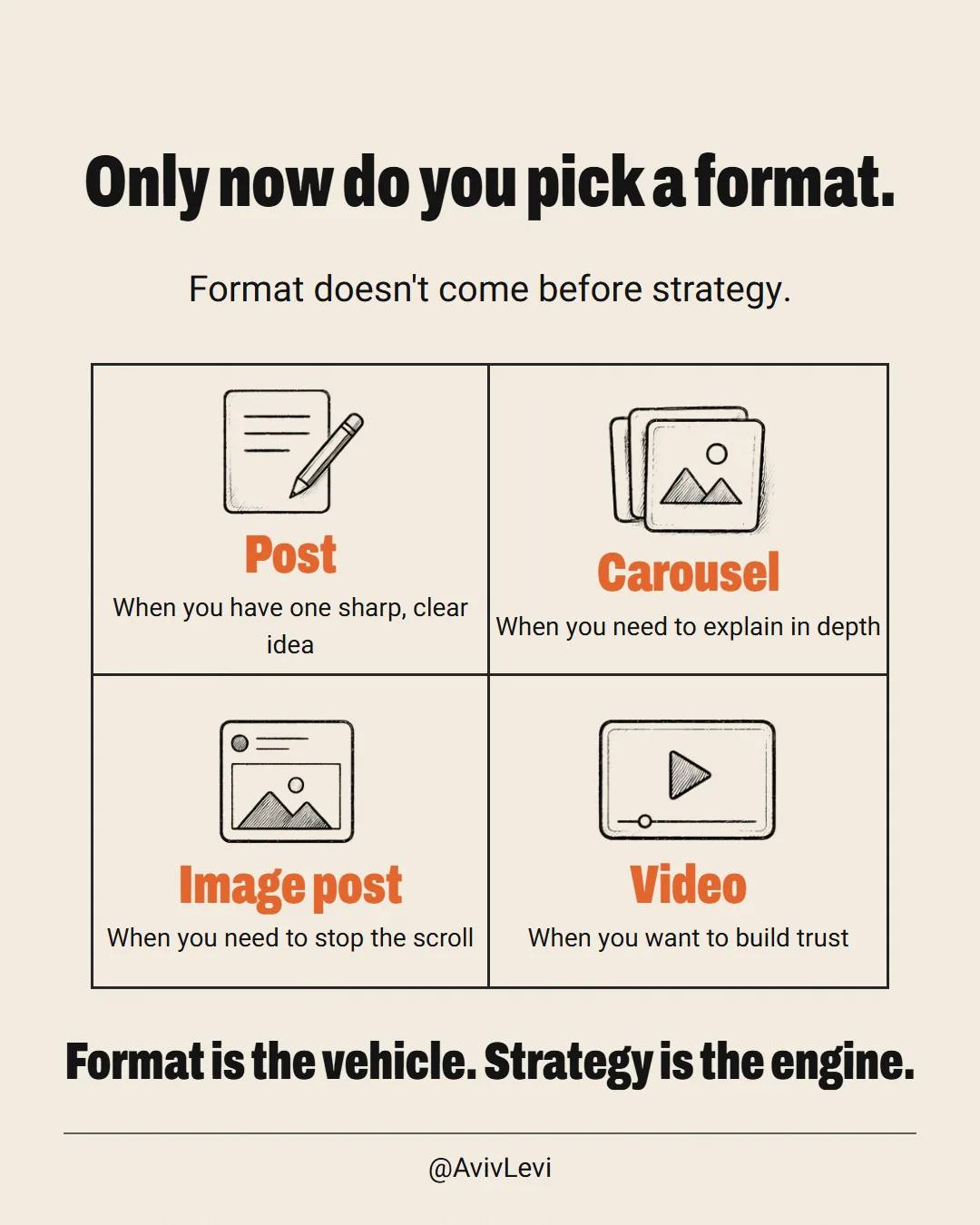
Only now do you pick a format: a text post for a sharp, clear idea, a carousel when you need to explain in depth, an image post when you need to stop the scroll, and video when you want to build trust. Format is the vehicle. Strategy is the engine. Before your next post, ask: who am I writing for? What really matters to them now? And which content pillar does this sit on?
With my clients this is the first step of the work, before the first post: the ICP and its pains, the messaging, the edge over competitors and the tone. Without it I don't start. Here is how we work.
The bottom line
Don't measure a post. Measure a journey. Your buyer meets you dozens of times, mostly without you knowing, and decides long before they talk to you. Your job is to be there along the way, with value, from different angles, around clear topics. Don't be the one who shouts "buy from me" once and disappears. Be the one who shows up in their feed, again and again, with something worth reading.
Frequently asked questions
How many touchpoints does it take to make a B2B sale?
Far more than the old rule of 7: from 13 pieces of content to several hundred touchpoints, depending on what is counted. According to FocusVision, a B2B buyer consumes 13 pieces of content on average before choosing a vendor. According to HockeyStack, a closed B2B SaaS deal took 266 touchpoints on average, and deals above $100,000 took 417.
Which attribution model fits a B2B company?
For most B2B companies with a CRM, a W-shaped model is a sound start: 30% of the credit to the first touch, 30% to the touch that created the lead, 30% to the one that created the deal and 10% to the rest. Add a free-text "How did you hear about us?" field to your forms, because software models miss touchpoints like a LinkedIn post read in the feed or a link shared on WhatsApp.
What is the rule of 7 in marketing?
An old advertising rule of thumb that a buyer needs to be exposed to a message seven times before buying. It isn't based on any single study, and in today's B2B sales the journey is much longer.
Is 28 touchpoints a research figure?
No. Twenty-eight is a concept I use to show that one post doesn't bring a client. Research shows a wide range, from 13 pieces of content to hundreds of touchpoints, depending on what is counted and the deal size.
When does a B2B buyer first contact a vendor?
According to 6sense (2025), on average 61% of the way through the buying journey, and about 80% of the time the vendor the buyer contacts first wins the deal.
How long does it take to get leads from LinkedIn content?
Usually 3 to 6 months of consistent presence before organic leads become meaningful. That is why I ask clients for at least a 90-day commitment.
What should you define before you start posting?
Three things: the client you want to attract (your ICP), what matters to them now (the pain, the outcome and the mistake), and your content pillars.