
SEO and GEO case study: how we went from zero to 10,000 Google impressions in 28 days, and got cited by AI

Published: · Updated: · 18 min read
Quick answer
Key takeaways
- From 9 non-branded impressions (3 months, to Oct 7) to 10,100 impressions and 67 clicks in 28 days (Oct 3-30).
- Google's AI features: from 11 impressions to 1,140 in three months, 948 of them for one article, Google AI Mode in Hebrew.
- AI Overviews cite velut.ai as the first source for Hebrew "AI Mode" and "LinkedIn agency for CEOs" searches, and my LinkedIn article for "how to get ChatGPT to cite you" in Hebrew.
- Of all AI engines, only ChatGPT sent visits (6). Copilot cited the site 6 times, and Perplexity recommends us first.
- The costliest mistake: changing the URL of an article that already had hundreds of impressions a day. It fell from 450 a day to almost zero.
- What's left: people see us but don't click yet. 0.7% CTR, with most impressions in positions 20-80.
Where did we start?
On October 3, 2026 we relaunched velut.ai: no longer an AI product site, but the site of a LinkedIn agency for CEOs. Four days later I ran a full SEO audit, and the picture was simple: 480 impressions and one click in three months. Almost all of them were for the word "velut", which on Google is mostly a Latin word (and part of the University of Toronto's motto). Non-branded impressions: 9.
On top of that: not one real backlink (the 22 domains linking to us were spam), 43 indexed pages, and ChatGPT wrote that there was "very little public information" about Velut and mixed us up with a French company with a similar name. A new site, no authority, no history, in a market where our Hebrew service terms ("LinkedIn management", "LinkedIn ghostwriter") get fewer than 10 searches a month.
That's where most small businesses I know are. So I decided to document everything we did, mistakes included, as a case study on ourselves.
What were the results after a month?
Search Console data, 28 days to October 30, 2026 (read November 1):
| Metric | Before (to Oct 7) | After (28 days to Oct 30) |
|---|---|---|
| Impressions | 480 (3 months) | 10,100 |
| Non-branded impressions | 9 (3 months) | ~7,900 |
| Clicks | 1 (3 months) | 67 |
| Distinct non-branded queries | a handful | 719 |
| Pages with impressions | 90 | |
| Impressions in Google's AI features | 11 | 1,130 |
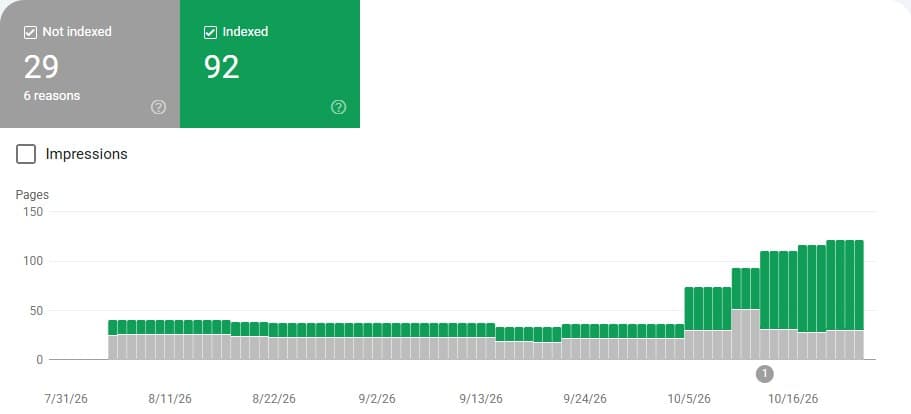
| Indexed pages | 43 (Oct 12) | 92 (indexing report, Oct 23) |
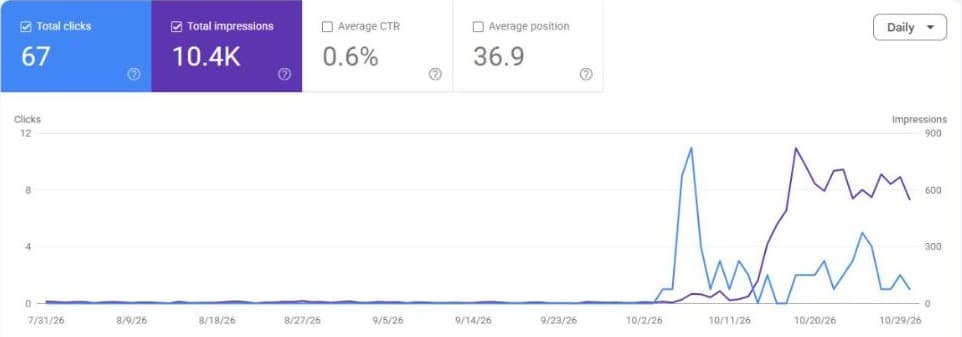
Two things stand out. First, the blue spike in clicks on October 6-8 is people searching the name "velut" after the launch, not SEO. Second, impressions (purple) start rising on October 14 and settle around 600-800 a day from October 18. That's when the articles we published on October 13 got indexed.
Which pages bring the impressions?
| Page | Impressions | Clicks | Avg. position |
|---|---|---|---|
| Google AI Mode (Hebrew) | 2,285 | 5 | 7.5 |
| GEO guide (English, old URL) | 1,824 | 0 | 58.9 |
| How to get ChatGPT to cite you (English) | 716 | 0 | 34.3 |
| LinkedIn SSI glossary entry (English) | 506 | 1 | 59.2 |
| LinkedIn text formatter (English) | 493 | 0 | 40.0 |
| GEO guide (Hebrew, old URL) | 482 | 0 | 72.1 |
| Employer branding glossary entry (Hebrew) | 481 | 0 | 59.7 |
| Prompt glossary entry (English) | 389 | 0 | 57.6 |
| English home page | 244 | 30 | 5.1 |
| LinkedIn text formatter (Hebrew) | 37 | 10 | 3.9 |
Nine of the top ten pages are content: articles, glossary entries and a tool. The service pages, where the money is, got 383 impressions together and no clicks, at an average position of 34.9. That's finding number one: on a new site, content that answers questions brings the first traffic, not service pages.
Do AI engines cite us?
Yes, and you can measure it in four places. Here's what it looked like on October 29, 2026.
The Generative AI report in Search Console
Search Console has a report that counts how often your pages appeared as a source in Google's AI search features: AI Overviews and AI Mode. Ours: 11 impressions on October 7, 39 on October 14, 53 on October 17, 896 over three months to October 27, and 1,140 to October 30. Almost all of it since October 17.
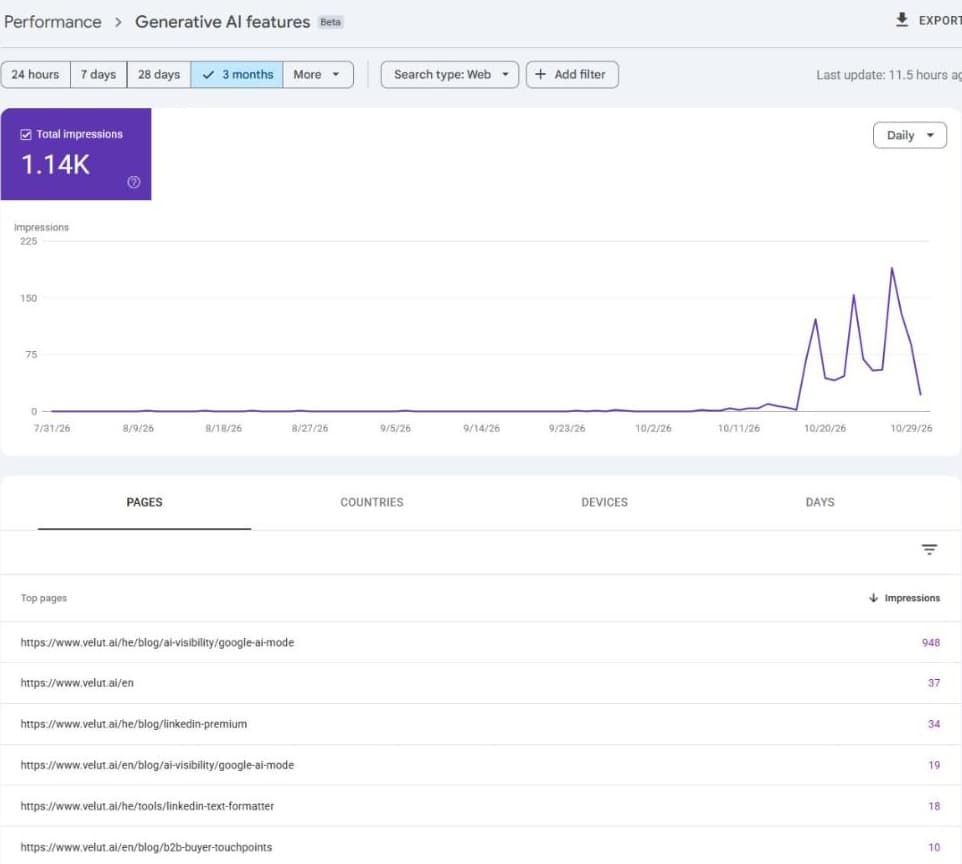
83% of our AI feature impressions come from one article: Google AI Mode, in Hebrew (948 of 1,140). Next: the English home page (37), LinkedIn Premium in Hebrew (34), AI Mode in English (19) and the Hebrew text formatter (18). The report shows impressions per page only, no clicks and no queries.
AI Overviews: the site as the first source
For the Hebrew search "מצב ai" (AI Mode), Google's AI Overview shows velut.ai as the first source card, ahead of Google Help and the big marketing sites:
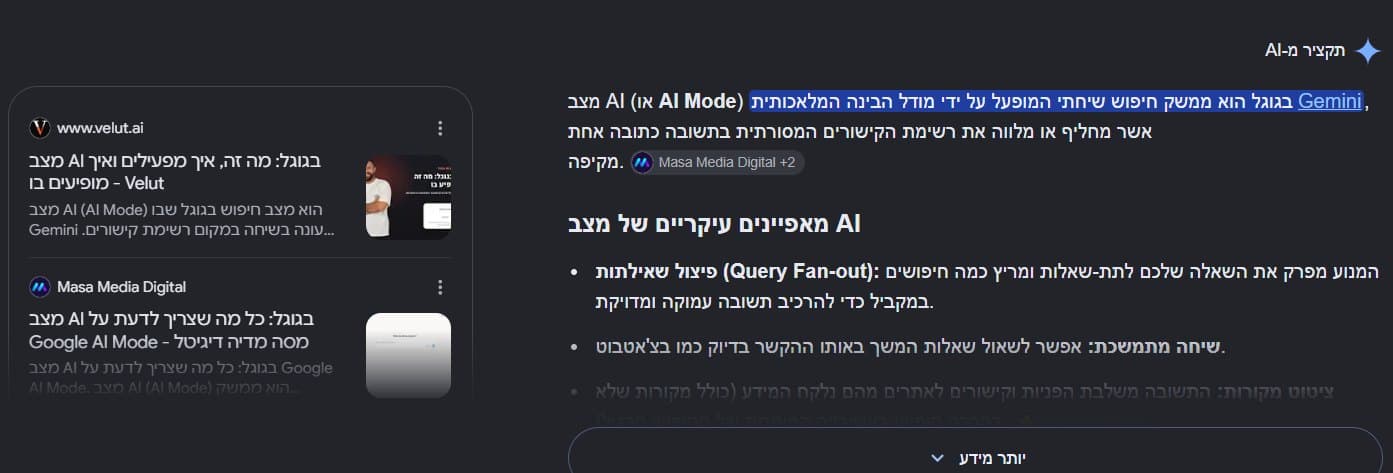
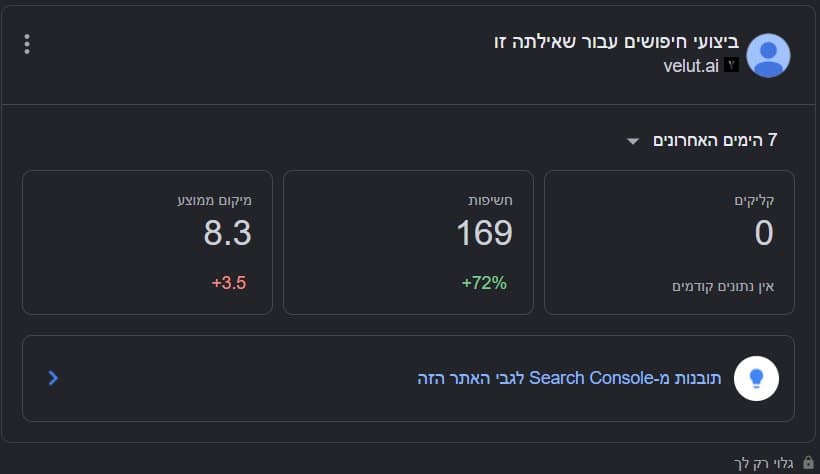
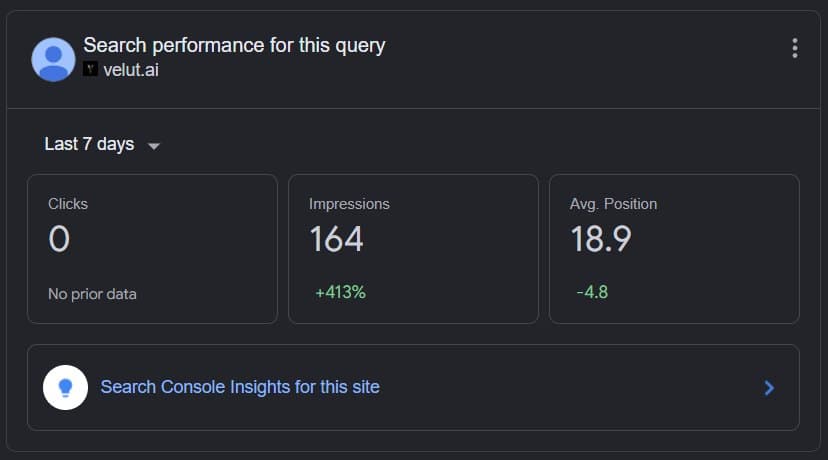
And when you own the site and you're signed in, Google shows a card under the results with your performance for that query. For "מצב ai": 169 impressions in a week, up 72%, average position 8.3. And zero clicks. More on that below.
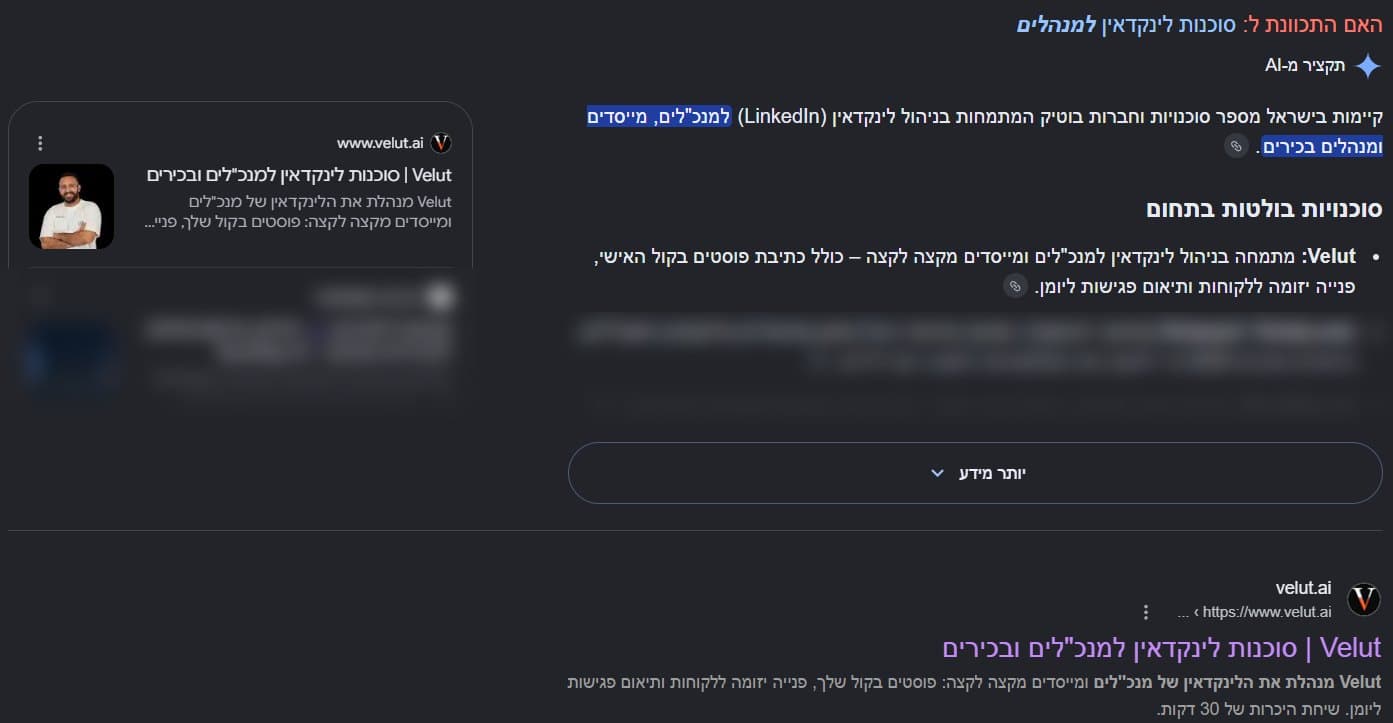
For "LinkedIn agency for CEOs" in Hebrew it's even clearer: Velut is the first agency the AI Overview lists, the site is the first source card, and also the first organic result. I blurred the other agencies.
AI Overviews: the LinkedIn article as the first source
This is the finding I find most interesting. For "how to get ChatGPT to cite you" in Hebrew, the AI Overview's first source isn't the site but the article I published on LinkedIn (LinkedIn Pulse) on the same topic:
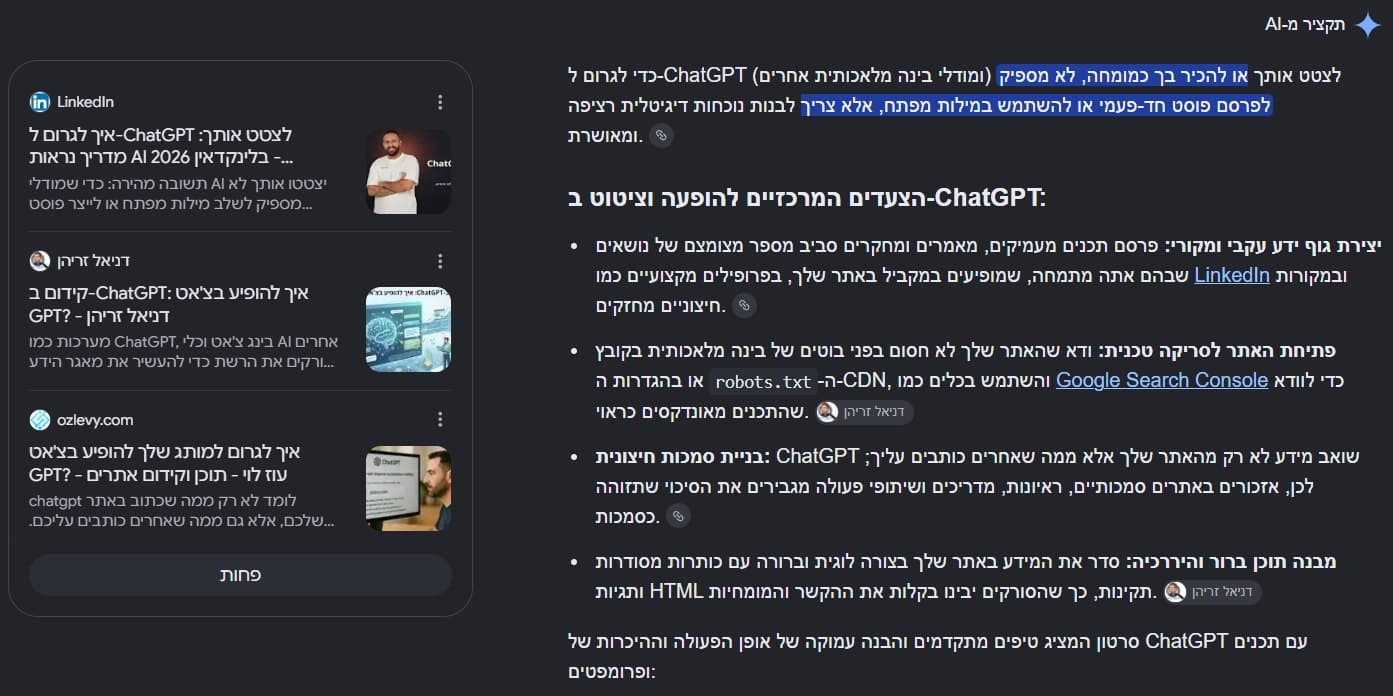
That's exactly what I wrote in the guide to getting ChatGPT to cite you: AI engines cite people and LinkedIn, not only websites. There's a flip side too: for "what is Google AI Mode" in Hebrew, my Pulse article ranks above the article on the site. Google picks one of the two, and not always the site. More in the mistakes section.
Copilot and Perplexity
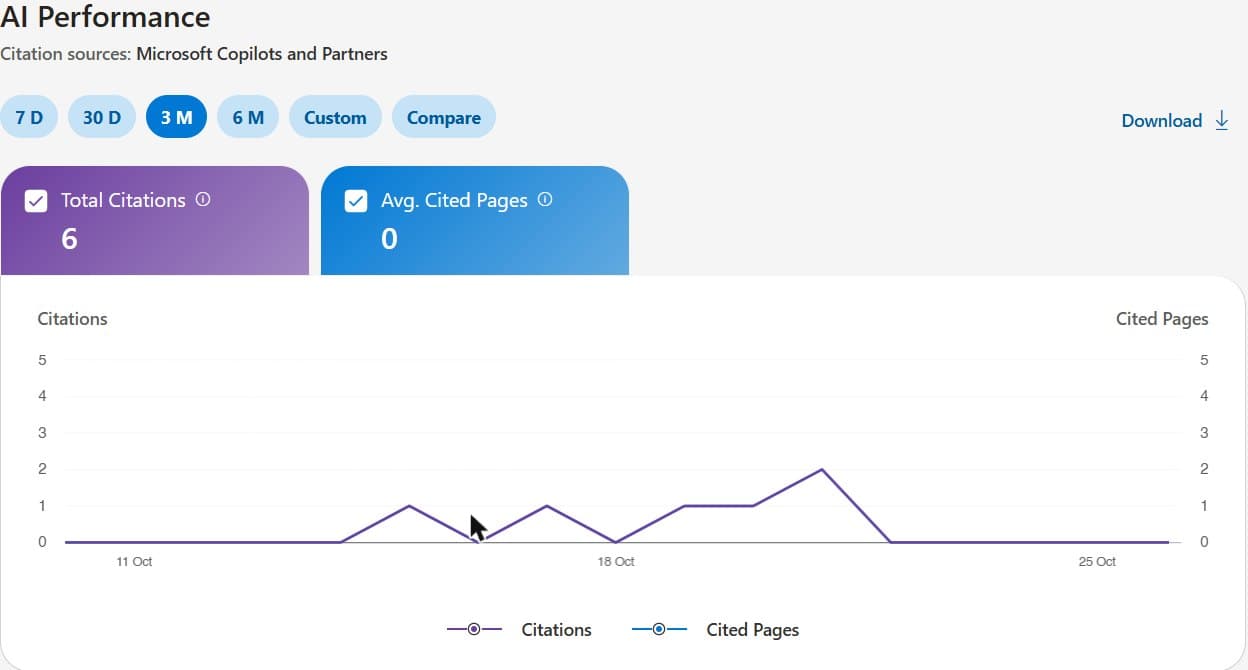
In February 2026 Bing Webmaster Tools added an AI Performance report that counts citations in Copilot and Microsoft's partners. Ours: 6 citations between October 15 and 21, five for the English home page and one for the English ghostwriting page. Small, but it was zero before. ChatGPT searches partly through Bing, so being there matters.
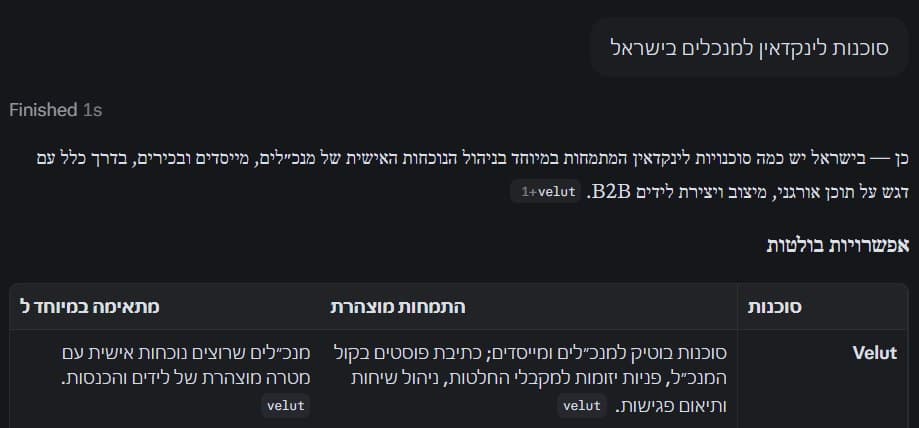
In Perplexity, asked for "LinkedIn agencies for CEOs in Israel" (in Hebrew), Velut is the first row of the recommendation table, citing velut.ai:
Which AI models send visits to the site?
A citation isn't a visit. To see who actually sends people, I checked Google Analytics: the "AI Assistant" channel (Google added it on May 13, 2026; it covers ChatGPT, Gemini, Copilot, Deepseek and Grok) and referral sources. Tracking on the site started on October 16, so this is 13 days:
| Channel | Sessions | Avg. time | Key events |
|---|---|---|---|
| Direct (incl. QR codes and WhatsApp links) | 189 | 2:54 | 7 |
| Organic social (mostly LinkedIn) | 152 | 2:45 | 7 |
| Organic search (Google) | 54 | 7:32 | 8 |
| AI Assistant (ChatGPT only) | 6 | 0:34 | 0 |
- ChatGPT is the only AI model that sent visits: 6, five of them to the English LinkedIn text formatter. A free tool that does one thing is what ChatGPT recommends, not an article.
- Perplexity, Gemini, Copilot and Claude: zero visits in this period, even though some of them cite us.
- Clicks from AI Overviews and AI Mode aren't separated in GA4. They count as "google / organic". The only place to see them is the Generative AI report in Search Console, which shows impressions only.
- Google organic is the highest-quality source: only 54 sessions, but 7.5 minutes on average and 8 key events (WhatsApp, Calendly and LinkedIn clicks), more than any other channel.
What exactly did we do? The timeline
| Date | What we did | Why |
|---|---|---|
| Oct 3 | Relaunch as an agency site in Hebrew and English, with structured data, FAQ and an answer block on every page | Foundation |
| Oct 4-6 | Google AI Mode article, AI Overviews article (with our study of 150 Hebrew searches), IndexNow, meta fixes for Bing | Content where demand is: "מצב ai" gets 18,100 searches a month in Israel |
| Oct 7 | Full SEO audit: speed (LCP from 14.1 to 2.7 seconds after slimming the font), titles, redirects | Technical foundation |
| Oct 8 | Guide to getting clients from LinkedIn, descriptive image file names | |
| Oct 13 | Bilingual glossary (10 terms), Sales Navigator and Premium guides, GEO guide, free LinkedIn text formatter, AI Mode refresh | A "LinkedIn for executives" cluster with real search volume |
| Oct 14 | Original research: 702 posts by CEOs from LinkedIn Top Startups 2026 | Data nobody else has |
| Oct 15 | Hebrew as the default at the root, so Google indexes /he and /en separately | hreflang and canonical |
| Oct 17 | Expanding pages by their Search Console queries, internal links | The method that worked best (below) |
| Oct 18-19 | Indexing fixes, redirects for old pages, LinkedIn algorithm guide, LinkedIn carousels as HTML on the site | |
| Oct 20 | Changed the GEO guide's URL + expanded it by queries | A mistake, see below |
| Oct 24 | New design across the site, Analytics loaded after the page | Speed |
| Oct 27-29 | Plan items T1-T16: AI Mode, founder-led marketing, ChatGPT, LinkedIn management, glossary cannibalization, ghostwriter vs AI, LinkedIn SSI, GEO recovery | Based on a full Search Console review |
In total: 13 articles in two languages, a glossary of 10+ terms, a free tool, and more than 50 changes (pull requests) to the site. Every article also went out as a LinkedIn version.
Who did I work with? Claude Code
I did all of this without an SEO team or developers, together with Claude Code, Anthropic's AI coding agent. It wrote the site's code, ran the keyword research, read Search Console and Google Analytics, suggested changes based on the data, and opened every change as a pull request for me to approve. I chose the topics, answered the interview questions for every article, and approved every title and every claim before it went live. Every step was documented as we went (plan, log, what was checked and when), and that's what this case study is built from. For our clients, LinkedIn posts are written by hand. Claude Code worked on the site, not on client content.
What worked best?
1. A topic with demand and no good content in our language
Google AI Mode gets 18,100 searches a month in Israel, and Hebrew content on it was thin. Our AI Mode article gets 2,285 impressions in 28 days at position 7.5, and 83% of the site's AI impressions. In Hebrew, competition is low, and whoever writes first and in depth gets in fast.
2. Expanding pages by the queries they already get
The simplest and most effective method we used: open Search Console, filter by page, and see which queries it already shows up for. Every query the page doesn't answer directly becomes a question-shaped H2 with a direct answer under it. "How to get ChatGPT to cite you" moved from position 39 to 22 in a week this way, and impressions for "how to get cited by chatgpt" jumped 413% last week.
3. An answer block at the top of every page
2-3 sentences that answer the title's question, with a number, in the first 50 words. That's what AI Overviews pull. You saw it in the AI Mode screenshot: the description on velut.ai's source card is the article's first sentence.
4. Original research and data only we have
150 Hebrew searches we checked ourselves for AI Overviews, 702 CEO posts, and my interview answers for every article. AI models prefer a source that has something others don't. Gemini recommended Velut first as early as October 7, before we had any Google impressions.
5. The same topic in two channels: the site and LinkedIn
Every article also went out as a LinkedIn Pulse article. Social networks, mostly LinkedIn, sent the site almost three times as many visits as Google (152 vs 54), and a Pulse article is the first source in an AI Overview about ChatGPT. LinkedIn is a very strong domain, and that works for you while your own site is still weak.
6. A free tool
The LinkedIn text formatter is the only page (besides the home page) that brings clicks consistently: position 3.9 in Hebrew, 10 clicks in 28 days, and the destination of 5 of the 6 ChatGPT referrals. A tool solves an immediate problem, so both Google and ChatGPT send people to it.
What didn't work, and which mistake cost us?
We changed the URL of an article that was already working
On October 20 we moved the GEO guide from `/geo` to `/generative-engine-optimization`, with a 301 redirect. On paper it made sense: the full keyword in the URL. But the article was already getting about 450 impressions a day. After the move: 181, 119, 46, and 2-3 a day at the new URL. Google kept showing the old URL, because it last crawled it on October 18-19, before the redirect. On October 29 we requested recrawls of both URLs and refreshed the GEO guide. Google crawled the old URLs on October 30 (Hebrew) and November 1 (English), saw the redirect and picked the new URL. In Hebrew, impressions started moving to the new URL the next day, at the same position. And in hindsight: the October 18 peak was mostly impressions at positions 40-75, with no clicks, and the English decline began a day before the move. The rule: don't change the URL of a page that already gets impressions.
The LinkedIn article competes with the site
The same AI Mode article was published on the site and on Pulse. For "what is Google AI Mode" in Hebrew, Google chose the LinkedIn version, and the site wasn't in the top eight. LinkedIn has no cross-domain canonical, so the fix is a different version: another angle, shorter, with a link to the site in the first line.
People see us but don't click
0.7% CTR. AI Mode at position 7.5 with 2,285 impressions and 5 clicks. Why: the intent is navigational (people searching "AI Mode" want to turn it on, and click Google's help center), the AI Overview answers without a click, and most other impressions are in positions 20-80. Impressions are stage one. Next month's target: 80 non-branded clicks.
The service pages aren't there yet
Service pages: 383 impressions in 28 days, no clicks, average position 34.9 (LinkedIn management in Hebrew at 28.6). Without real backlinks, a page that sells something struggles to rank. What works meanwhile: linking to them from articles that already rank, with varied anchors.
Guide: how to do this on your site, step by step
This is the order I'd do it all in from scratch, with what we learned. You can start today.
Step 1: Measurement (day one, one hour)
- Google Search Console as a Domain property (not URL prefix), to cover www, non-www, http and https. Verify through DNS.
- Bing Webmaster Tools: import the site from Search Console in one click. That gives you the AI Performance report (Copilot citations), and ChatGPT searches partly through Bing.
- Google Analytics 4: the "AI Assistant" channel is built in. Also check `sessionSource` with a regex: `chatgpt|perplexity|gemini|copilot|claude`.
- Write down your baseline: impressions, clicks, non-branded impressions (a Query filter that excludes your brand name), indexed pages and the Generative AI report. Without it you won't know what worked.
Step 2: Technical foundation (week one)
- robots.txt open to AI crawlers. Ours is `Allow: /` for everyone. Check OAI-SearchBot (ChatGPT), PerplexityBot and Googlebot specifically, and make sure your CDN's bot protection isn't silently blocking them.
- sitemap.xml with a real lastModified for every page, updated only when the content actually changes.
- IndexNow after every deploy. Ours is a GitHub Action that pings Bing and the other engines with the sitemap after each production deploy.
- Two languages? hreflang and canonical on every page, and a separate URL per language (/he, /en).
- Speed: we preloaded four font files of about 500KB each on every page, even pages that didn't use the font. After slimming them, LCP dropped from 14.1 to 2.7 seconds. In PageSpeed Insights, check what loads on every page first.
- Structured data (JSON-LD): Organization and Person site-wide, Article and FAQPage on articles, BreadcrumbList.
- llms.txt: a text file summarizing the site. Not required, and Google says you don't need special files, but it's cheap.
- Explicit 301 redirects for every old URL, and descriptive image file names.
Step 3: Find the demand (before writing a word)
- Check real search volumes for your terms (Google Keyword Planner, Ahrefs, DataForSEO). Our Hebrew service terms were under 10 searches a month. That was the most important finding of the research.
- Look for topics next to your core that have demand: for us, AI search (AI Mode, GEO, ChatGPT) and LinkedIn tools (Sales Navigator, SSI, Premium).
- Check Google autocomplete and "People also ask": those are the questions your article should answer.
- Build a cluster, not single articles: a pillar article, articles around it, and a glossary that links to all of them.
Step 4: How to write an article Google and AI engines cite
- The keyword in the title (at the start), the H1, the URL, the first sentence and the meta description.
- Answer block: 2-3 sentences at the top that answer the question, with a number, in the first 50 words.
- Question-shaped H2s ("What is...", "How do you...", "How much...") with a direct answer in the first sentence under each.
- An HTML table whenever there's a comparison. Models extract tables easily.
- 15-20 facts with a source (name, date, link), and at least one original data point only you have.
- An interview: 8-10 questions for the business owner. Opinions and stories are the part no model can write.
- FAQ from real questions, with FAQPage schema.
- 3-5 internal links in the text, with varied anchors, one to a service page. And from a page that already ranks, a link to the new article.
Step 5: LinkedIn as an SEO and GEO channel
- Publish every article as a LinkedIn Pulse article too, from your personal profile.
- But a different version: another angle, shorter, with a link to the full version on your site in the first line. Otherwise it will compete with your site on Google, as it did with ours.
- A title that contains the keyword, because Google ranks and cites Pulse articles.
Step 6: After publishing
- Request indexing in URL Inspection for every new or updated page. There's a daily quota, so spread requests over a few days.
- Check the page is live: status 200, correct title, schema, and that it's in the sitemap.
- Don't change the URL of a page that already gets impressions.
Step 7: The weekly loop (an hour a week)
- Performance, 28 days, last 7 days vs. the previous 7 by page: what went up, what went down.
- Pages in positions 8-30 with impressions: expand them by their queries. A refresh is worth more than a new article.
- Long queries: Query filter → Custom (regex) `^([^ ]+ ){3,}[^ ]+$`. These are AI-style questions, and each can become an H2.
- Cannibalization: for each topic, a query filter, then Pages. If two pages get the same queries, pick the target and link to it.
- The Generative AI report and Bing AI Performance: which pages get cited.
- Once a month, a manual check in ChatGPT, Gemini, Perplexity and Claude: your brand name, "X agency in [your country]", and the questions your articles answer.
Step 8: What not to do
- Don't change the URL of a page that gets impressions.
- Don't write a page for every query. One page per search intent.
- Don't copy the same article to your site and to LinkedIn.
- Don't use statistics without a source. AI models and people check.
- Don't expect clicks in month one. Impressions first, then positions, and only then clicks.
What's next?
Targets for November 24, 2026: 80 non-branded clicks (about 37 today), 1% CTR, 10,000 non-branded impressions (about 7,900 today), 1,000 impressions in AI features (already 1,130 in 28 days), and 15 visits from AI engines. These are targets, not a forecast. I'll update this article with the numbers.
And if you're a CEO who wants to be the one AI cites, for us it starts with your LinkedIn. Here's how we work.
Frequently asked questions
How long does it take to see SEO results on a new site?
For us, impressions started rising 11 days after the relaunch (October 14) and settled at 600-800 a day after two weeks. Non-branded clicks are still few after a month. This is one site in one market, not a rule.
How do I know if Google's AI Overviews cite my site?
In Search Console, under Performance, the Generative AI report shows how often each page appeared as a source in AI Overviews and AI Mode. It shows impressions only, without queries or clicks. To see the citation itself, search your page's queries and open the overview's source list.
How do I see how many visits come from ChatGPT?
In Google Analytics 4, in the "AI Assistant" channel (added in May 2026), or by the referral source chatgpt.com. Clicks from Google's AI Overviews aren't separated; they count as organic search.
Should I publish the same article on my site and on LinkedIn?
Publish on both, yes, but as two different versions. For us, the LinkedIn article is the first source in one AI Overview, and for another search it pushed out the article on our site. A different version with a link to the site in the first line gives you LinkedIn's advantage without competing with yourself.
Do I need llms.txt or special schema for AI engines?
Google says no special files or schema are needed to appear in its AI features. We have llms.txt and standard structured data (Article, FAQPage, Organization), but what moved the numbers was the content: answer blocks, question-shaped H2s and original data.
Why are there many impressions and few clicks?
Because most impressions are in positions 20-80, where almost nobody clicks, and on queries where the AI Overview already answers. The next step is moving pages from positions 8-30 to page one, and sharpening titles and descriptions so they promise something the overview doesn't give.